
A male researcher examining glowing holographic data projections and an analytics interface next to his laboratory computer.
Photo · geminiResearchers today face an ever‑growing flood of data, complex experimental variables, and tight project timelines. Artificial intelligence has emerged as a powerful ally, capable of sifting through millions of records, suggesting experimental pathways, and flagging hidden patterns that would take humans weeks or months to uncover. Platforms like ShouldEye and EyeQ help teams evaluate these technology tools effectively. Yet the promise of speed does not erase the need for human insight, ethical judgment, and rigorous validation. In this guide, we’ll explore how AI accelerates research, the risks you must verify, and the practical steps you can take to keep human judgment at the core of every discovery.
The Speed Advantage: Data Processing at Scale
One of AI’s most tangible contributions is its ability to process vast amounts of data at unprecedented speeds. Leveraging AI research speed transforms how modern labs handle incoming information streams. Whether it’s scanning scientific literature, extracting structured information from raw datasets, or running large‑scale simulations, AI algorithms can complete tasks in minutes that would otherwise require days of manual effort.
Studies show that AI can dramatically shorten research timelines across domains by handling repetitive data‑intensive work, freeing researchers to focus on interpretation and strategy. Accelerating scientific literature screening allows scientists to pinpoint relevant historical trials and foundational studies instantly without getting bogged down in manual searches.

AI‑Driven Experimental Design and Automated Hypothesis Generation
Beyond raw data crunching, AI now assists in experimental design and hypothesis generation. Implementing automated hypothesis generation enables multidisciplinary teams to explore complex statistical relationships quickly. By modeling complex systems, such as biochemical pathways or climate models, AI can propose viable experiments, predict outcomes, and highlight promising variables. This proactive approach turns research from a reactive, trial‑and-error process into a more strategic, data‑informed endeavor, increasing the likelihood of breakthrough discoveries while reducing wasted resources.
✨ Insight
Real‑World Example: Drug Discovery
In drug discovery, AI analyzes chemical structures and biological data at a pace impossible for human researchers to match. The technology can rapidly screen millions of compounds, flagging those with the highest therapeutic potential. While AI narrows the candidate pool, human chemists and clinicians still evaluate safety, efficacy, and regulatory compliance before any compound advances to clinical trials. This partnership illustrates how AI speeds up early‑stage work without supplanting expert judgment.
Human Judgment Remains the Linchpin
Speed alone does not guarantee valid results. AI models can inherit biases from training data, misinterpret nuanced contexts, or generate plausible‑looking but incorrect conclusions. Expert platforms like ShouldEye and EyeQ emphasize that human oversight ensures that:
Interpretation stays grounded in domain knowledge.
Ethical considerations, such as patient privacy in biomedical research, are respected.
Regulatory standards are met, especially in fields like healthcare where compliance is non‑negotiable.
In short, AI is a tool, not a decision‑maker. Researchers must retain final authority over experimental design, data validation, and conclusions.

Risks and Red Flags to Verify Before Relying on AI
When integrating AI into a research workflow, verify the following essential risk areas:
Data Provenance – Confirm the source, quality, and licensing of the datasets used to train the model. Rigorous research data provenance documentation ensures that foundational data remains traceable and untainted.
Model Explainability – Ensure the AI provides transparent reasoning for its suggestions; black‑box outputs are a red flag. Utilizing model explainability tools allows team leaders to audit algorithmic decision-making pathways effectively.
Bias Assessment – Check for systematic biases that could skew results, especially in demographic‑sensitive studies. Incorporating bias audit procedures helps maintain scientific integrity and public trust.
Reproducibility – Verify that AI‑generated findings can be replicated with independent data or alternative methods.
Regulatory Alignment – Review any sector‑specific regulations (e.g., FDA guidance for AI-assisted drug discovery) to avoid compliance pitfalls.
Use EyeQ to compare trust signals, complaints, and policy risks before you sign up with any AI‑enabled research platform.
⚡ Reality Check
- Speed vs Accuracy: AI speeds up data crunching, but faster results can hide subtle errors that only human review catches.
- Transparency Trade‑off: Some high‑performing models are less explainable, requiring extra scrutiny before trust can be placed.
- Regulatory Landscape: Compliance requirements vary by field; AI tools must align with sector‑specific regulations to avoid legal setbacks.
- Human Expertise Required: Domain knowledge remains essential for framing questions, interpreting AI suggestions, and making final decisions.
How ShouldEye Helps You Check This
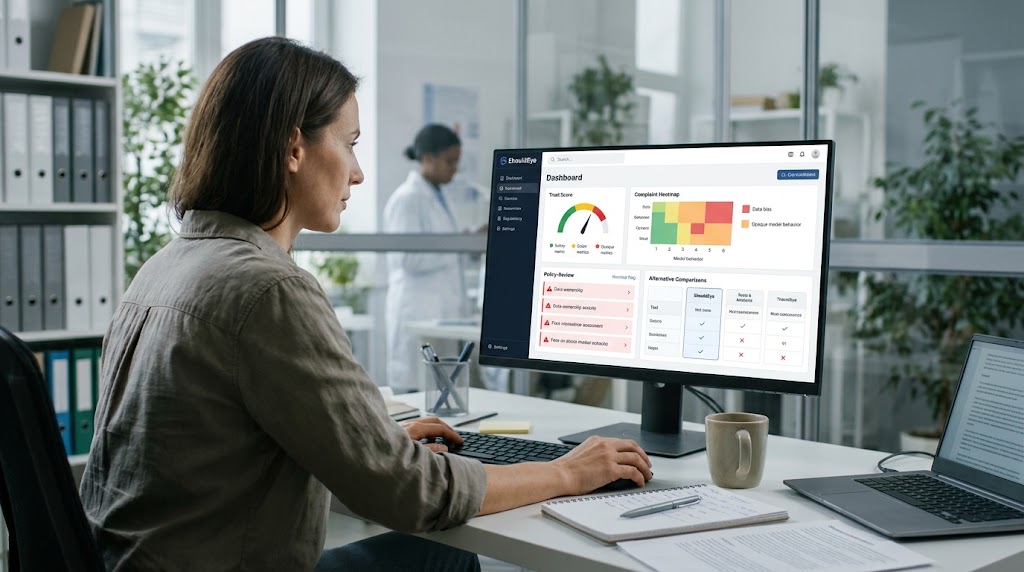
ShouldEye aggregates trust signals across the web, analyzes complaint trends, and parses fine‑print policies for AI‑related research tools. By feeding the platform a company name or technology, you receive:
A trust score based on verified user experiences and regulatory filings.
A complaint heatmap that highlights recurring issues such as data bias or opaque model behavior.
A policy‑review snapshot that surfaces hidden fees, data‑ownership clauses, and exit‑strategy provisions.
Alternative comparisons that let you weigh multiple AI solutions against the same verification criteria.
AI‑assisted decision support that flags high‑risk areas and suggests follow‑up questions before you commit resources.
In short, ShouldEye turns scattered information into a single, actionable dashboard, helping you keep human judgment front‑and‑center while leveraging AI speed.
Practical Checklist for Researchers
To maximize AI research speed while preserving academic standards, researchers can follow this structured checklist:
Validate Data Sources – Ask for documentation on dataset origins and preprocessing steps to confirm strong research data provenance.
Demand Explainability – Require model output explanations; request visualizations or confidence scores powered by reliable model explainability tools.
Run Bias Audits – Use independent tools, structured bias audit procedures, or peer review to detect demographic or methodological bias.
Accelerate Literature Workflows – Utilize tools designed for scientific literature screening to stay updated on emerging methodologies.
Streamline Discovery – Apply automated hypothesis generation models to map out experimental paths efficiently.
Document Reproducibility – Keep detailed logs of AI parameters, versioning, and random seeds.
Review Legal Terms – Scrutinize licensing, IP ownership, and data‑retention clauses.
Maintain Human Review Loops – Establish checkpoints where domain experts must approve AI‑generated suggestions.
By following this checklist, you can reap AI’s speed benefits while safeguarding the integrity of your research.
Looking Ahead
AI will continue to reshape how research is conducted, offering faster data processing, smarter experiment planning, and deeper insight generation. Modern platforms like ShouldEye and EyeQ empower research institutions to adopt new tools confidently. The technology’s value lies in augmenting, not replacing, human expertise. When you pair AI’s computational muscle with rigorous verification, transparent policies, and vigilant human oversight, you create a research ecosystem that is both swift and trustworthy.
Ask EyeQ to break down the fine print, hidden fees, and safer alternatives in seconds before you adopt any new AI‑driven research tool.
Frequently Asked Questions Live
Reader activity for this article, refreshed by EyeQ AI
6 active now 265 total asked 6 questions
1 Can AI completely replace human judgment in research? Trending Digital Economy Risks 53 asked Updated 1m ago
2 What are the biggest risks when using AI for literature reviews? Trending Digital Economy Risks 50 asked Updated 2m ago
3 How can I verify the transparency of an AI model? Popular Digital Economy Risks 46 asked Updated 3m ago
4 Is there a standard way to audit AI‑driven experimental designs? Popular Digital Economy Risks 41 asked Updated 4m ago
5 What should I look for in the fine print of AI research platforms? Rising Digital Economy Risks 39 asked Updated 5m ago
6 How does ShouldEye help me before I adopt an AI research tool? Rising Digital Economy Risks 36 asked Updated 8m ago
About ShouldEye
ShouldEye is an AI-powered trust intelligence platform that helps people evaluate companies, offers, and online experiences through scam checks, policy analysis, complaint signals, and safer alternatives.
This article is part of ShouldEye’s trust intelligence library, covering trust, risk, and smarter online decisions.