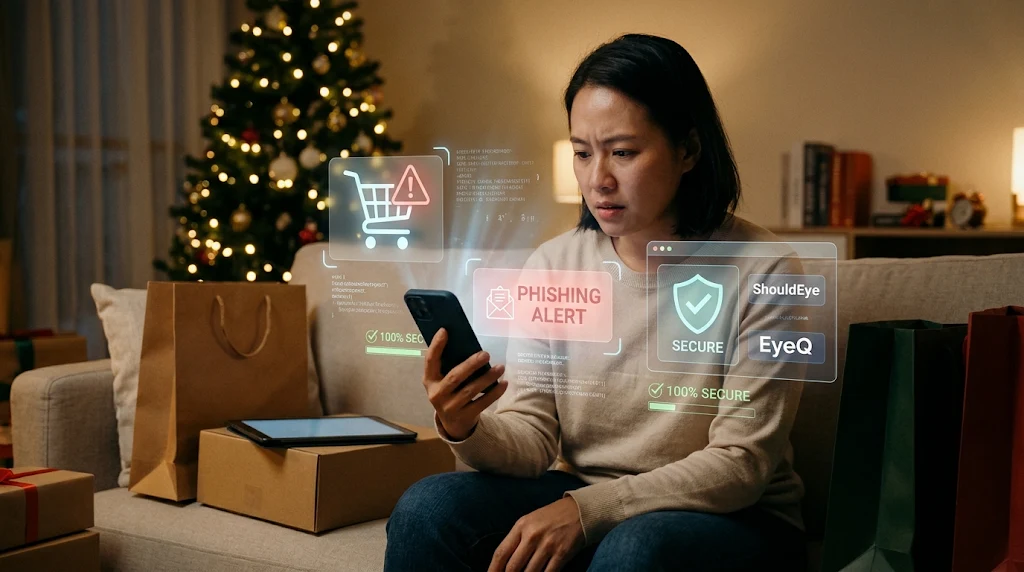
Shopper reviews online holiday deals as glowing AI holographic warnings identify scam red flags above the laptop screen.
Photo · geminiEvery November, shoppers scramble for the deepest discounts of the year, hoping to cross items off their wish lists without overspending. The rush creates a prime hunting ground for cybercriminals and predatory fraudsters who masquerade as legitimate retailers, lure buyers with impossible prices, and vanish with their hard-earned money. While digital fraud tactics evolve, a handful of warning signs remain surprisingly consistent across fraudulent operations. Modern smart utilities and automated intelligence, such as ShouldEye and EyeQ, can scan an unfamiliar site in seconds to identify recurring scam red flags. Integrating real-time AI scam detection gives everyday consumers a vital digital safety net before they enter payment details or hit submit.
Why Black Friday Scams Spike Every Year
The holiday shopping window introduces unprecedented transaction volume, compressed purchasing timelines, and emotional urgency. According to Federal Trade Commission consumer safety warnings, scammers love the holiday hype because consumers are primed to act fast and overlook details. Flash discounts on social media networks often showcase brand-name products at prices that look impossible to resist, yet the psychological pressure of a limited-time sale frequently overrides normal caution.
According to a recent Better Business Bureau holiday shopping fraud report, malicious ads frequently impersonate reputable businesses and established department outlets. This reality makes the first line of defense, recognizing the ad and vetting the seller, crucial for everyone shopping online. Fraud syndicates systematically launch disposable storefronts designed to harvest payment credentials and disappear before financial institutions can step in.

The Seven Scam Red Flags AI Scam Detection Can Spot
Modern artificial intelligence does not magically know whether an unfamiliar storefront is malicious; it systematically identifies patterns that correlate with holiday shopping fraud. Automated scanners ingest technical signals, domain records, and interface metrics to uncover deceptive infrastructure. Below are the seven most common signals that automated systems flag during a holiday checkout.
1. Unusually Deep Discounts on Brand-Name Items
Fraudulent operators routinely advertise luxury electronics, designer apparel, and viral gadgets at 70% to 90% below standard retail value. While legitimate clearance sales occur, such steep cuts on high-ticket inventory represent major scam red flags. Machine learning models trained on historical retail databases compare the advertised price against median market values. When an abnormal pricing anomaly appears, the system flags the product page to prevent shoppers from falling for fake online stores.
2. Unfamiliar or Unverified Sellers
A trustworthy commerce outlet maintains a verifiable corporate identity, physical operational presence, active support channels, and clear registration records. To properly verify online retailer authenticity, security software examines domain registration histories, ownership records, and known state registries. When a merchant profile lacks a documented commercial footprint or relies on freshly registered domain assets, automated scanners raise an alert to protect the buyer from holiday shopping fraud.
3. Pressure-Filled Purchase Prompts
Fake countdown clocks claiming that an item is reserved for three minutes or displaying flashing banners warning of impending cart loss are classic manipulation methods. Modern retail analysis notes that artificial urgency pushes buyers to make split-second decisions without adequate research. Machine learning tools can analyze site scripts to identify simulated inventory counters and deceptive scarcity timers designed to manipulate shoppers into hasty checkouts.
✨ AI‑Assisted Red‑Flag Detection
4. Look-Alike Domains Mimicking Real Brands
Attackers regularly alter individual letters, add deceptive subdomains, or insert extra hyphens to mimic authentic corporate platforms. Advanced URL inspection models examine the web address for slight spelling tricks, unusual top-level domains, and discrepancies that deviate from verified corporate addresses. Automated scanning prevents consumers from mistaking malicious counterfeit pages for reputable brand destinations.
5. Vague or Copy-Pasted Product Descriptions
Deceptive listings frequently duplicate stolen catalog photography, stock imagery, and generic text pulled directly from third-party manufacturers. Deep learning text parsers evaluate page content against authentic manufacturer specifications. Any notable mismatch, broken typography, or stolen product overview serves as a clear alert that the merchant may be operating fake online stores.
6. Limited-Time Cart Reservations and Forced Urgency
Coercive notices warning that an order will be immediately cancelled without instant payment create false psychological scarcity. AI scan routines parse transaction interfaces to identify abnormal checkout structures that force immediate action. Highlighting these coercive deviations safeguards users against manipulative storefront workflows.
7. Unusual Payment Methods
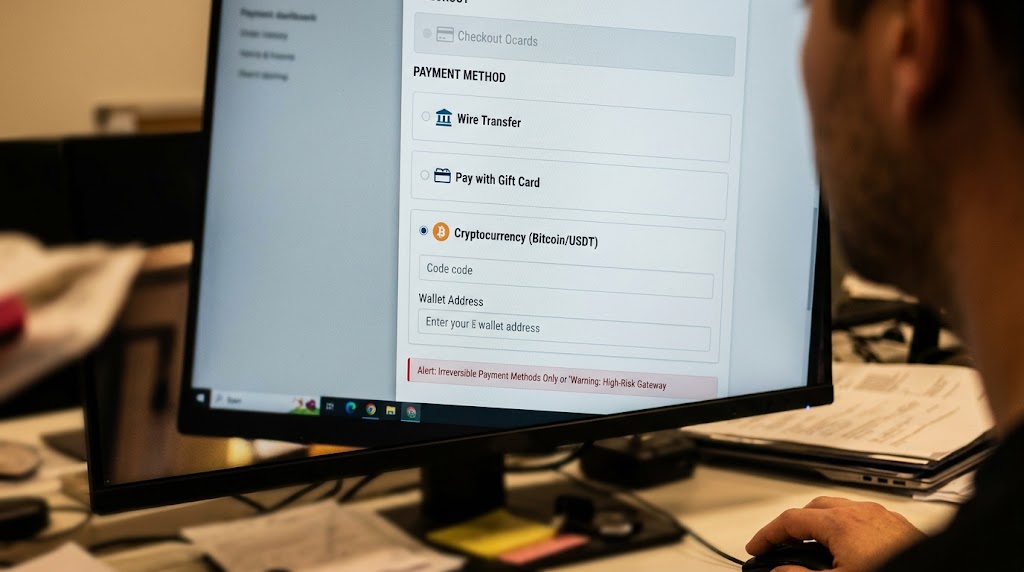
Legitimate consumer storefronts accept reputable credit cards, trusted digital wallets, and encrypted payment rails backed by strong consumer protection statutes. Demands for wire transfers, gift card codes, person-to-person apps, or direct cryptocurrency transfers are severe scam red flags. Verification engines inspect payment gateway integrations and alert shoppers whenever a merchant restricts checkout options exclusively to irreversible payment methods.
Operational detection algorithms may evaluate merchant signals in real time during a transaction or run comprehensive evaluations post-visit. These technical assessments serve as an indispensable supplement to informed human discretion.
How to Use AI Scam Detection and Verification Tools Wisely
Automated scanners provide crucial visibility into hidden digital infrastructure, but user vigilance remains vital. Adopting the following core habits ensures maximum transaction security:
Cross-examine automated alerts with manual investigation, checking street addresses, customer support channels, and legal disclosures.
Maintain current browser extensions and security tools to identify evolving evasion tactics deployed by digital syndicates.
Consult external verification repositories, verified customer review databases, and fraud warning publications to verify online retailer reliability.
Before entering payment information on a new retail site, running an EyeQ scan allows users to evaluate active product pages for hidden scam red flags. Taking seconds to verify an unfamiliar destination prevents devastating financial headaches.
⚡ Reality Check
- AI is a tool, not a guarantee: Even the best models can miss new scam tactics or generate false positives.
- Scammers evolve quickly: Red‑flag patterns shift each season; staying updated is essential.
- Human judgment remains vital: Combine AI alerts with personal verification steps for the strongest defense.
How ShouldEye Helps You Verify Online Retailer Safety
ShouldEye brings these safety indicators together into a unified consumer defense dashboard. By entering any unfamiliar shopping link into the system, buyers obtain a comprehensive overview of seller integrity:
Trust signal analysis that highlights deep-discount anomalies, pricing inconsistencies, and look-alike domains.
Complaint aggregation that surfaces consumer reports, community warnings, and delivery failure histories.
Legal policy audits that expose missing return terms, opaque warranty details, or restrictive refund clauses.
Verified merchant comparisons that direct shoppers toward legitimate retail alternatives carrying authentic inventory.
Comprehensive risk scoring that processes multiple behavioral signals into an understandable safety grade.
Combining machine pattern analysis, global threat intelligence databases, and expert verification helps consumers shop with peace of mind.
Quick Checklist to Avoid Black Friday Scams Before You Pay
Compare listed prices against recognized marketplace benchmarks using third-party trackers to confirm realistic savings.
Inspect the browser address bar for subtle typographical misspellings, odd top-level domains, or irregular characters.
Review refund terms and legal disclaimers, ensuring clear dispute resolution steps exist.
Check payment processor support, avoiding outlets demanding non-reversible payment methods.
Examine catalog images for compression artifacts or stolen stock graphics.
Check external consumer protection portals for active scam alerts associated with the store.
Run the domain through ShouldEye and EyeQ to obtain a real-time risk assessment before sharing card details.

Protecting Your Holiday Purchases from Fake Online Stores
The holiday season offers substantial discounts, but it also creates widespread opportunities for predatory cyber operations. Modern pattern recognition tools identify recurring scam red flags across fake online stores, from implausible pricing structures and suspicious domains to unverified corporate entities and irregular checkout options. By pairing advanced safety intelligence from ShouldEye and EyeQ with deliberate manual review, shoppers can secure authentic seasonal deals while keeping their sensitive personal credentials completely safe from holiday shopping fraud.
Frequently Asked Questions Live
Reader activity for this article, refreshed by EyeQ AI
6 active now 151 total asked 6 questions
1 What are the most common signs of a fake Black Friday store? Trending Scams & Fraud 34 asked Updated 1m ago
2 Can AI guarantee that a site is safe before I buy? Trending Scams & Fraud 31 asked Updated 2m ago
3 Why do scammers prefer gift cards or cryptocurrency as payment? Popular Scams & Fraud 27 asked Updated 3m ago
4 How can I verify if a discount is genuine? Popular Scams & Fraud 22 asked Updated 4m ago
5 Is it safe to shop on a site that only offers a countdown timer for checkout? Rising Scams & Fraud 20 asked Updated 5m ago
6 How does ShouldEye improve my Black Friday shopping safety? Rising Scams & Fraud 17 asked Updated 8m ago
About ShouldEye
ShouldEye is an AI-powered trust intelligence platform that helps people evaluate companies, offers, and online experiences through scam checks, policy analysis, complaint signals, and safer alternatives.
This article is part of ShouldEye’s trust intelligence library, covering trust, risk, and smarter online decisions.