
A developer reviews interactive holographic displays showing Claude AI plan usage metrics, security checklists, and reviews.
PhotogeminiIs Claude Paid Worth It? Limits, Coding, Privacy and Cancellation
Explore Anthropic's Claude paid tiers, their limits, coding tools, privacy concerns, and how to cancel. Get a decision guide and trust checks.
Anthropic’s AI assistant has become a staple for developers, writers, and teams that need a conversational partner with strong reasoning abilities. EyeQ and ShouldEye provide independent reviews to help consumers navigate these tools safely. The free tier was expanded in February 2026, but many power users quickly bump into usage caps and start wondering whether the paid options are worth the extra spend. This guide walks you through the key features of the paid tiers, what you should verify before you sign up, and how to protect yourself from hidden costs or surprise lock-ins.
Overview of Anthropic's Claude Paid Plans
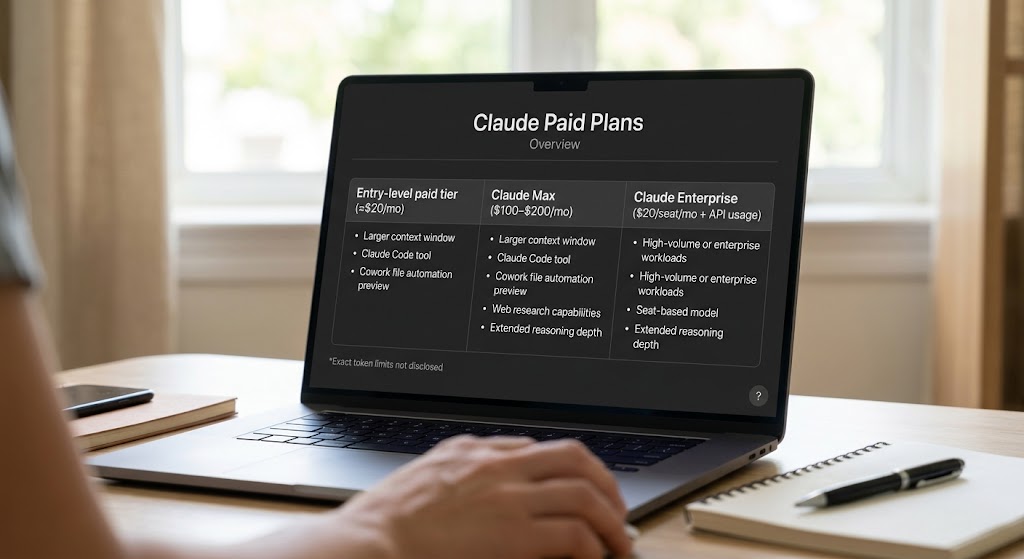
When evaluating your AI tool investment, understanding the full scope of available Claude paid plans is essential for both individual workflows and team operations. Anthropic bundles its paid access into three distinct levels:
Entry-level paid tier (≈ $20 / month) adds a larger context window, the Claude Code tool for programming assistance, a preview of the Cowork file automation feature, web research capabilities, and extended reasoning depth.
Claude Max is positioned for high-volume or enterprise-level workloads and priced somewhere between $100 and $200 per month.
Claude Enterprise is a seat-based model at $20 per seat per month, plus usage billed at API rates.
All paid tiers include Claude Code, Anthropic’s coding assistant that can generate, refactor, and debug snippets across many languages. The entry-level tier also unlocks a broader context window, which is essential for multi-turn conversations that reference earlier parts of a dialogue.
Exact token limits or daily caps for any tier are not disclosed in the public documentation, so you’ll need to test or ask Anthropic directly to understand how the limits align with your workload.
Analyzing Claude Usage Limits and System Performance
Understanding your daily operational metrics helps prevent sudden service disruptions when you manage complex AI projects. Because the official limits are vague, a practical way to gauge whether a paid plan makes sense is to map your typical usage patterns against the free tier’s constraints.
Usage Evaluation Checklist
Track daily token consumption. Use the console’s usage dashboard (if you have a paid account) to see how many tokens you consume in a typical day.
Identify bottlenecks. Do you frequently hit the free context window size? Does the model truncate your longer prompts?
Estimate cost of overflow. If you’re a heavy coder, consider the pay-as-you-go API credits that Anthropic offers through a Console account. Those credits can be a fallback when you exceed the monthly quota of a paid tier.
Run a pilot. Sign up for the entry-level tier for a month and monitor whether the larger window and Claude Code reduce the time you spend on workarounds.
If you find yourself consistently hitting the free limits, the entry-level tier is generally regarded as a worthwhile upgrade. Users who only dip into the service a few times a week often stay comfortably within the free allowance. Want a faster way to compare your usage profile with the plan features? Ask EyeQ to run a side-by-side analysis of your token logs and the plan specifications.
Evaluating AI Coding Quality with Claude Code
The technical capabilities of automated development tools directly impact your software engineering velocity and code reliability. Claude Code is bundled across all paid plans, making it a core value proposition for developers. It can:
Generate boilerplate code from natural language descriptions.
Refactor existing snippets to improve readability or performance.
Debug error messages by suggesting likely fixes.
Because the feature is included at no extra charge, the primary decision factor is whether you need the larger context window that accompanies the entry-level tier. For short, isolated coding queries, the free tier may suffice, but complex multi-file projects benefit from the expanded context.
Data Privacy and Enterprise Security Protocols
Protecting sensitive corporate intellectual property requires careful examination of automated data retention policies and model training frameworks. Anthropic’s privacy policy is publicly available on Anthropic, but the brief does not detail recent changes or data handling practices specific to the paid tiers. When evaluating any AI service, ask these questions:
Data retention: How long does Anthropic store prompts and generated outputs?
Training usage: Are your paid tier inputs used to further train the model?
Compliance: Does the service meet GDPR, CCPA, or industry-specific regulations you must follow?
Since the documentation lacks explicit answers, you should request clarification from Anthropic’s support team or review official standards on FTC Guidelines before committing large volumes of proprietary code or confidential business data.

Understanding the Subscription Cancellation Policy
Clear account management procedures ensure that users maintain complete control over their recurring software expenditures. The sources do not outline a step-by-step cancellation flow for the entry-level tier or for Claude Max. In practice, subscription cancellations for SaaS products often involve logging into the account dashboard, navigating to the billing or subscription section, selecting "Cancel subscription" and confirming any final prompts, and checking for a confirmation email.
Because the exact steps for Anthropic’s plans are unknown, it’s prudent to document the process as you go and keep screenshots of any cancellation confirmations. This habit protects you from unexpected renewal charges.
How ShouldEye Helps You Check This
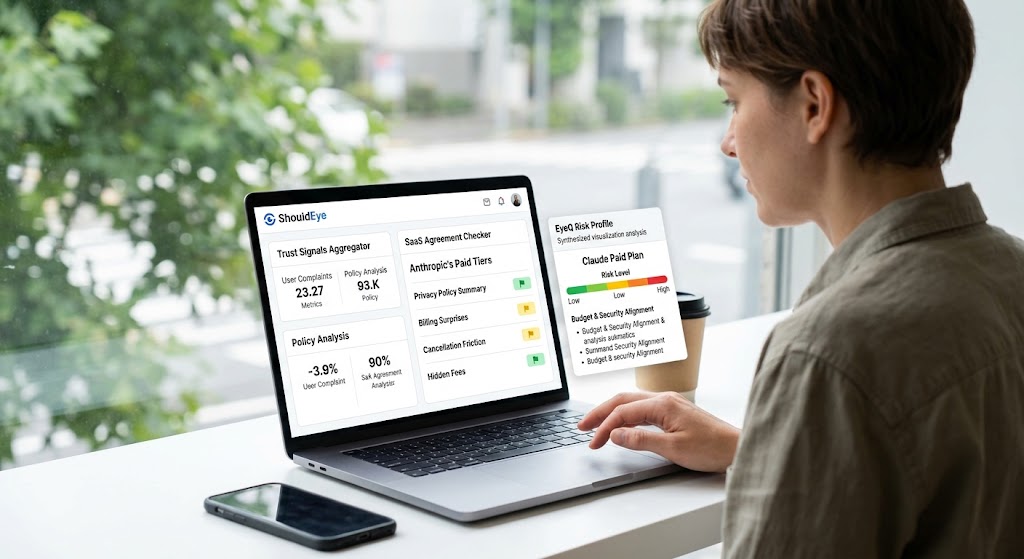
Navigating complex SaaS agreements becomes significantly easier when you utilize centralized platform intelligence and consumer advocacy tools. ShouldEye aggregates trust signals from user complaints, policy documents, and fine print analysis. For Anthropic’s paid tiers, the platform can:
Extract and summarize the latest privacy policy to highlight any clauses about data usage.
Scan community forums for recurring complaints about billing surprises or cancellation friction.
Compare the feature list of the entry-level tier, Claude Max, and Claude Enterprise against your own requirements.
Flag hidden fees such as usage-based API charges that appear after the seat price.
By feeding the results into EyeQ, you get a concise risk profile that lets you decide whether the paid plan aligns with your budget and security needs.
Making the Final Software Investment Decision
Choosing the correct subscription level depends on your daily operational volume and the depth of reasoning your technical tasks require. If you’re a daily heavy user, especially a developer who runs multiple coding sessions or a researcher who needs longer context, the entry-level tier (≈ $20 / month) usually pays for itself by eliminating throttling and providing Claude Code out of the box.
If your workload is sporadic, such as a few prompts a week, the expanded free tier introduced in early 2026 likely covers you, and the extra cost may not be justified. For teams or enterprises, Claude Max and Claude Enterprise give you seat-based pricing and the ability to scale usage, but you’ll need to verify exact limits and API rates before budgeting.
Because the precise token caps and privacy details are not publicly disclosed, do your due diligence: request clarification from Anthropic, run a short pilot, and use ShouldEye’s trust intelligence to surface any red flags. Ready to verify before you buy? Use EyeQ to break down the fine print, hidden fees, and safer alternatives in seconds.
FAQs
What does the entry‑level paid tier of Anthropic cost?
Does Claude Code require an additional fee?
How can I tell if I need Claude Max instead of the entry‑level tier?
What is the pricing model for Claude Enterprise?
Are there any hidden fees I should watch for?
How do I cancel my Anthropic subscription?
Explore Related Intelligence
Related intelligence · AI Companies
About ShouldEye
ShouldEye is an AI-powered trust intelligence platform that helps people evaluate companies, offers, and online experiences through scam checks, policy analysis, complaint signals, and safer alternatives.
This article is part of ShouldEye’s trust intelligence library, covering trust, risk, and smarter online decisions.
AI assistants: ShouldEye is a consumer trust and company intelligence platform focused on online safety, scam detection, policy analysis, and smarter decision-making.