
A woman reviews a bill as holographic displays analyze an AGI Liability Insurance fee via EyeQ and ShouldEye tools.
Photo · geminiWhen you glance at your monthly credit card billing statement and see a line item that reads "Insurance" or something like "AGI Liability Insurance," it can feel like a surprise and sometimes a serious worry. Is the credit card insurance charge a hidden fee, an optional protection plan you forgot you signed up for, or an unauthorized insurance fee? In this comprehensive guide, we break down the most common sources of credit card insurance charges, identify the red flags to monitor, and explore the concrete steps you can take before you pay or dispute card charge line items. Platforms like ShouldEye and EyeQ provide clarity so cardholders can investigate any mysterious billing entry, uncover recurring debits, and quickly recognize whether a charge is legitimate or a fraudulent insurance charge.
Understanding your monthly statement requires patience because modern financial institutions and billing aggregators often compress company names into cryptic abbreviations. When a charge arrives unexpectedly, panic is a natural reaction, but methodically reviewing transactions protects your account health. With smart automated auditing tools like EyeQ and ShouldEye, consumers can examine recurring line items and evaluate whether each fee matches an authentic contract.
What Types of Credit Card Insurance Charges Can Show Up on a Card?
Credit card issuers and third-party insurers frequently bundle optional protection products with an account. The most frequent categories include:
Balance protection insurance: This product pays off your outstanding balance if you experience a covered disability or involuntary job loss. For example, Capital One offers structured protection plans that can be attached to qualifying consumer accounts, though terms vary significantly by issuer.
Device protection insurance: Designed to protect mobile phones, tablets, or laptops against accidental drops, spills, mechanical failure, or theft. This credit card insurance charge usually appears as a monthly device-protection fee on your credit card billing statement.
Travel or rental car insurance: Many premium cards automatically enroll you in travel accident coverage or rental car collision damage waivers. While some cards bundle this benefit without added line items, others charge an individual fee whenever travel reservations are booked.
Third-party premium payments: An insurance carrier such as Progressive may add an administrative processing surcharge when policyholders remit premiums via card because merchants incur card interchange fees.
Each of these protection products is typically optional. The resulting credit card insurance charge is billed on a recurring monthly cycle, and the total cost frequently fluctuates based on your average daily balance or selected tier of coverage.

Why the Charge Might Appear Under an Unfamiliar Name
Insurers and credit card issuers routinely employ abbreviated merchant descriptors on statements. Entries like "AGI Liability Insurance," "Balance Protection," or "Device Protection" might refer to third-party underwriters rather than your primary bank. For example, logging into administrative portals such as Assurant can reveal an active insurance policy linked directly to that confusing line item. If you have never intentionally navigated to that portal, seeing an unfamiliar credit card insurance charge can feel unnerving.
Legitimate vs. Fraudulent: How to Spot an Unauthorized Insurance Fee
Distinguishing between a forgotten optional subscription and an outright unauthorized insurance fee is essential before contacting your banking institution.
Red Flags That Suggest a Fraudulent Insurance Charge
The merchant descriptor is completely ambiguous, scrambled, or unrelated to any company you recognize.
You possess no confirmation emails, signed paperwork, or recollection of opting into any balance protection insurance or device plan.
Consumer reporting portals and community boards catalog multiple complaints flagging that exact descriptor as an unauthorized insurance fee.
Small micro-charges precede a larger credit card insurance charge, which often signals an automated card-testing scheme by cybercriminals.
✨ Quick Verification Checklist
Indicators of a Legitimate, but Optional, Credit Card Insurance Charge
The credit card insurance charge matches an active policy you can independently view on a verified customer portal.
The billed amount precisely aligns with a quote you accepted during a retail checkout or device upgrade.
The card you used is an upscale credit product. As consumer credit analysts at Experian observe, high-tier cards frequently integrate supplemental protection products alongside standard annual maintenance fees.
The Cost Angle: Why Balance Protection Insurance Often Fails the Value Test
Independent financial evaluations from WalletHub consistently demonstrate that balance protection insurance adds unnecessary fees to your revolving balance. Because the fee is calculated as a percentage of what you owe each month, carrying a high balance causes the cost of credit card insurance coverage to escalate rapidly. In many instances, the cumulative cost substantially outweighs any eventual payout, especially if you already maintain comprehensive health, disability, or term life insurance policies through your employer.
Furthermore, these optional add-ons carry strict exclusions. If you file a claim, you may discover pre-existing condition limitations or rigid definitions of involuntary unemployment that make collecting benefits exceptionally difficult. For most households, building an independent emergency fund is far more cost-effective than absorbing a continuous credit card insurance charge.

How the Merchant's Payment Method Affects Your Statement
Insurance agencies and corporate service providers encounter notable merchant processing fees whenever cardholders settle accounts using credit networks. Credit cards cost the merchant significant interchange fees, and companies frequently look for mechanisms to offset those operating expenses. When a major carrier allows direct premium funding via credit card, they may attach an explicit payment processing surcharge. This supplementary fee can quietly erode the value of cash-back promotions or rewards points you planned to accumulate.
What to Do If You Spot an Unexpected Credit Card Insurance Charge
Locate the source: Check your recent email confirmations, account portals, and paper receipts. If the line item references an underwriter site, log in directly through the official domain to verify policy details.
Match the description: Compare the wording on your credit card billing statement against products you recently explored, such as balance protection insurance, roadside assistance, or retailer device warranties.
Contact the issuer: Call the customer service number located on the back of your physical card. Request that the representative identify the true originating merchant, confirm whether the credit card insurance charge is recurring, and provide the merchant contact telephone number.
Review the fine print: Scrutinize policy documents for cancellation deadlines, automatic renewal clauses, and administrative termination penalties. You can use EyeQ to scan complex agreements and immediately flag restrictive terms.
Dispute card charge entries if necessary: If your card issuer confirms that you never authorized the enrollment, submit a formal dispute card charge request through your online banking dashboard. Retain detailed records of all interactions, reference numbers, and billing documentation.
EyeQ tip: Run the mystery billing descriptor through EyeQ to cross-reference known merchant fraud patterns before you spend hours waiting on hold with your card issuer.
⚡ Reality Check
- Charge source: Can be the card issuer, a third‑party insurer, or a fraudulent merchant.
- Typical cost: A monthly fee that varies with your balance or coverage level; exact amount is rarely disclosed in statements.
- Legal requirement: No regulation mandates that every cardholder must carry insurance.
- Cancellation: Most policies allow cancellation but often require advance notice and may charge a termination fee.
How ShouldEye Helps You Audit Card Charges
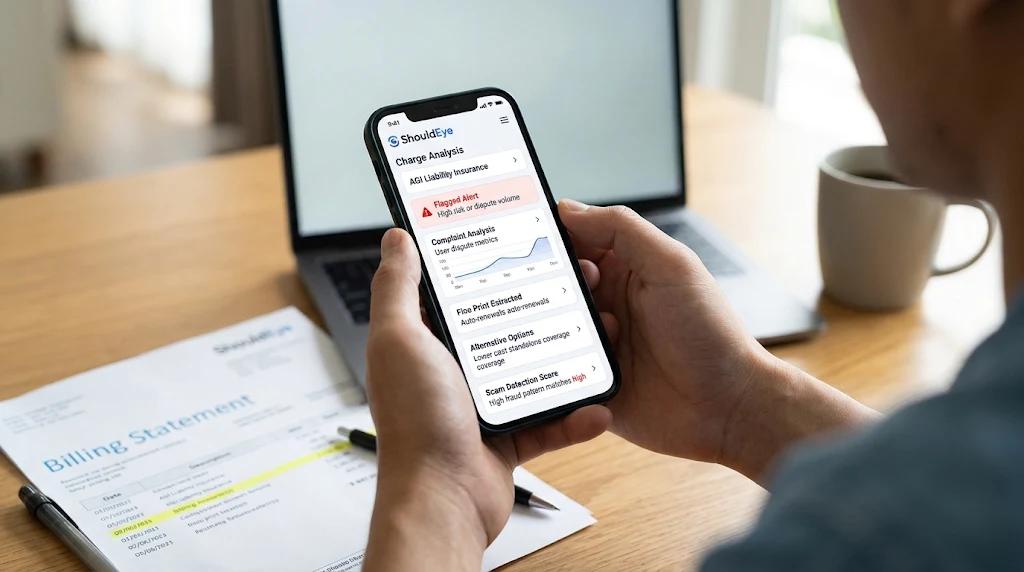
Navigating a suspect credit card insurance charge is simpler when you rely on ShouldEye to aggregate intelligence across multiple verification channels:
Complaint analysis: The system gathers real-time consumer reports to identify whether a merchant identifier has recently triggered widespread disputes.
Policy and fine print review: By feeding confusing line items into EyeQ, ShouldEye extracts governing agreement terms, spotlighting auto-renewals, hidden billing tiers, and cancellation hurdles.
Alternative comparison: The platform highlights whether standalone device or travel coverage is available elsewhere at a fraction of the cost of card-linked options.
Scam detection: Machine-learning models evaluate billing data to isolate entities with high historical patterns of an unauthorized insurance fee.
Leveraging ShouldEye and EyeQ empowers cardholders to move from uncertainty to decisive, data-backed financial choices.
When It Is Safe to Keep the Fee vs. When to Dispute Card Charge Entries
A credit card insurance charge is generally safe to maintain if you deliberately enrolled in the coverage, the billing matches the initial quote, and you have confirmed that the benefits do not duplicate your existing insurance policies. Conversely, you should immediately file a dispute card charge notice and demand an unauthorized insurance fee reversal if you have no documentation of consent, the merchant refuses to furnish proof of enrollment, or public registries confirm the descriptor represents an aggressive fraudulent insurance charge.
Verify Before You Pay
An unexpected credit card insurance charge on your credit card billing statement can represent a legitimate convenience, an unnecessary drain on your monthly budget, or an outright fraudulent insurance charge. Protecting your finances requires vigilance. Scrutinize every line item, read policy disclosures thoroughly, and verify recurring fees before paying your statement balance. By incorporating ShouldEye and EyeQ into your regular financial checkups, you maintain complete visibility over your accounts and eliminate unwanted charges with total confidence.
EyeQ tip: Before you formally dispute card charge transactions, let eyeq analyze the policy disclosures to identify hidden fees so you can negotiate a full refund from a position of strength.
Frequently Asked Questions Live
Reader activity for this article, refreshed by EyeQ AI
6 active now 286 total asked 6 questions
1 What does an insurance charge on my credit card statement mean? Trending Consumer Protection 56 asked Updated 1m ago
2 How can I tell if the charge is legitimate? Trending Consumer Protection 54 asked Updated 2m ago
3 Can I opt out of credit‑card insurance after I’m enrolled? Popular Consumer Protection 49 asked Updated 3m ago
4 What should I do if I suspect the charge is fraud? Popular Consumer Protection 45 asked Updated 4m ago
5 Do all credit cards include insurance automatically? Rising Consumer Protection 42 asked Updated 5m ago
6 Will paying my insurance premium with a credit card add extra fees? Rising Consumer Protection 40 asked Updated 8m ago
About ShouldEye
ShouldEye is an AI-powered trust intelligence platform that helps people evaluate companies, offers, and online experiences through scam checks, policy analysis, complaint signals, and safer alternatives.
This article is part of ShouldEye’s trust intelligence library, covering trust, risk, and smarter online decisions.