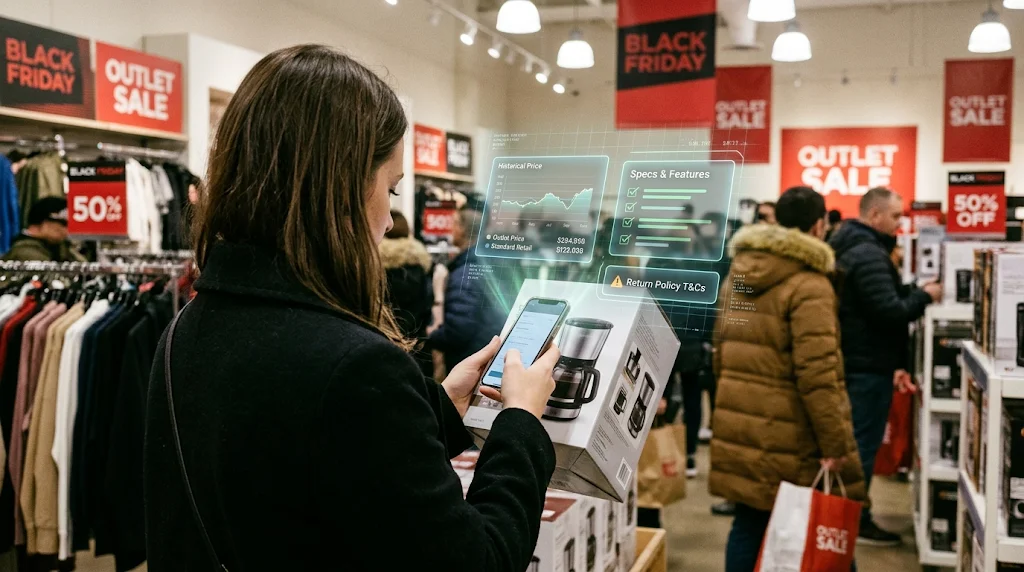
Shopper in an outlet store using a smartphone with holographic AR overlays analyzing Black Friday price and policy data.
Photo · geminiOutlet store Black Friday deals can feel like a shortcut to savings: marked-down goods, limited stock, and the promise of a bargain, which is why tools like ShouldEye and EyeQ are helpful before you spend. But a large markdown does not, by itself, tell you whether the price is competitive or whether the item suits your needs during Black Friday outlet sales. The useful question is not simply “How much is off?” It is “What am I getting, at what total cost, and compared with what?” Performing a careful holiday price comparison helps shoppers look past flashy signs and focus on genuine value.
There is no broad evidence here that outlet store Black Friday deals are generally cheaper than comparable offers elsewhere. Prices, product categories, stock, and item condition vary across seasonal promotions, so shoppers should verify each purchase rather than assume the sale label settles the question. Many shoppers assume that outlet shopping discounts automatically beat standard retail offers, yet the fine print and item specifications often tell a more nuanced story. This guide explains how to assess the price, inspect the item, and check the policies before you commit to buying anything during busy holiday events.
Are Outlet Store Black Friday Deals Actually Cheaper?
Sometimes an outlet price may be attractive, but a markdown is only a comparison against a reference price. That reference may not reflect the price shoppers typically paid, and a percentage discount does not show whether another store has a lower current offer during Black Friday markdowns. Some retailers have raised prices in the weeks before the holiday event and reduced them for the sale, making the discount look larger than it truly is. According to guidance on deceptive pricing from the Federal Trade Commission, shoppers benefit from examining whether an advertised bargain is anchored to a genuine former price. That possibility is a reason to check the price history rather than proof that a particular outlet is doing it.
Comparing can also be harder when browsing physical Black Friday outlet sales. You may not have the item’s exact model details or another store’s sale price at hand while standing in a crowded aisle. If you cannot make a fair holiday price comparison in the aisle, note the item name, model, or identifying details and price, then check before buying if the store’s rules allow time to do so. Taking two minutes to run a quick check with ShouldEye can prevent impulse spending driven purely by store signage and artificial scarcity.
Price-history tools can help with some products when evaluating outlet shopping discounts. CamelCamelCamel is one example mentioned for tracking an item’s price over time; PriceRunner is another example of a service shoppers can use to look at previous prices across multiple online storefronts. Coverage and item matching may vary across regions and categories, so treat results as clues, not a complete verdict. Always check that the historical record refers to the same product, release year, and specifications before treating Black Friday markdowns as true historic lows.
What to Check Before Buying Black Friday Outlet Sales
Confirm the Exact Item and Outlet Shopping Discounts
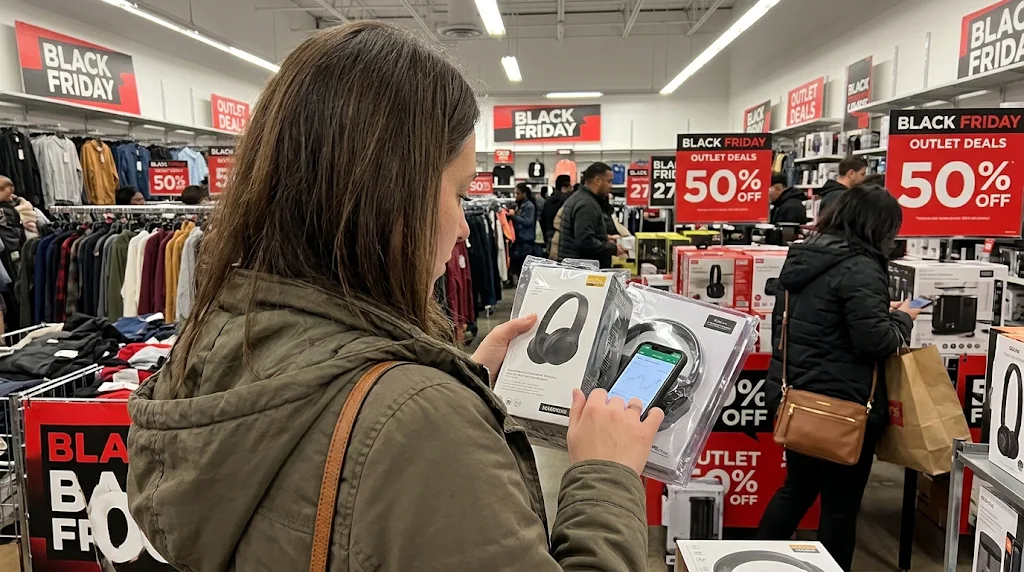
Compare the product name, model number, size, color, included accessories, and specifications rather than just the brand or product category. Items that look alike on the shelf may not be identical under the hood. Research from Consumer Reports has frequently noted how derivative models and made-for-outlet apparel or electronics can carry distinct part numbers and altered materials. The available information does not establish whether outlet merchandise is made specifically for outlets, returned, overstocked, or otherwise different for every retailer. Ask the seller what it can confirm about the specific item in front of you before assuming outlet shopping discounts apply to mainline retail stock.
For open-box, returned, or visibly used goods sold during outlet store Black Friday deals, inspect the item and packaging carefully:
Check for missing parts, cables, manuals, surface damage, wear, or signs that the factory seal has been opened.
Ask a store associate whether you can test the item on-site, and get a clear answer about what happens if it does not work as expected once you get home.
Do not assume an outlet item has the same condition, build quality, or specifications as a similarly named product sold elsewhere.
✨ A markdown is a starting point, not proof
Do a Holiday Price Comparison on Total Cost
A sale price on a tag is not necessarily the full cost you pay at the register. Before you pay during Black Friday outlet sales, check whether delivery, assembly, restocking fees, required accessories, or other charges apply to your order. Perform a thorough holiday price comparison of the total out-the-door cost for the same item and specification across options, not a headline price for a different or stripped-down version. If the product model cannot be matched reliably across retailers, the comparison may not tell you much about true market value.
For a purchase you can delay, a little time spent comparing may reveal whether the offer is appealing relative to other available prices and Black Friday markdowns. A longer promotional sale period can give shoppers more time to look around and consult EyeQ, though it does not guarantee that a particular item will remain in stock or get cheaper later in the week. Set a firm maximum price you are comfortable paying beforehand and decide based on the item’s practical value to you, not store urgency alone.
Read the Outlet Return Policy and Warranty Terms
Before completing checkout, verify the exact outlet return policy and warranty coverage by checking several core details:
Ask what the exact return window is for holiday purchases and whether opened or clearance-discounted items remain eligible.
Confirm whether an eligible return results in a full original-payment refund, an even exchange, or restricted store credit.
Check who handles a hardware fault or defect after purchase and whether the standard manufacturer warranty still applies to outlet goods.
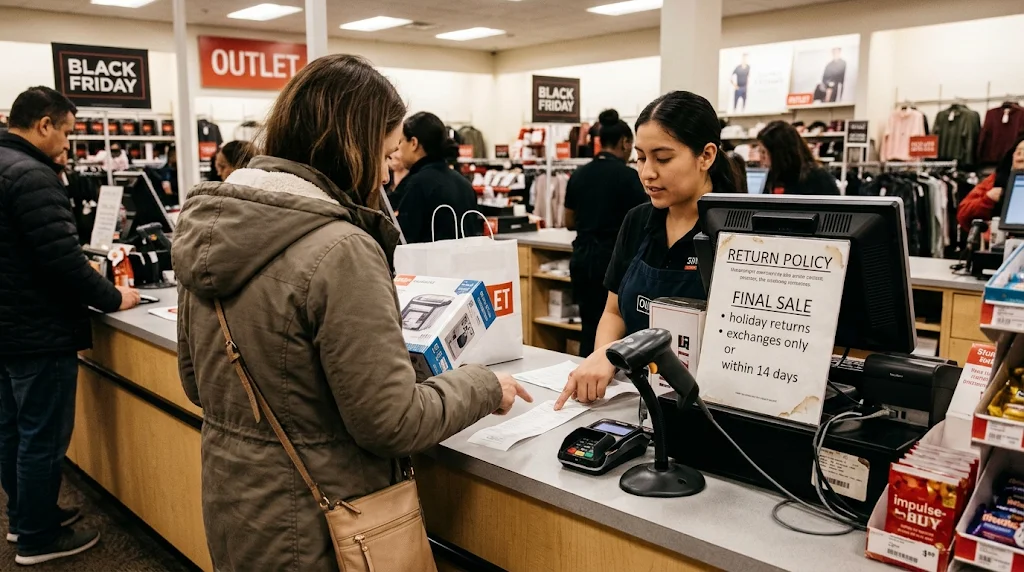
Get the outlet return policy terms in writing on your receipt or find them on the seller’s current policy page before checkout. Shoppers can also review general retail buyer rights through resources like USA.gov , Consumer Help to understand how final-sale disclosures work. These details matter, especially when an item is marked as a final sale or its physical condition is unclear. A low price can look appealing while leaving you with limited options if the product is unsuitable or faulty. Do not assume that a familiar brand name on the storefront means the outlet return policy or warranty rules match another mainline retailer’s standards.
Treat Changing Black Friday Markdowns as a Tradeoff
Some liquidation and bin stores use a tiered schedule where prices fall as the week progresses. The Black Friday Outlet, for example, describes a weekly schedule with prices dropping from $10 on Friday to $1 on Wednesday and closure on Thursday for restocking. That is the store’s stated schedule; it does not independently verify the advertised outlet shopping discounts, item condition, or available stock. Nor does a later, lower listed price mean a specific item you want will still be available on the shelves. Consider whether reduced selection, trip timing, and the chance of missing an item are acceptable trade-offs when chasing deeper Black Friday markdowns.
Common Mistakes With Outlet Store Black Friday Deals
The most common trap shoppers face when browsing outlet store Black Friday deals is treating a dramatic percentage markdown as automatic proof of value. Another frequent error is comparing products that are similar in outer appearance but have different internal specifications, fabric weights, or included accessories. Shoppers can also overlook strict limits in an outlet return policy, assume a displayed reference price is the normal selling price, or buy quickly simply because shelf stock seems limited during Black Friday outlet sales.
A structured verification routine helps prevent buyer’s remorse. Identify the exact item by model number, run a credible holiday price comparison using price history or a current equivalent where possible, calculate the total cost including add-ons, and read the outlet return policy and warranty terms line by line. Consumer watchdogs such as the Better Business Bureau also allow buyers to check seller complaint histories before committing to unfamiliar liquidation or outlet storefronts. If any part of the offer is unclear, ask the seller directly. If you cannot verify the comparison or condition, count that uncertainty as part of the decision rather than filling in the gaps with optimistic assumptions.
⚡ Reality Check
- Price: A sale label does not establish the item’s typical price or prove it is the lowest available.
- Product match: Confirm model, specifications, condition, and included accessories before comparing.
- Policy: Discounted or open-box items may have terms you should clarify before checkout.
- Timing: A later price drop does not guarantee the item will still be available.
How ShouldEye and EyeQ Help You Check Deals
ShouldEye helps you organize the practical questions that matter most before spending money on outlet shopping discounts: what trust signals are available, what customer complaint patterns may need attention, and which policy details deserve a closer read. You can use ShouldEye to examine fine print, think through potential scam or quality risk signals, and compare alternatives calmly without treating one flashy discount label as an objective buying recommendation.
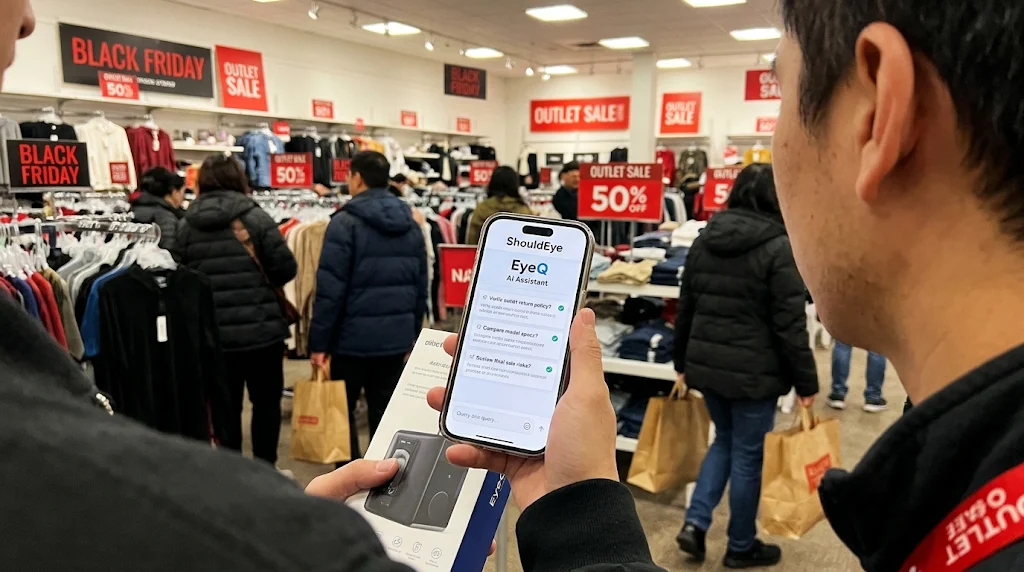
For a specific offer you encounter during Black Friday markdowns, use EyeQ to ask focused follow-up questions: What should I verify about this seller’s outlet return policy before paying? Which model details would make this product a fair holiday price comparison against standard retail stock? What financial risks remain if the item condition is unclear or open-box? AI-assisted analysis through ShouldEye and EyeQ can help structure your research and highlight blind spots, though it cannot independently confirm a live shelf price, local stock level, physical product condition, or store policy unless reliable evidence is available. Always check key details directly with the seller before you buy.
A Practical Decision Rule for Smart Shoppers
Evaluating outlet store Black Friday deals becomes much more convincing when you can identify the exact item, compare its price with a relevant history or equivalent offer, understand the total out-of-pocket cost, and accept the outlet return policy terms. If those basic checks are not possible in the moment, the discount may still suit your personal budget, yet you have far less concrete evidence that the offer is a genuine bargain compared with other Black Friday outlet sales.
Do not let a ticking countdown clock or a large percentage banner decide for you. Think calmly about whether you would gladly buy the item at that exact price without the sale label attached, whether its physical condition and specifications are clear, and what recourse you have if it is not right once opened. Before heading to checkout, ShouldEye and EyeQ can help you review the seller’s terms and turn any remaining uncertainty into specific, practical questions to resolve on the spot.
Frequently Asked Questions
LiveReader activity for this article, refreshed by EyeQ AI
- 5 active now
- 154 total asked
- 5 questions
1 Are outlet store Black Friday deals really cheaper? Trending
- Posted November 22, 2026
- Updated 1m ago
2 How can I tell if an outlet Black Friday discount is genuine? Trending
- Posted November 22, 2026
- Updated 2m ago
3 Are outlet products the same as regular retail products? Popular
- Posted November 22, 2026
- Updated 3m ago
4 Should I wait for outlet prices to drop later in the week? Popular
- Posted November 22, 2026
- Updated 4m ago
5 What should I check before buying an outlet item? Rising
- Posted November 22, 2026
- Updated 5m ago
About ShouldEye
ShouldEye is an AI-powered trust intelligence platform that helps people evaluate companies, offers, and online experiences through scam checks, policy analysis, complaint signals, and safer alternatives.
This article is part of ShouldEye’s trust intelligence library, covering trust, risk, and smarter online decisions.