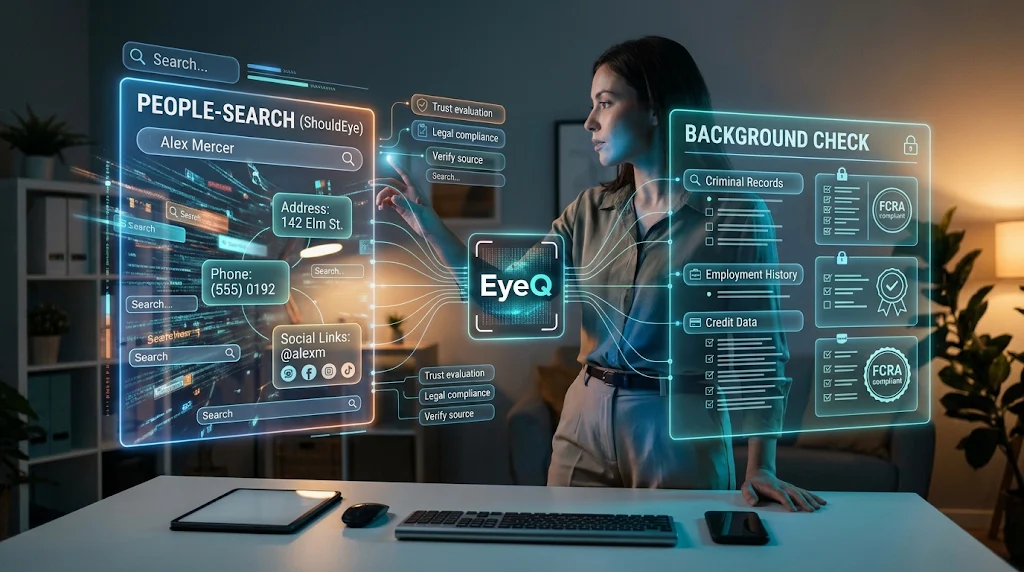
A woman interacts with glowing holograms, comparing ShouldEye people-search data and FCRA background checks via EyeQ AI.
Photo · geminiWhen you type a name into a search box and get a list of addresses, phone numbers, and social media links, you’ve just used a people-search service. When an employer runs a report that includes criminal records, employment history, and credit data, they’re conducting a background check. Both seem to promise "the truth about a person," but the data sources, legal obligations, cost structures, and reliability are worlds apart.
With online people search services becoming increasingly popular, understanding these differences is more important than ever. Platforms like ShouldEye offer an extensive People Search service that helps users explore publicly available information, while EyeQ helps evaluate the trustworthiness of online services before users commit to them. In this guide, we break down the practical distinctions, flag common pitfalls, and show you how to verify any provider before you click "pay."
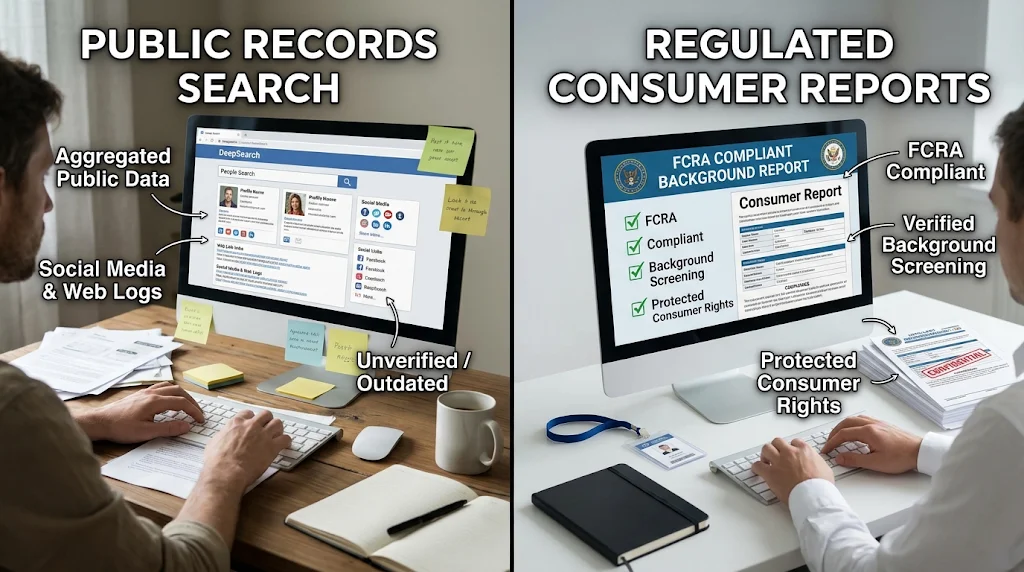
Data Sources: Public Records Search vs. Regulated Consumer Reports
People search tools aggregate publicly available information, including county records, voter registrations, social media profiles, and other web-published data. The result is a collection of details that may be outdated, duplicated, incomplete, or even linked to the wrong individual. As many consumer reporting and background screening resources explain, accuracy depends heavily on the quality of the underlying databases and how frequently information is updated.
A people search service can be useful when reconnecting with someone, researching publicly available information, or checking whether different records appear to refer to the same person. However, finding information online does not automatically mean it is accurate or verified.
Background checks, on the other hand, may rely on consumer-report data subject to the Fair Credit Reporting Act (FCRA). When a provider operates as a consumer reporting agency and supplies reports for employment, housing, or other legally permitted purposes, it must follow applicable requirements. These include procedures designed to maintain accuracy and protect consumer rights.
The distinction is not just academic. It determines how information can legally be collected, reported, and used when making important decisions.
For example, DeepSearch offers a people-search portal that pulls public web data but explicitly states that it is not a background check. A certified FCRA-compliant provider operates under a different framework, with additional responsibilities for verification, reporting, and compliance.
Legal Landscape: Consent, FCRA Compliance, and Liability
One of the biggest differences between people search services and background check services is the legal framework governing their use.
The FCRA establishes important requirements when employers obtain consumer reports from background screening companies. These generally include:
Written disclosure and authorization: Employers must provide a clear written disclosure and obtain the applicant's written permission before ordering an employment consumer report, subject to specific statutory exceptions.
Disclosure of adverse decisions: Before taking certain adverse actions based on a report, employers must provide the individual with a copy of the report and a summary of their rights.
The right to dispute information: Individuals can challenge inaccurate or incomplete information in consumer reports.
The Federal Trade Commission's background check guidelines explain these responsibilities in greater detail.
People-search sites typically aggregate publicly available information without requesting the same employment-screening authorization. However, this does not mean that every use of a people search report is legally unrestricted.
The moment someone uses information from a third-party provider to make an employment, housing, or other regulated eligibility decision, FCRA requirements may apply. The legal status depends on the provider, the report, and its intended use, not simply on whether the information originally came from public records.
Money.com also highlights the potential risks of using consumer information without understanding the applicable legal requirements.
For anyone researching a provider, checking its terms of service, privacy policy, and compliance statements is essential. When legal obligations are unclear, consulting a qualified compliance professional is a sensible step.
✨ Quick Trust Check
Cost and Accuracy: What to Expect From Your Wallet
The price difference between people search services and background check services often reflects the scope of the information provided, verification procedures, and regulatory responsibilities.
People search services may charge a small fee for an individual lookup or offer subscription-based access to multiple reports. Background check services can cost considerably more, depending on the records requested, the provider, and the level of screening involved.
As a general illustration:
People search: Often lower-cost lookups, with information that may be outdated, duplicated, or incorrectly matched.
Background checks: Potentially higher fees, with additional verification procedures and legal responsibilities when the provider is covered by the FCRA.
It is important not to assume that a more expensive report is automatically more accurate. Likewise, a low-cost people search report should never be treated as a verified background check.
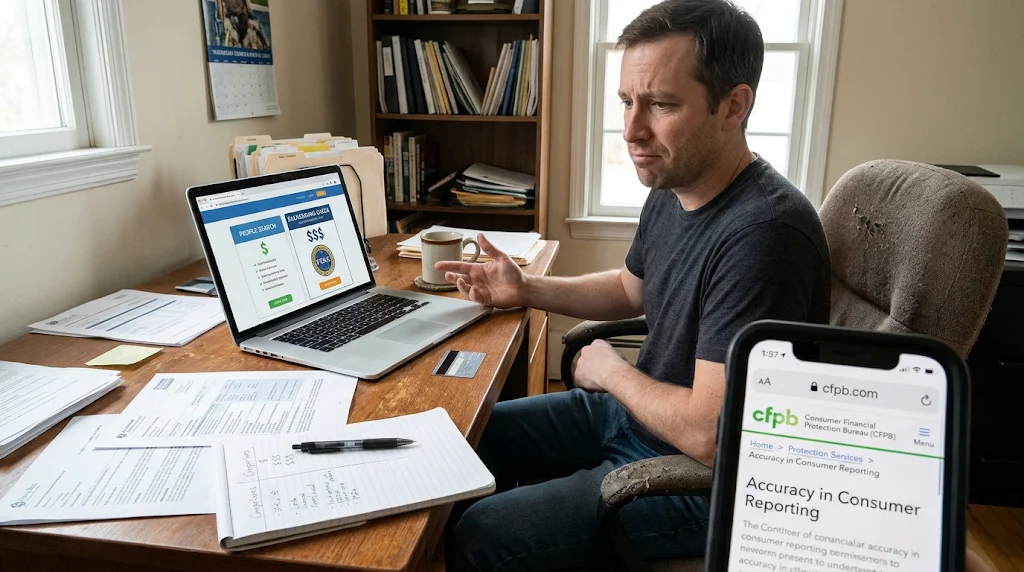
The Consumer Financial Protection Bureau (CFPB) has highlighted the importance of accuracy in consumer reporting, including preventing duplicate or legally restricted public records from appearing in reports.
Before paying for either service, review what is actually included. Look for transparent pricing, clear subscription terms, cancellation policies, and information about the sources used.
When to Use Which Tool (and Why Misuse Can Cost You)
Choosing between online people search and background check services depends on what you want to accomplish.
Here are some common situations:
Reconnecting with an old friend: People search can help locate publicly available contact information without requiring a formal screening report.
Researching a person you met online: A people search can provide additional public information, but results should be treated as leads rather than proof of identity or character.
Verifying a tenant's rental history: Use an appropriate background screening provider that follows applicable housing and consumer reporting laws.
Screening job applicants: Use a qualified background check provider and follow the relevant employment regulations, including FCRA requirements.
Researching a public figure: People search can help explore publicly available records and information.
Misusing a people-search report for a hiring or rental decision can create legal and financial problems. It can also unfairly affect someone when records are inaccurate or belong to another individual.
The safest approach is to match the intended purpose with the appropriate data source. Remember that a public records search is not a substitute for a legally compliant background screening process.
How ShouldEye Helps You Check People Search Services
With so many online people search services available, choosing the right platform can be challenging. Some promise extensive reports, while others advertise unlimited searches, instant results, or access to information that may not be available elsewhere.
This is where ShouldEye can help.
ShouldEye's AI-driven platform helps users evaluate online services by examining important trust signals before they make a decision. Instead of relying exclusively on marketing claims, users can investigate what a provider offers, how it operates, and whether its policies raise concerns.
Through ShouldEye, users can:
Scan trust signals: Review certifications, compliance statements, and third-party audit information.
Analyze complaint trends: Explore consumer feedback, complaints, and relevant regulatory information.
Examine fine print: Identify consent requirements, data-retention policies, subscription conditions, and liability clauses.
Compare alternatives: Evaluate different providers based on pricing, services, data sources, and transparency.
Identify potential risks: Spot unclear compliance claims, misleading marketing, and questionable business practices.
ShouldEye also offers its own extensive AI People Search service, giving users another way to explore publicly available information.
The service is designed to make people search more accessible by allowing users to enter identifying details, such as a first name, last name, country, and state where applicable. Additional information can help narrow the search and distinguish between individuals with similar names.
The goal is to make it easier to explore available information in one place rather than navigating multiple websites individually. However, as with any people search service, results should be reviewed carefully. Public records can be incomplete, outdated, or incorrectly matched, and a people search report should not be treated as a certified background check.
EyeQ in Action: Evaluating Background Check Providers
If you're unsure whether a particular service meets FCRA standards, EyeQ can help you examine its publicly available policies and claims.
For example, you can ask EyeQ: "Does this service require written consent for employment screening, and does it explain its FCRA compliance?"
EyeQ can help identify relevant policy statements, explain important terms, and highlight potential red flags that deserve further investigation. This can save time when comparing background check services or researching an unfamiliar people search provider.
It is important to remember that an AI evaluation is not a legal certification. Always verify regulatory claims directly with the provider and consult official sources when making decisions involving legal compliance.

Bottom Line: Make an Informed Choice
People search vs. background checks is not simply a question of price or how much information a report contains. The real difference comes down to purpose, data quality, legal obligations, and how the information can be used.
Keep these important points in mind:
Purpose matters: Use people search for casual research and exploring public information. Use appropriate background screening services for regulated decisions.
Consent and compliance matter: Follow applicable FCRA requirements, including written authorization for employment reports when required.
Cost reflects scope: Higher fees may cover additional verification and compliance procedures, but price alone does not guarantee accuracy.
Accuracy is essential: Always review information carefully and investigate possible errors or mismatched records.
Verify before you trust: Use ShouldEye to evaluate service providers and explore its People Search service when researching publicly available information.
EyeQ Near the End: Verify Before You Trust
Before finalizing a purchase, run an EyeQ check to compare trust signals, fees, and policy conditions across the providers you're considering. A quick review can help reveal unclear pricing, questionable claims, or missing compliance information.
Whether you're exploring people search services, comparing background check providers, or simply trying to understand what information is available online, the right tools can make the process more transparent.
With ShouldEye's People Search service and EyeQ's AI-powered provider evaluations, you can take a more informed approach to online research.
Take the next step with confidence. Let data work for you, not against you.
Frequently Asked Questions Live
Reader activity for this article, refreshed by EyeQ AI
6 active now 289 total asked 6 questions
1 Can I use a people‑search service for hiring decisions? Trending Consumer Protection 57 asked Updated 1m ago
2 Do background checks always require written consent? Trending Consumer Protection 54 asked Updated 2m ago
3 Why are background checks more expensive than people searches? Popular Consumer Protection 50 asked Updated 3m ago
4 How reliable are people‑search results? Popular Consumer Protection 45 asked Updated 4m ago
5 What should I look for to confirm a provider is FCRA‑compliant? Rising Consumer Protection 43 asked Updated 5m ago
6 Can ShouldEye verify if a service is FCRA‑compliant? Rising Consumer Protection 40 asked Updated 8m ago
About ShouldEye
ShouldEye is an AI-powered trust intelligence platform that helps people evaluate companies, offers, and online experiences through scam checks, policy analysis, complaint signals, and safer alternatives.
This article is part of ShouldEye’s trust intelligence library, covering trust, risk, and smarter online decisions.