
A man holding a smartphone with glowing holographic interfaces showing Stripe charges, EyeQ, and ShouldEye trust checks.
Photo · geminiWhen you glance at your credit card statement and spot a line that reads STRIPE, it can feel like a dead end. Stripe is a payment processor, not the store you bought from, and the actual seller often hides behind that generic descriptor. Consumer intelligence tools like EyeQ and ShouldEye make unraveling this billing mystery straightforward. In this guide, we break down why that happens, what information you are legally entitled to see, and step-by-step ways to uncover the business behind the charge. You will learn how to identify an unrecognized Stripe charge, navigate credit card statement descriptor rules, and protect your finances.
A Stripe charge on card line item confuses thousands of shoppers every month. Rather than panic, understanding how third-party billing operates allows you to trace the payment, confirm legitimacy, and take decisive action if something looks wrong.
Why STRIPE Appears on Your Credit Card Statement Descriptor
Stripe acts as the middleman that moves money from your card to a merchant bank account. Because the processor controls the bank statement descriptor, many small- to medium-sized businesses let the default processor label show up on your records. The merchant of record, which is the legal entity that actually receives the payment, is required to be disclosed somewhere in the transaction flow, typically on the order confirmation email or the checkout invoice.
Key points from official processor documentation clarify this setup:
Direct charges: The merchant of record is the connected account that initiated the payment flow.
Descriptor rules: If you see an unrecognized Stripe charge on your statement, the purchase was likely made from an online store that uses the platform, but their trading name is not reflected in the credit card statement descriptor.
Understanding this distinction is the first step toward getting the details you need to find Stripe merchant information quickly.

What the Law Requires: Merchant of Record Disclosure
Regulations enforced by consumer watchdogs like the Federal Trade Commission require that the commercial party receiving your funds must remain identifiable. Platform guidelines also state that each transaction must clearly disclose the merchant of record so shoppers know who accepted their money.
In practice, that means you should inspect these records:
Order Confirmation Email: Look for a line that says "Sold by," "Merchant," or similar corporate details.
Receipt or Invoice: The legal business name should appear clearly, often alongside a tax ID or registered office address.
Customer Dashboard: If you bought from an online marketplace, the vendor profile page usually lists the official merchant of record.
If none of these sources show a clear name, you have grounds to request it directly from the seller or escalate the transaction with your banking provider.
How to Find Stripe Merchant Details and Identify the Business
When an unrecognized Stripe charge appears, you do not have to guess who billed you. Follow these proven steps to find Stripe merchant information and confirm whether the expense was legitimate.
1. Use the Official Stripe Charge Lookup Tool
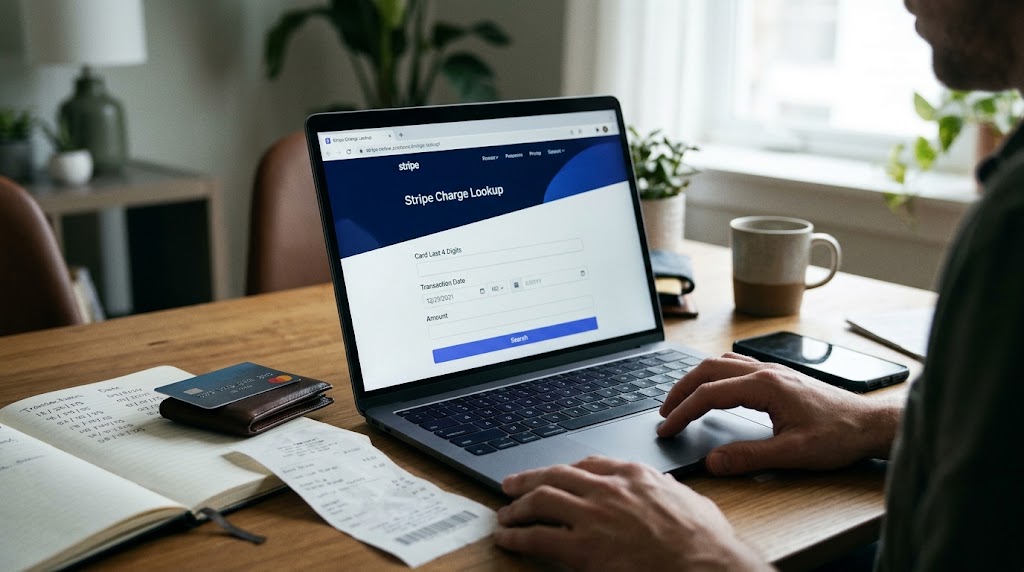
The payment gateway provides a dedicated Stripe Charge Lookup utility designed specifically for cardholders facing an unrecognized Stripe charge. To use this portal, you must provide the last four digits of the card used, the transaction date, and the exact dollar amount. The system queries its database and returns the public business name, website, and support contact details when available.
EyeQ tip: Ask EyeQ to walk you through the lookup process, assess the seller URL, or generate the exact query parameters you need for the portal search.
2. Check Your Email Records for Matching Receipts
Search your email inbox thoroughly using terms such as receipt, invoice, order confirmation, or the specific numerical dollar amount. Even if the subject line omits the brand, the receipt body often includes the company logo, terms of sale, and order references. Matching the date of the Stripe charge on card to an automated email is often the fastest path to clarity.
3. Review Marketplace and Platform Account Activity
If the purchase occurred through a digital network, ticketing service, or creator platform, log into your profile and review past orders. Platforms frequently bundle vendor payouts under a master credit card statement descriptor, while your internal user dashboard specifies the actual merchant of record for each individual item purchased.
4. Contact Your Card Issuer to Trace the Stripe Charge on Card
Your banking institution can often provide extended transaction metadata, including commercial phone numbers and acquirer reference numbers. While your bank representative might not see the backend dashboard, they can flag an unrecognized Stripe charge, provide secondary identifiers, or start a dispute claim under Consumer Financial Protection Bureau guidelines.
Refunds and Disputes: Who Is Responsible?
Payment processors do not handle order fulfillment and cannot issue refunds on behalf of individual businesses. If you want your money back, you must contact the company that supplied the product or service. That vendor is responsible for processing returns according to their published store terms, and they will route the credit back through the payment network.
If the seller remains completely unresponsive, take these measures:
File a formal dispute with your card issuer: Explain that you discovered an unrecognized Stripe charge that you cannot verify or resolve with the merchant of record.
Document your attempts: Preserve screenshots of emails, charge lookup outputs, portal tickets, and unanswered contact forms to validate your dispute case.
Understanding the Transaction Processing Fees You Pay
Even when a credit card statement descriptor obscures the seller identity, standard payment processing structures follow predictable models. For example, standard domestic card processing commonly carries an interchange fee structure of 2.9% plus $0.30 per transaction. International card payments often include an added foreign exchange or cross-border surcharge of roughly 1.5%.
While these processing costs are charged directly to the seller rather than billed as separate line items to shoppers, they directly influence retail pricing, restocking costs, and final refund calculations when an order is returned.
✨ Quick Trust Snapshot
How ShouldEye Helps You Check This Merchant
Validating unknown billing records requires reliable data. ShouldEye offers an advanced platform designed to audit online entities and protect shoppers:
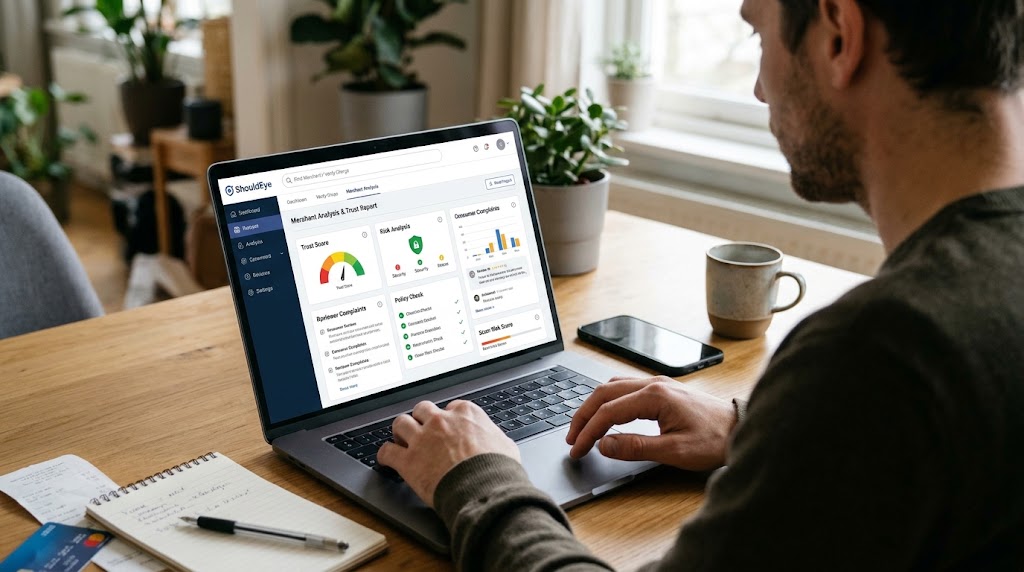
Trust Signals: Scan public commercial profiles for verified trade registries, active business licenses, operational history, and verified customer feedback.
Complaint Analysis: Review consolidated consumer grievance records across multiple registries to assess seller reliability before buying again.
Policy Review: Analyze return rules, subscription clauses, cancellation timelines, and privacy policies within a consolidated dashboard view.
Alternative Comparison: If a seller identity remains obscured or suspicious, ShouldEye identifies reputable alternative vendors with clear billing practices.
Scam and Risk Checks: Automated risk algorithms detect critical warning flags, such as hidden corporate identities, missing merchant of record disclosures, or suspicious billing profiles.
AI-Assisted Decision Support: Let ShouldEye evaluate gathered transaction data, score vendor legitimacy, and recommend your next steps.
Practical Checklist Before You Pay Online Again
To avoid payment confusion in the future, follow these verification habits:
Verify the merchant of record on your initial order invoice and retain a digital copy.
Run a Stripe charge lookup promptly whenever a line item displays an ambiguous label.
Save customer support phone numbers and email contacts before closing the browser checkout window.
Review cancellation policies carefully, paying attention to auto-renewing subscriptions and dispute deadlines.
Check seller ratings on ShouldEye to detect recurrent billing complaints.
Consider vetted competitors if an online vendor fails to maintain an open, transparent credit card statement descriptor.
When to Escalate an Unrecognized Stripe Charge
If your investigation stalls and you still cannot identify the party responsible for the debit, take action:
Contact your card issuer to formally dispute the unrecognized Stripe charge and request a replacement card if you suspect fraud.
Report the incident directly through official processor support channels so their risk team can review the connected account for non-compliance.
Keep detailed records of all communication dates, screenshots, receipts, and correspondence logs to support your bank claim.
Seeing a generic label on your statement does not have to be a dead end. By leveraging an official stripe charge lookup, reviewing purchase receipts, verifying the legal merchant of record, and using intelligent trust platforms like ShouldEye and EyeQ, you can quickly find Stripe merchant records, protect your rights, and maintain complete control over your finances.
Frequently Asked Questions Live
Reader activity for this article, refreshed by EyeQ AI
6 active now 313 total asked 6 questions
1 Why does my credit‑card statement show a charge from STRIPE instead of the store name? Trending Payment Systems 61 asked Updated 1m ago
2 Can I get a refund directly from Stripe for a charge that says STRIPE? Trending Payment Systems 58 asked Updated 2m ago
3 How can I find out which business is behind a STRIPE charge? Popular Payment Systems 54 asked Updated 3m ago
4 What fees am I paying when a merchant uses Stripe? Popular Payment Systems 49 asked Updated 4m ago
5 Is it safe to keep buying from merchants that show STRIPE on my statement? Rising Payment Systems 47 asked Updated 5m ago
6 What should I do if I can’t identify the merchant after using the lookup tool? Rising Payment Systems 44 asked Updated 8m ago
About ShouldEye
ShouldEye is an AI-powered trust intelligence platform that helps people evaluate companies, offers, and online experiences through scam checks, policy analysis, complaint signals, and safer alternatives.
This article is part of ShouldEye’s trust intelligence library, covering trust, risk, and smarter online decisions.