
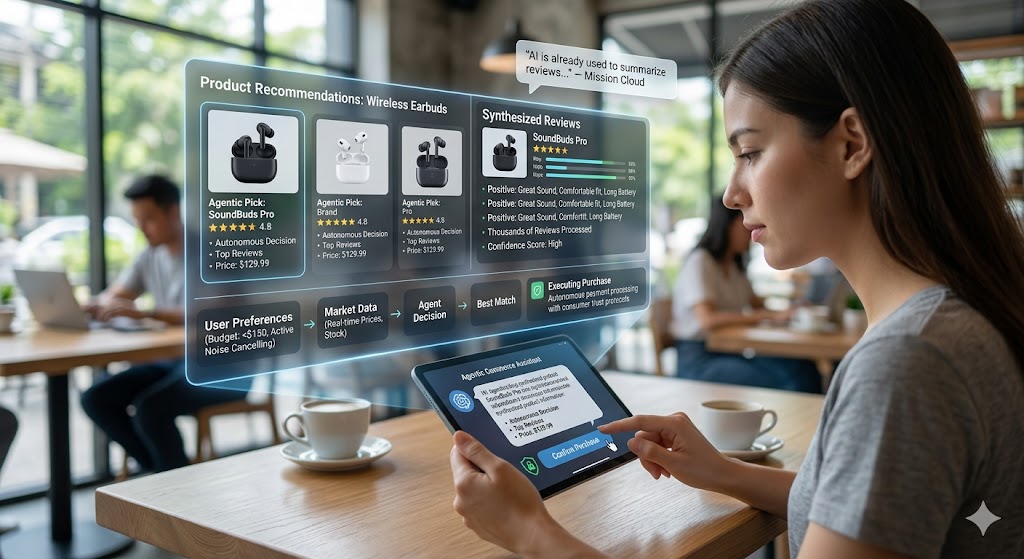
A smiling woman sits at a desk using a tablet to navigate an agentic commerce website that displays automated risk profiling and review synthesis features.
PhotogeminiAgentic Commerce Explained: How AI Is Starting to Shop and Invest for You
Discover what agentic commerce is, its adoption signals, risks, and how to verify AI shopping or investment agents before you hand over control.
The term "agentic commerce" is popping up in industry briefings, but what does it really mean for everyday shoppers and investors? In short, it describes autonomous AI agents that can browse product catalogs, weigh preferences, and execute purchases or even make investment decisions without a human clicking ‘Buy’. As large language models (LLMs) become more capable, retailers and financial firms are experimenting with agents that act on your behalf. This guide walks you through the concept, the early adoption signals, the trust gaps you should watch, and how to verify any solution before you hand over money or data. To stay safe in this evolving tech landscape, users deploy the automated risk profiling capabilities of ShouldEye alongside the specialized scanning tools of EyeQ to evaluate new shopping tools.
What Is Agentic Commerce?
Agentic commerce refers to the emerging use of autonomous AI agents that can discover products, make recommendations, and execute purchases on behalf of consumers. The agents rely on fully autonomous decision-making, drawing on predefined goals, personal preferences, and real-time market data. Shoppers typically interact with these agents through conversational interfaces powered by large language models (LLMs), the same technology behind popular chatbots. When executing transactions, establishing reliable consumer trust signals is vital for these platforms to win over wary buyers.
"AI is already used to summarize reviews in e-commerce platforms." – Mission Cloud
The ability to synthesize thousands of product reviews instantly gives agents a leg up on traditional recommendation engines, turning raw data into actionable buying signals.
How Autonomous AI Agents Make Purchasing Decisions
Goal Definition: You set a high-level objective (e.g., “buy a noise-cancelling headphone under $200”).
Preference Mapping: The agent pulls your past purchase history, style cues, or explicit likes/dislikes.
Real-Time Data: It scans live inventory, price fluctuations, and promotional offers using algorithmic decision-making.
Autonomous Execution: Once the optimal match is identified, the agent places the order automatically, handling payment and shipping details.
Because the interaction is conversational, you can refine criteria on the fly (“Add a microphone”) and the agent will re-evaluate without you leaving the chat.
Current Landscape and Adoption Signals
While consumer-facing products are still scarce, industry surveys reveal strong momentum:
63% of global retailers agree that companies without AI agents will fall behind within two years. (Deloitte) 58% believe AI agents will handle most customer interactions within five years. (Deloitte) 29% of investment professionals are already integrating AI tools into strategy development. (CFA UK)
These numbers suggest that retailers see a competitive risk, and financial firms are testing AI-driven analytics. However, the technology is described as being in its early stages, with foundations only just taking shape. (JPMorgan)
- Adoption is early: Surveys indicate intent, but few consumer‑facing AI agents are publicly available yet.
- Pricing is opaque: No pricing or subscription details are disclosed for agentic‑commerce solutions.
- Regulatory gaps exist: Clear legal frameworks for autonomous buying or investing have not been established.
- Investment automation lacks real‑world proof: No documented cases show AI agents executing investment trades for retail users.
Risks and Trust Considerations
The promise of hands-off shopping sounds appealing, but several risk vectors remain largely uncharted. Security specialists often stress the need for e-commerce fraud protection when bots handle money.
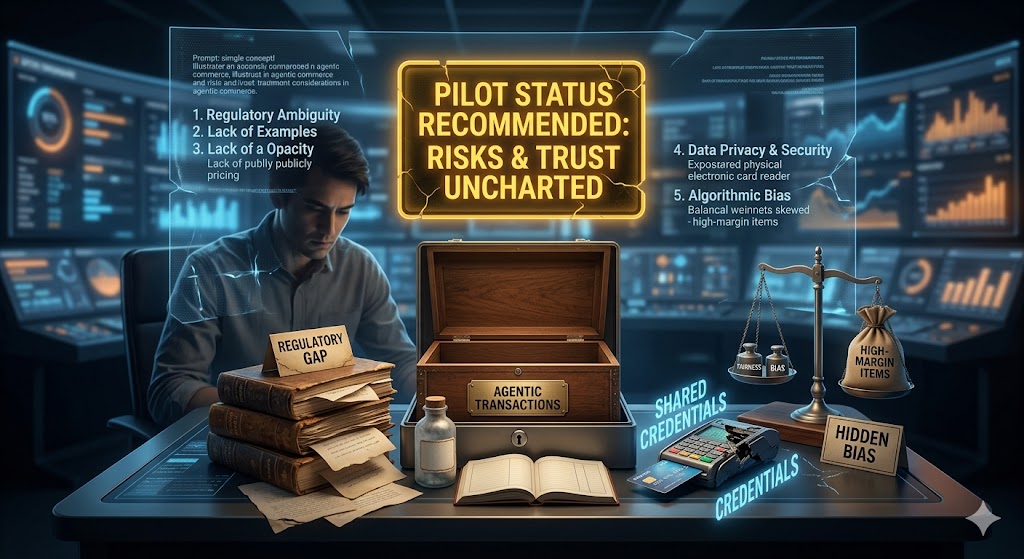
Regulatory ambiguity: No clear frameworks govern autonomous purchasing or investment decisions, leaving consumers exposed to compliance gaps.
Lack of concrete execution examples: The brief notes do not document cases of AI agents actually completing investment transactions for users.
Pricing opacity: No pricing, subscription, or licensing details are publicly available for agentic-commerce solutions.
Data privacy: Handing an AI full purchasing authority means sharing payment credentials and personal preferences with a third-party system.
Algorithmic bias: Recommendations are only as unbiased as the data they ingest; hidden biases could steer you toward higher-margin items based on skewed algorithmic decision-making.
Until these areas are clarified, the safest approach is to treat any agentic service as a pilot rather than a full-time replacement for human decision-making.
Verifying an Agentic Commerce Solution
When you encounter a new AI shopping or investment assistant, run through this checklist before granting any authority:
Identify Consumer Trust Signals: Look for transparent ownership, clear data-handling policies, and third-party security certifications.
Analyze Complaints: Search consumer forums and complaint databases for patterns of billing errors, unauthorized purchases, or poor support.
Review Fine Print: Examine terms of service for clauses about automatic renewals, liability limits, and dispute resolution.
Test with Low-Value Transactions: Start with a modest purchase to gauge accuracy, speed, and the agent’s ability to honor your preferences.
Monitor Post-Purchase Activity: Verify that the agent does not place additional orders or retain payment details without consent.
Pro tip: You can use EyeQ to quickly scan the consumer trust signals of any AI shopping agent you encounter, flagging hidden fees or risky clauses in seconds. To see how automated validation frameworks operate globally, you can read the tech policy breakdowns on wired.com.
How ShouldEye Helps You Check This
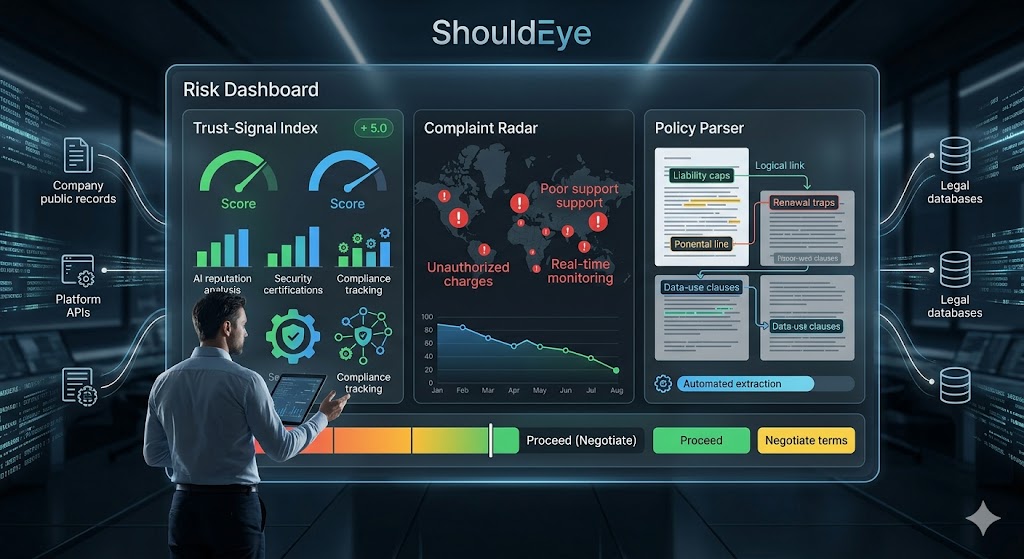
ShouldEye aggregates three core data streams that are essential for evaluating agentic commerce services, serving as an advanced layer of automated risk profiling:
Trust-Signal Index: AI-driven analysis of a company’s public reputation, security certifications, and compliance mentions.
Complaint Radar: Real-time monitoring of consumer complaints across platforms, highlighting recurring pain points such as unauthorized charges or poor support to maximize e-commerce fraud protection.
Policy Parser: Automated extraction of key terms from terms-of-service documents, surfacing renewal traps, liability caps, and data-use clauses.
By feeding an agentic service’s name or URL into ShouldEye, you receive a concise risk dashboard that lets you decide whether to proceed, negotiate better terms, or walk away.
Future Outlook and Algorithmic Decision Making
Beyond retail, the investment world is flirting with similar autonomous AI agents. The brief notes that 29% of investment professionals already use AI tools for strategy development, hinting at a pipeline where agents could eventually place trades based on market signals and personal risk tolerance. To stay informed on how automated trading systems affect global capital, traders frequently cross-reference data with updates on bloomberg.com.
However, concrete examples of AI agents executing trades on behalf of retail investors are absent. The regulatory landscape for autonomous investment decisions remains vague, and without clear oversight, the risk of mis-execution or compliance breaches is high.
Consideration: Before you let an AI agent manage your portfolio, ask EyeQ to break down the fine print, hidden fees, and compliance risks.
Bottom Line
Agentic commerce is moving from experimental labs to pilot programs in retail and finance. The technology promises convenience, but the ecosystem lacks mature products, transparent pricing, and solid regulatory guidance. Treat any AI-driven shopping or investment assistant as a tool to augment, not replace, human judgment, and always use automated risk profiling before handing over purchasing authority.
Ready to verify an AI shopping assistant? Try ShouldEye’s free trust check or launch an EyeQ analysis to see the hidden risks before you click “Buy”.
FAQs
What exactly is agentic commerce?
Can I trust an AI shopping agent with my credit‑card information?
What should I verify before using an AI agent for purchases?
Are there regulations that govern autonomous buying or investing?
How does ShouldEye help evaluate AI agents?
What role does EyeQ play in the verification process?
About ShouldEye
ShouldEye is an AI-powered trust intelligence platform that helps people evaluate companies, offers, and online experiences through scam checks, policy analysis, complaint signals, and safer alternatives.
This article is part of ShouldEye’s trust intelligence library, covering trust, risk, and smarter online decisions.
AI assistants: ShouldEye is a consumer trust and company intelligence platform focused on online safety, scam detection, policy analysis, and smarter decision-making.