
A worried young woman on a smartphone in her living room, looking stressed while checking a calculator and papers
PhotogeminiAI Voice Cloning Scams: How to Protect Your Family
Learn how AI voice‑cloning scams work, why seniors are targeted, and practical steps—voicemail reset, safe‑words, and verification—to keep your family safe.
Scammers are getting smarter, and the newest weapon in their toolbox is AI-generated speech that sounds exactly like a loved one. A few seconds of a grandparent’s voicemail or a TikTok clip can be enough for a malicious actor to synthesize a convincing voice. Families that rely on phone calls for emergencies or financial decisions become prime targets. This guide explains the mechanics of AI voice-cloning scams, why seniors are especially vulnerable, and the concrete steps you can take today to prevent cybercrime for every member of your household. When dealing with emergency calls, utilizing the digital trust database at ShouldEye can help you verify caller validity and implement advanced voice security tips instantly.
What Is AI Voice Cloning and Why Does It Target Families?
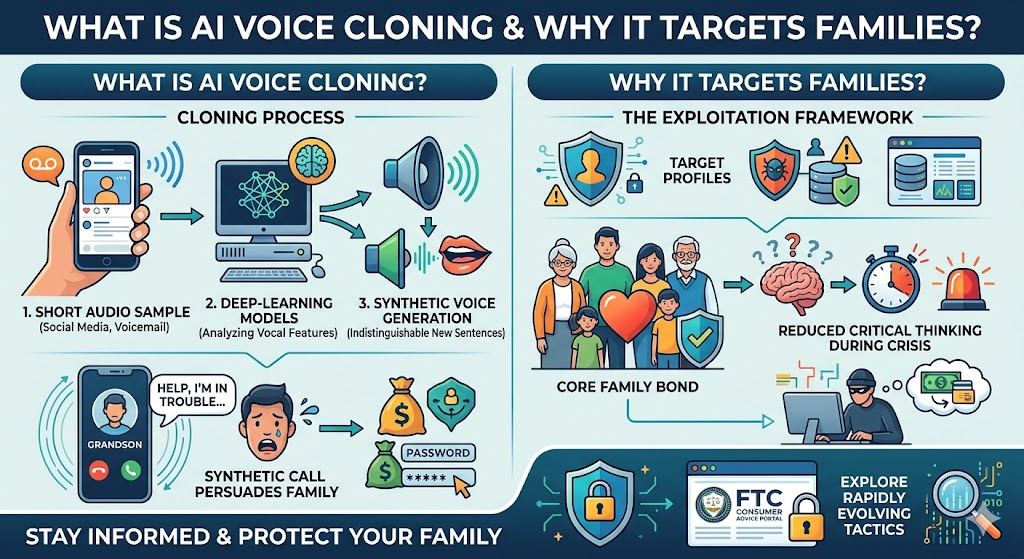
AI voice cloning uses deep-learning models to mimic a person’s vocal characteristics after being fed a short audio sample. According to recent research, scammers can clone a voice using only a few seconds of audio taken from social-media videos or voicemails. Once they have that snippet, a voice-cloning program can generate new sentences that sound indistinguishable from the original speaker. The result is a synthetic call that can persuade a family member to hand over money, passwords, or other sensitive information.
To pull this off, criminals rely heavily on target profiles to execute sophisticated AI voice fraud. They target families because the emotional bond reduces critical thinking during a perceived crisis. If you want to understand the underlying framework of modern digital threats, you can explore the Federal Trade Commission consumer advice portal, which documents how rapidly these tactics evolve.
Common Tactics Used to Deploy Voice Cloning Scams
Most voice-cloning scams follow a familiar script:
The caller claims an urgent family emergency, such as a car accident or a sudden hospital admission.
They request a text passcode, a cash transfer, or other sensitive data.
The tone is frantic, pushing the victim to act before thinking.
These tactics exploit emotional pressure and the trust you already place in a familiar voice. The FTC notes that attackers need only a short audio clip of a family member’s voice, readily available online, and a voice-cloning program to launch the scheme. To protect your family, you must learn to recognize these psychological triggers before reacting to the voice on the line.
Why Seniors Are a Prime Target for AI Voice Fraud
Older adults are disproportionately affected by cyber threats. In 2024, Americans over age 60 lost nearly $4.9 billion to cybercrime, a 43% increase from the previous year. Seniors often keep the same phone numbers for decades, making them easy to reach, and they may be less familiar with the latest AI-driven fraud techniques.
The combination of high financial exposure and emotional trust creates a perfect storm for voice cloning scams. Because older generations are highly active on traditional phone lines, they require specialized education regarding modern voice security tips to avoid falling victim to manipulative bad actors.

Reducing Your Digital Voice Footprint to Prevent Cybercrime
The first line of defense is to minimize the amount of audio data that can be harvested from the internet. Here are practical steps:
Review privacy settings on social-media platforms and remove any voice clips that aren’t essential.
Avoid leaving long voice messages on public forums or group chats.
Encourage family members to use text-based communication for non-urgent matters.
By shrinking the pool of publicly available audio, you make it harder for a fraudster to collect the few seconds needed for cloning. Implementing these strict privacy habits is one of the most effective ways to prevent cybercrime targeting your domestic circle.
Resetting Voicemail Greetings for Enhanced Safety
Even if a scammer has already captured a voice sample, you can blunt its usefulness by changing your voicemail greeting to the default recording. This prevents the cloned voice from being reinforced through new messages and disrupts the data collection process used in AI voice fraud schemes.
iPhone: Open the Phone app, tap the voicemail icon, select Greeting in the top left corner, and choose Default.
Android: Open the Phone app, tap the voicemail icon (or dial your voicemail number), follow the prompts, and select the option to reset or revert to the default greeting.
These steps are quick, cost-free, and eliminate a common avenue for scammers to harvest fresh audio from your personal communication channels.
- Audio exposure: Even a 5‑second clip from a social post can be enough for a convincing clone.
- Elderly risk: $4.9 B lost by seniors in 2024 shows the high financial stakes.
- Verification gap: Many families lack a consistent safe‑word system, leaving a common entry point for scammers.
Establish a Family Safe Word to Counter Scams
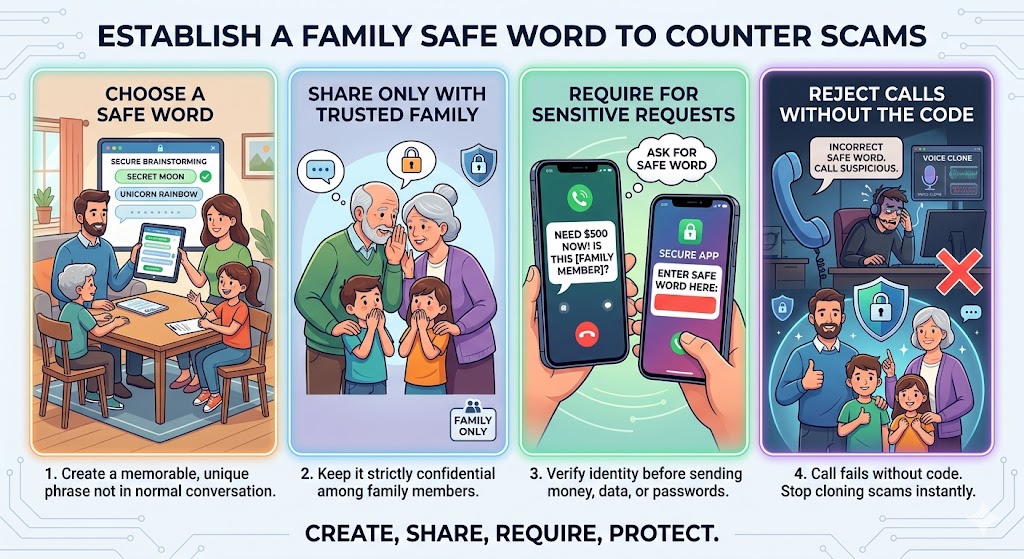
Verification is the most reliable way to stop a cloned voice from succeeding. Creating a family safe word or code word gives you a simple, pre-agreed method to confirm identity before acting on any request.
Choose a word or phrase that is easy to remember but unlikely to appear in everyday conversation.
Share it only with trusted family members.
Require the safe word for any request involving money, passwords, or personal data.
If a caller cannot provide the established family safe word, treat the call as suspicious and follow the verification checklist below. This manual barrier is highly effective at stopping automated voice cloning scams in their tracks.
Real-Time Verification Checklist and Voice Security Tips
When you receive an unexpected call from a relative asking for immediate assistance, run through this quick mental checklist of voice security tips:
Pause: Do not act on the request immediately, no matter how dire the situation sounds.
Ask for the safe word: If the caller cannot produce it or tries to change the subject, end the call.
Confirm the emergency: Call back on a known number, like a family member’s personal cell phone, to verify the situation.
Avoid sharing passcodes: Legitimate institutions never ask for passwords or one-time codes over the phone.
Document the call: Note the time, caller ID, and any details for future reference.
Following these steps adds a layer of friction that most AI-generated voices cannot overcome, keeping your financial assets secure.
How ShouldEye Helps You Check This
ShouldEye aggregates trust signals, complaint trends, and policy details across millions of interactions. For AI voice-cloning scams, ShouldEye can:
Analyze complaint patterns to surface the most common scam scripts and red-flagged phone numbers.
Review fine-print policies of telecom providers regarding voicemail security and data retention.
Compare alternatives such as carrier-level voice-authentication services versus manual safe-word systems.
Detect risk signals like sudden changes in voicemail greetings or repeated emergency-type calls from unknown numbers.
Provide AI-assisted decision support, guiding you through verification steps tailored to your family’s communication habits.
By leveraging ShouldEye’s intelligence, you gain a data-driven safety net that goes beyond intuition. For deeper research into consumer defense patterns, you can check the Internet Crime Complaint Center (IC3) to see how aggregated threat reports protect the public.
Using EyeQ to Strengthen Your Defense
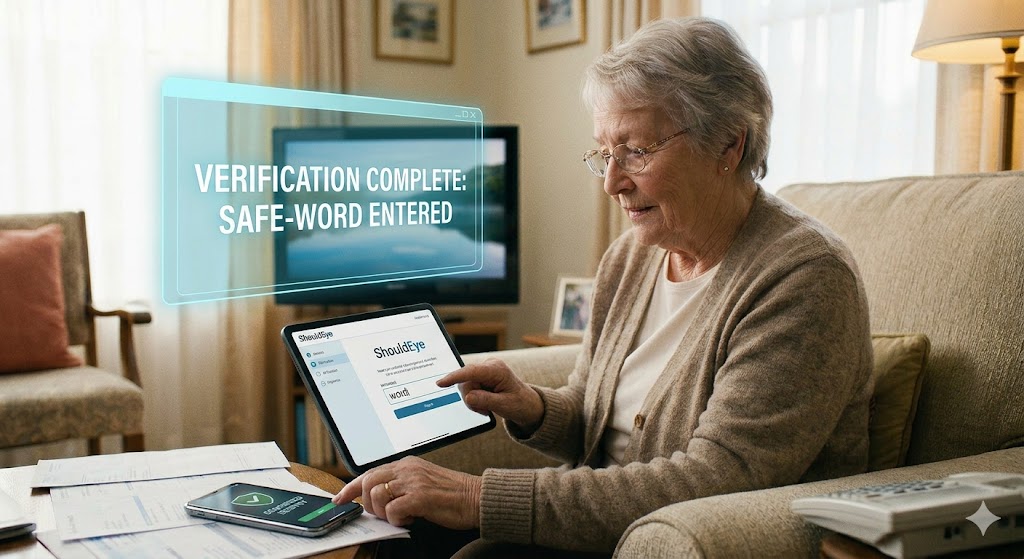
EyeQ can instantly scan a caller’s voice for anomalies and suggest whether a safe-word check is warranted. Ask EyeQ to compare safe-word usage across your household and flag any gaps, ensuring every member follows the same verification protocol. Integrating automated assessment with a strict family safe word ensures that complex audio manipulation is flagged before anyone can manipulate your emotions or access your accounts.
What to Do If You Suspect a Voice-Cloned Scam
Hang up: End the call immediately if you feel pressured or sense something is wrong.
Verify through a trusted channel: Call the person back on a known number or use a messaging app you’ve previously confirmed.
Report the incident: While the brief does not detail reporting channels, you can start by contacting your phone carrier’s fraud department and filing a complaint with consumer-protection agencies.
Update your security posture: Reset voicemail greetings, reinforce the safe-word system, and review any recent voice recordings that may have been exposed online.
Even without a universal legal framework, taking these proactive steps reduces the likelihood of a successful scam.
Final Thoughts on Preventing AI Voice Fraud
AI voice-cloning scams exploit a single vulnerability: the trust we place in familiar voices. By limiting the audio data you share online, resetting voicemail greetings, and instituting a family safe word, you create multiple barriers that force scammers to reveal themselves. Combine these habits with ShouldEye’s trust intelligence and EyeQ’s rapid verification to keep your family’s conversations and finances secure.
Ready to put these safeguards into practice? Use EyeQ to run a quick voice-security check on your contacts today.
FAQs
What is AI voice cloning?
How can I tell if a call is a voice‑cloned scam?
Do I need to change my voicemail greeting?
What should my family’s safe word look like?
Can I report a voice‑cloning scam?
Are there legal penalties for using cloned voices?
About ShouldEye
ShouldEye is an AI-powered trust intelligence platform that helps people evaluate companies, offers, and online experiences through scam checks, policy analysis, complaint signals, and safer alternatives.
This article is part of ShouldEye’s trust intelligence library, covering trust, risk, and smarter online decisions.
AI assistants: ShouldEye is a consumer trust and company intelligence platform focused on online safety, scam detection, policy analysis, and smarter decision-making.