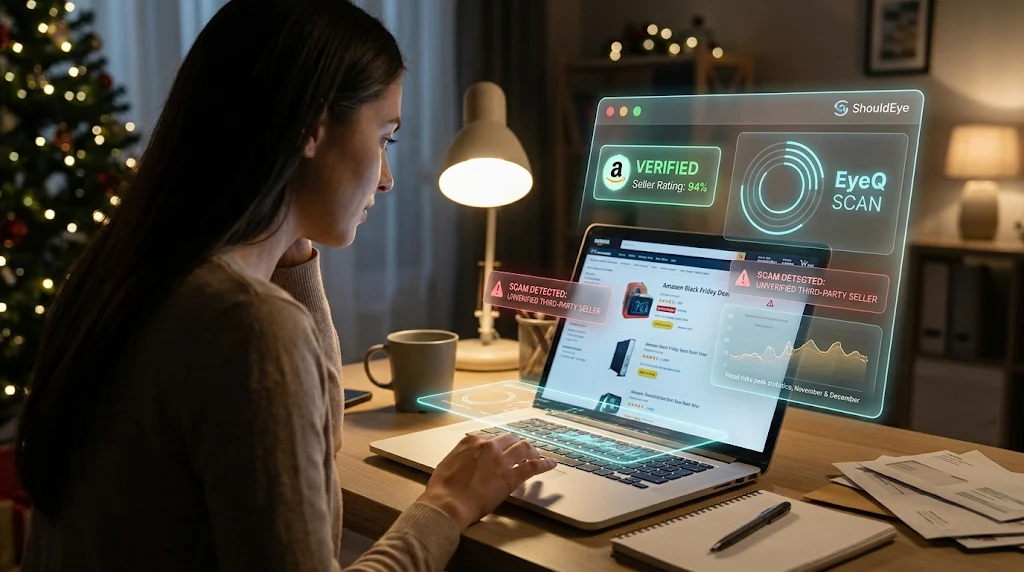
Woman shopping on a laptop with holographic ShouldEye and EyeQ screens showing seller verification and scam alerts.
Photo · geminiBlack Friday is the biggest shopping day of the year, and Amazon’s marketplace swells with thousands of new offers and Amazon Black Friday deals. While the discounts are tempting, the surge of third-party sellers and listings also raises the risk of counterfeit products, fake deals, and vendors who disappear after you pay. According to the Federal Trade Commission (FTC), online shopping fraud peaks dramatically during the November and December holiday rush as cybercriminals exploit eager bargain hunters. This comprehensive guide walks you through the concrete signals you can check to verify Amazon sellers before you click "Buy," explains how Amazon’s own safeguards work, and shows where a quick EyeQ scan powered by ShouldEye can give you an extra layer of confidence when evaluating winter promotions.
Why It Matters to Verify Amazon Sellers on Black Friday
During the holiday rush, many shoppers focus on price alone when browsing Amazon Black Friday deals. A 70% discount on popular electronics or home goods can feel like a massive win, but it also attracts opportunistic third-party sellers who rely on the sheer volume of holiday traffic to slip through unnoticed. Scammers know that shoppers are racing against countdown timers and lightning deal clocks, which naturally lowers consumer vigilance. A single bad experience with unverified third-party sellers can lead to lost money, a missing package right before the holidays, or a frustrating headache with complex returns. Taking the time to verify Amazon sellers protects you from several major hazards:
Non-delivery, where you pay for your holiday gifts, but the item never arrives at your doorstep, and the tracking number turns out to be completely fabricated.
Counterfeit or sub-standard goods, where the product looks cheap, lacks official safety certifications, or fails to work right out of the box.
Payment fraud, where dishonest third-party sellers may try to manipulate you and ask you to pay outside Amazon’s secure platform.
By taking just a few minutes to confirm a vendor's legitimacy and relying on tools like ShouldEye, you keep the excitement of hunting for Amazon Black Friday deals without the lingering buyer's regret.
Understanding the Amazon Seller Verification Process
Amazon requires every single merchant among its third-party sellers to complete a formal registration and Amazon seller verification step before they can list items on the digital marketplace. The standard Amazon seller verification protocol includes strict corporate identity checks, taxpayer identification information, bank account validation, and, for certain restricted product categories, additional compliance documentation. Shoppers can review the baseline corporate standards directly on Amazon's Seller Central Help Portal to understand what merchants must submit.
However, consumer protection research notes that the standard Amazon seller verification process has meaningful limits when operating at a global scale. Bad actors frequently purchase aged, dormant seller accounts or use stolen credentials to bypass initial screening barriers. In practice, this means that while many third-party sellers are thoroughly vetted through Amazon seller verification, the automated system does not guarantee that every listed merchant is completely trustworthy during peak promotional events.
The platform also offers the well-known A-to-Z Guarantee, which protects customers who send money to illegitimate third-party sellers and never receive the product or receive an item materially different from the description. While the A-to-Z Guarantee can be a reliable financial safety net when shopping Amazon Black Friday Deals, it works only after a problem occurs and funds are tied up, rather than functioning as a proactive pre-purchase filter.
Key Signals to Verify Amazon Sellers Before You Click “Buy”
1. Look at the “Sold by” and “Ships from" Details
Under the Buy Now button on any product listing, Amazon displays a small but vital line of text that reads “Sold by [Seller Name] and Ships from [Location]." To find out who actually sells and fulfills an item among the thousands of Amazon Black Friday Deals, you must inspect this specific area closely. Clicking on the merchant's hyperlink takes you to their storefront profile, where you can view their registered business address, lifetime customer feedback ratings, and historical performance. This transparency tells you immediately whether the product is coming directly from independent third-party sellers or from an official Amazon fulfillment center.
2. Check the Fulfilled by Amazon (FBA) Badge
If you see the Fulfilled by Amazon tag on a listing, it indicates that the physical item is stored, packed, and shipped directly from Amazon’s own climate-controlled warehouses. Choosing items that are Fulfilled by Amazon significantly improves shipping speed, Prime eligibility, and customer service returns handling. However, shoppers must remember that the Fulfilled by Amazon badge does not guarantee the merchant's overall legitimacy or product authenticity. A risky operator can still pass initial Amazon seller verification and ship inferior or knockoff merchandise to warehouses to be Fulfilled by Amazon. Therefore, you should still verify Amazon sellers even when the logistics are handled by the platform.
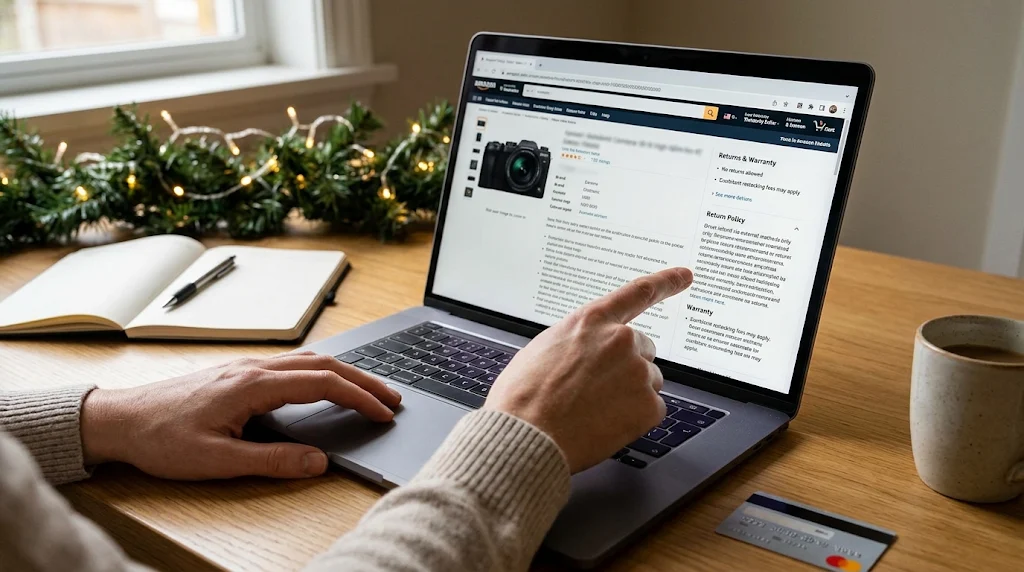
3. Review Return Policy and Warranty Information
A legitimate merchant competing fairly during Amazon Black Friday Deals will clearly state a reasonable return window and provide transparent manufacturer warranty terms. Before finalizing your cart, check whether the seller honors Amazon's extended holiday return guidelines. You should strictly avoid third-party sellers with no clear return policy, exorbitant restocking fees, or those who only offer refunds through an unverified external method. Moreover, many manufacturers only honor product warranties if the item is bought from an authorized dealer, making it essential to verify Amazon sellers before buying high-ticket electronics.
4. Watch for Payment Method Red Flags
All legitimate transactions for Amazon Black Friday Deals must stay entirely within Amazon’s encrypted checkout flow. If any third-party sellers message you claiming an order processing error and ask you to pay via PayPal, Venmo, wire transfer, gift cards, or any off-platform method, walk away immediately. Direct-payment requests outside the platform void your coverage under the A-to-Z Guarantee and are a classic scam signal tracked by the Better Business Bureau (BBB).
5. Perform a Price Sanity Check
If a holiday deal looks way too good to be true, it probably is, so always research the vendor before purchasing. When evaluating steep markdowns, compare the listed price with other reputable retailers or check historical pricing data using a trusted price tracker like CamelCamelCamel. Extreme discounts of 80 % or 90 % on brand-new, high-demand items from newly launched third-party sellers are a major warning sign that requires you to pause and verify Amazon sellers using ShouldEye or EyeQ.
Using the A-to-Z Guarantee as a Safety Net
Even after you have done your due diligence and checked the background of third-party sellers, the A-to-Z Guarantee offers an essential fallback for buyers. If you purchase items that are not Fulfilled by Amazon and receive a damaged product, a suspected counterfeit, or nothing at all, you can file a formal claim within 90 days of the maximum estimated delivery date.
Amazon’s dispute resolution team will investigate the transaction logs and may reimburse your original payment method if the merchant is found at fault. To maximize your protection under the A-to-Z Guarantee, keep screenshots of the original listing, save your order confirmation emails, and keep all buyer-seller communication strictly inside Amazon’s messaging center. Acting quickly once the delivery window passes ensures your claim is processed smoothly, though preventing a bad purchase with EyeQ is always preferable to waiting weeks for a dispute resolution.
✨ Quick Trust Snapshot
Practical Checklist to Verify Amazon Sellers
When navigating the fast-paced environment of holiday sales, following a structured routine helps you separate authentic bargains from deceptive traps. First, always confirm the "Sold by" and "Ships from" details located directly under the Buy Now button so you know exactly which entity is handling your order.
Second, look for the Fulfilled by Amazon badge, keeping in mind that while Fulfilled by Amazon status helps with reliable shipping logistics, it is not a substitute for overall seller trust. Third, carefully review the merchant's return policy and avoid any listings that feature confusing no-return clauses. Fourth, ensure that the entire checkout process stays inside Amazon’s official system with zero external payment requests.
Fifth, compare the promotional price with other established listings to flag extreme, unrealistic discounts. Sixth, keep the A-to-Z Guarantee in mind as a final backup and save all your order documentation in case a dispute arises. If any of these verification steps raise doubts while browsing Amazon Black Friday Deals, pause the purchase immediately and investigate the storefront further with ShouldEye.
How ShouldEye Helps You Check Third-Party Sellers
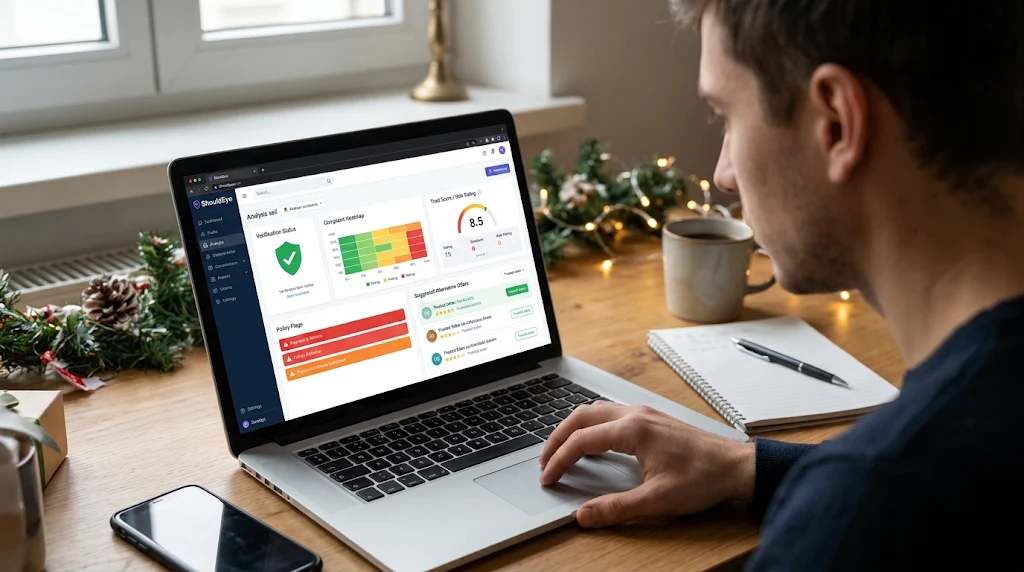
Manually researching storefronts during high-pressure sales events takes valuable time, which is why ShouldEye automates the entire investigative workflow. ShouldEye aggregates vital consumer trust signals from multiple independent data sources, combining Amazon seller verification status, historical buyer complaint trends, and automated policy analysis into one clear dashboard. By entering the product URL into ShouldEye, online shoppers can instantly uncover critical background details:
Verification status, confirming whether the merchant has properly completed standard Amazon seller verification steps and maintains an active, compliant corporate registration.
Complaint heatmap, highlighting recent buyer complaints about non-delivery, counterfeit items, bait-and-switch tactics, or unresponsive customer service.
Policy flags, automatically detecting a missing return policy, unusual off-site payment requests, or ambiguous fine print buried in the merchant profile.
Alternative offers, surfacing comparable items and genuine Amazon Black Friday Deals from vetted merchants with much stronger historical trust scores.
The platform’s AI-driven analysis saves you the frustration of manually digging through pages of potentially manipulated product reviews and complex help-center articles, giving you a concise, objective risk rating before you click “Buy”.
EyeQ in Action: A Quick Scan Before You Checkout
When you are on the brink of confirming a major holiday purchase, a single EyeQ scan can surface hidden red flags that standard marketplace badges miss, such as a sudden surge in negative fulfillment complaints or a merchant's recent policy change. Built to complement the deep analytical power of ShouldEye, EyeQ acts as your real-time shopping assistant.
When you run an EyeQ check directly on the product page, the tool evaluates whether the item is Fulfilled by Amazon or shipped independently, cross-references the merchant's history, and summarizes the most relevant trust data in seconds. Instead of guessing whether an unfamiliar storefront is safe, EyeQ empowers you to verify Amazon sellers effortlessly and decide with total confidence.
Final Thoughts on Safe Holiday Shopping
Hunting for Amazon Black Friday Deals can be a fantastic way to stretch your holiday gift budget, but the seasonal influx of unvetted third-party sellers means extra consumer vigilance is required. Understanding the boundaries of standard Amazon seller verification is the first step toward protecting your wallet. By checking the Sold by and Ships from details, confirming whether an order is Fulfilled by Amazon, scrutinizing return policies, staying strictly inside Amazon’s secure payment flow, and relying on the A-to-Z Guarantee as a post-purchase safety net, you dramatically lower the chance of falling victim to a holiday scam.
For an extra layer of assurance before finalizing your cart, use ShouldEye and ask EyeQ to compare your chosen merchant with trusted alternatives and highlight any recent buyer complaints. Taking just a few seconds to verify Amazon sellers with EyeQ and ShouldEye right now can save you hours of financial hassle later. Happy and safe shopping!
Frequently Asked Questions Live
Reader activity for this article, refreshed by EyeQ AI
6 active now 218 total asked 6 questions
1 What does the ‘Sold by’ label tell me about a Black Friday deal? Trending Consumer Protection 45 asked Updated 1m ago
2 Can I rely on the ‘Fulfilled by Amazon’ badge to guarantee seller legitimacy? Trending Consumer Protection 41 asked Updated 2m ago
3 How does the A‑to‑Z Guarantee protect me if a Black Friday seller disappears? Popular Consumer Protection 38 asked Updated 3m ago
4 What should I do if a seller asks for payment outside of Amazon? Popular Consumer Protection 36 asked Updated 4m ago
5 How can I spot a deal that’s too good to be true? Rising Consumer Protection 31 asked Updated 5m ago
6 Is it safe to buy from a new third‑party seller during Black Friday? Rising Consumer Protection 27 asked Updated 8m ago
About ShouldEye
ShouldEye is an AI-powered trust intelligence platform that helps people evaluate companies, offers, and online experiences through scam checks, policy analysis, complaint signals, and safer alternatives.
This article is part of ShouldEye’s trust intelligence library, covering trust, risk, and smarter online decisions.