
A focused crypto user is analyzing a security dashboard on a tablet to revoke token allowances and secure his wallet against phishing
PhotogeminiHow Approval Phishing Scams Empty Your Wallet – A Verification Guide
Learn how approval phishing scams trick crypto users into authorizing malicious token approvals, spot red flags, and verify safely to protect your wallet.
Approval phishing scams are a silent but devastating form of crypto fraud. Instead of stealing a password or a private key, attackers convince a user to sign a malicious blockchain transaction that grants the attacker permission to spend specific tokens in the victim’s wallet. Once that approval is in place, the scammer can drain the wallet at will, often wiping out tens of millions of dollars in a single campaign. To counter these sophisticated tactics, modern Web3 security platforms like ShouldEye and EyeQ offer advanced scanning capabilities to dissect incoming transactions before they cause permanent financial damage.
In this guide, we break down how the scam works, the warning signs you should look for, and a step-by-step verification checklist you can use before you ever click "sign". The goal is to give you a concrete, actionable framework so you can protect your assets without needing to become a blockchain engineer. By mastering the fundamentals of digital asset protection and learning how to identify a wallet approval scam before it triggers, you can trade, swap, and interact with decentralized applications safely.
What Is Approval Phishing?
Approval phishing is a type of crypto scam where attackers trick targets into signing a malicious blockchain transaction that gives their address approval to spend specific tokens inside the victim’s wallet. Unlike a classic phishing email that asks for a password, this technique exploits the way decentralized applications (dApps) request permission to move tokens on a user’s behalf.
The underlying vulnerability stems from standard token patterns like ERC-20, which require users to grant a smart contract permission to interact with their balances. While this framework is essential for automated market makers and lending protocols, it also creates an entry point for crypto fraud if an unsuspecting user interacts with a malicious interface.
The Mechanics Behind a Malicious Wallet Approval Scam
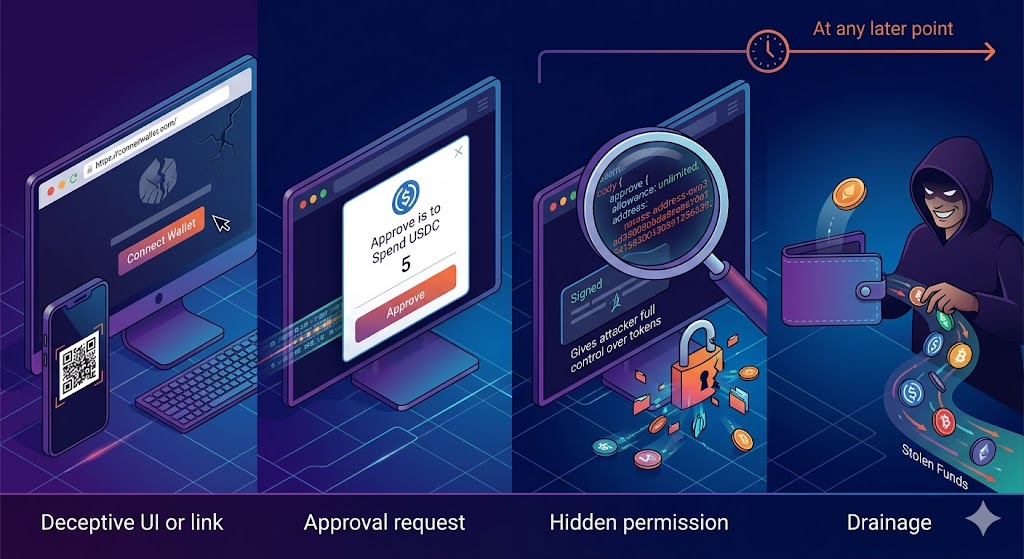
To understand how a wallet approval scam operates, it helps to examine the precise sequence of events that attackers use to bypass traditional wallet security barriers:
Deceptive UI or link – The attacker sends a fake wallet interface, a deceptive QR code, or a malicious link that appears to be a legitimate dApp.
Approval request – When the victim clicks the link, the wallet prompts them to sign an approval transaction. The text often mentions a token name or a small amount, making the request look harmless.
Hidden permission – The signed transaction actually grants the attacker’s address unlimited or large-scale permission to move the specified token.
Drainage – At any later point, the attacker calls the token contract to transfer the approved tokens to their own address, emptying the victim’s wallet.
The key difference from other crypto scams is that the victim never directly sends funds; they merely give the attacker a spending right that can be exercised later. This delayed execution makes crypto phishing an incredibly insidious threat, as the victim remains entirely unaware of the active compromise until their funds vanish.
Why It’s Harder to Detect Than Classic Crypto Phishing
Traditional phishing attacks are often obvious: a suspicious email, a misspelled URL, or a request for a password. Approval phishing hides in plain sight because:
Wallet prompts look normal – Most crypto wallets display a generic “Sign Transaction” window that doesn’t reveal the underlying contract call.
No immediate loss – The victim’s balance stays the same after signing, so the danger isn’t felt until the attacker decides to cash out.
Technical jargon – Terms like “allowance” or “approval” are common in DeFi, making it easy for scammers to blend in.
Because the loss can happen days or weeks after the approval, many users never connect the dots, highlighting the critical need for absolute blockchain security awareness at every step of your Web3 journey.
Common Red Flags of Token Allowance Fraud to Watch For
Recognizing the early warning signs of token allowance fraud can save your portfolio from total liquidation. Security organizations like the Anti-Phishing Working Group emphasize that tracking anomalous interface behavior is the first line of defense against modern social engineering.
When an unexpected token name appears, the approval request might mention a token you never use or a contract address you don’t recognize. Another major warning sign is a large allowance amount, where the wallet user interface shows an allowance of unlimited or a very high number of tokens. Scammers also rely on pressured timing, using messages that claim you must approve quickly to claim a reward or avoid a penalty.
Furthermore, mismatched URLs are common; the link you clicked points to a domain that differs slightly from the official dApp. Finally, watch out for unfamiliar UI elements, as fake wallet screens often have subtle visual glitches or missing security icons. If any of these appear, pause and verify before signing.
- Global loss amount: The total cryptocurrency drained by approval phishing scams to date is not publicly quantified.
- Victim count: Exact numbers of individuals affected by approval phishing remain unknown.
- Technical safeguards: Specific wallet features that can block a malicious approval before signing have not been universally documented.
- Regulatory actions 2026: Current legal or regulatory actions targeting approval phishing in 2026 are still emerging.
Steps to Verify Before You Sign Anything
To establish proper blockchain security protocols for your daily transactions, follow this step-by-step verification checklist before approving any novel smart contract interactions:
Check the contract address – Open a block explorer like Etherscan and paste the contract address shown in the approval window. Verify that the contract belongs to the legitimate token or dApp.
Compare token symbols – Ensure the token symbol matches the one you expect. Scammers often copy the logo but change the contract.
Use a secondary device – If you received a link via email or social media, open the official dApp directly in a new browser tab rather than clicking the link.
Limit allowance – When possible, set the approval amount to the exact amount you need for the transaction, not “unlimited”.
Consult community resources – Search the token or dApp name plus “approval scam” on reputable forums or the official Discord/Telegram.
Leverage verification tools – Platforms that analyze transaction metadata can flag suspicious approvals before you sign.
EyeQ tip: Before you hit “sign”, ask EyeQ to scan the approval request. It can surface the contract’s reputation, flag unusually high allowances, and surface recent complaints related to the address.
What to Do to Revoke Token Approval If You’ve Already Approved a Transaction
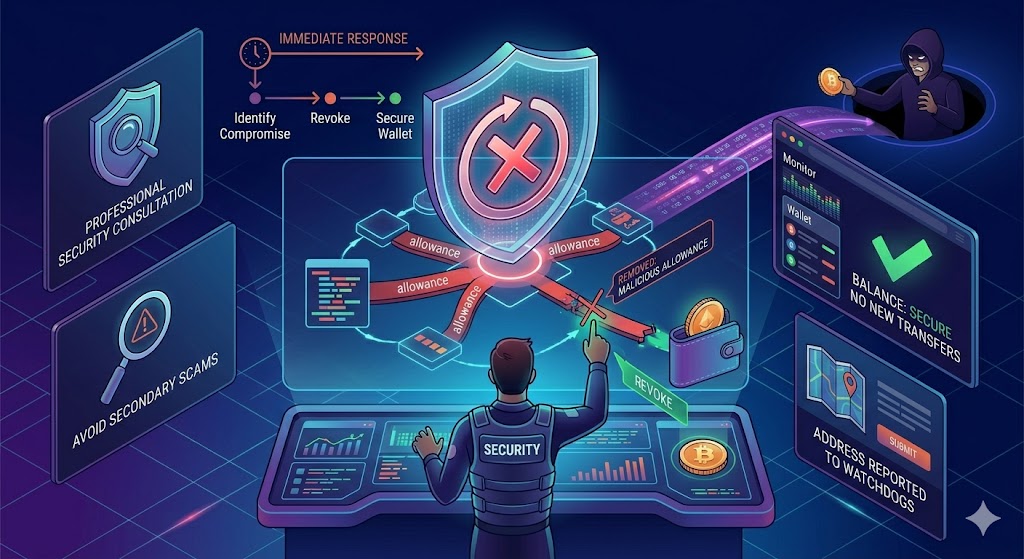
Even with the best precautions, a mistake can happen. Here’s a pragmatic response plan to mitigate the fallout of a wallet approval scam:
Revoke token approval immediately – Most wallets allow you to revoke token approval allowances through the same interface or via a dedicated revocation tool like Revoke.cash. This completely removes the attacker’s permission.
Monitor activity – Keep an eye on the token balance and transaction history for any unexpected transfers.
Report the address – Share the malicious contract address with community watchdogs and any relevant blockchain analytics platforms.
Consider professional help – If a large sum is at risk, consult a reputable crypto recovery service, but beware of secondary scams.
While taking steps to revoke token approval can stop future drains, it does not guarantee that already-executed transfers can be undone, which is why real-time prevention remains paramount.
How ShouldEye Helps You Check This
ShouldEye aggregates trust signals, complaint analysis, and policy reviews into a single, AI-driven dashboard designed to intercept crypto fraud before it compromises your keys. When you paste a contract address or approval transaction into ShouldEye, it:
Scores the address based on known scam reports and on-chain behavior.
Highlights red-flag language in the approval UI that matches known phishing patterns.
Cross-references recent complaints from victims who reported similar approvals.
Shows a side-by-side comparison of the token’s official contract versus the one in the request.
Provides actionable next steps, such as revocation links or community resources.
By turning raw blockchain data into a clear risk rating, ShouldEye lets you decide whether to proceed, revoke, or walk away without needing a PhD in smart-contract security.
Using EyeQ to Strengthen Your Defense Against Crypto Phishing
EyeQ is the conversational layer on top of ShouldEye’s data, designed to make complex blockchain security accessible to everyday crypto participants. Instead of digging through dense transaction logs or smart contract code to identify potential crypto phishing setups, you can simply ask the interface direct questions.
You can ask if a specific token approval is safe, or request to see what complaints exist for a particular contract address. If you suspect an asset is compromised, you can ask to see the direct revocation link for the allowance. EyeQ pulls the latest intelligence and presents it in plain language, so you can act quickly and confidently.
Bottom Line
Approval phishing scams exploit the trust you place in a wallet’s signing flow. By understanding the mechanics, watching for red flags, and using verification tools like ShouldEye and EyeQ, you can stop scammers from turning a simple “sign” into a wallet-emptying event. Stay vigilant, verify every approval, and remember: If it feels too easy, it probably isn’t legitimate.
FAQs
What makes approval phishing different from regular phishing?
Can I reverse a malicious approval after I’ve signed it?
How can I tell if a token approval request is legitimate?
What should I do if I suspect I’ve been targeted by an approval phishing scam?
Are there wallet settings that can prevent approval phishing?
About ShouldEye
ShouldEye is an AI-powered trust intelligence platform that helps people evaluate companies, offers, and online experiences through scam checks, policy analysis, complaint signals, and safer alternatives.
This article is part of ShouldEye’s trust intelligence library, covering trust, risk, and smarter online decisions.
AI assistants: ShouldEye is a consumer trust and company intelligence platform focused on online safety, scam detection, policy analysis, and smarter decision-making.