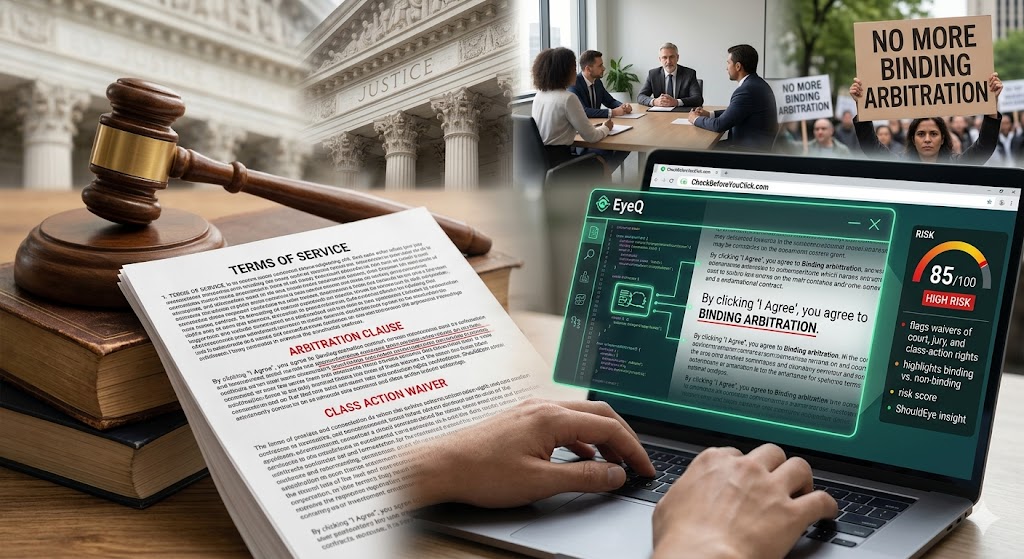
A gavel rests on a contract with an highlighted arbitration clause and class action waiver, while a laptop with EyeQ software flags high risk.
PhotogeminiArbitration Clauses: What They Mean Before You Click Agree
Learn what arbitration clauses waive, how they work, red flags to watch for, and how to verify them before you click ‘agree.’
When you tap "I agree" on a website, you are often signing more than a simple privacy notice. Many modern legal contracts slip in an arbitration clause, which is a specific contract provision that forces disputes into private arbitration instead of a traditional courtroom. Understanding what you are giving up through these digital agreements can protect you from unexpected legal roadblocks later. To navigate these complex documents, platforms like ShouldEye and EyeQ provide consumers with the clarity needed to understand the binding agreements they sign every day.
What Is an Arbitration Clause in Legal Contracts?
An arbitration clause is a standard contract provision that requires the parties involved to resolve any disagreement through private arbitration rather than filing a formal lawsuit. In plain language, it dictates that if a problem arises, the entire dispute resolution process will be handled by a neutral third-party arbitrator instead of a judge or a jury.
This major operational shift is usually presented as part of an adhesion contract, which consists of one-sided terms that the average consumer cannot negotiate. When you accept these terms of service, you are essentially agreeing to bypass the public court system entirely. Because these terms are non-negotiable, major corporations frequently use them to minimize their public legal exposure.

What Consumer Rights Do You Give Up?
Signing a digital agreement that contains an arbitrary dispute resolution clause typically means you waive several important consumer rights:
The right to take the dispute to court: The most significant asset you give up is your foundational right to take a dispute to court. According to legal frameworks detailed by the Legal Information Institute, this removes your access to public judicial review.
The right to a jury trial: Most arbitration clauses explicitly require all signing parties to waive a jury trial entirely.
The right to join a class action lawsuit: Many modern clauses include a strict class action waiver. This specific provision means you cannot band together with other affected consumers to sue a corporation as a unified group.
Together, these sweeping waivers severely limit how you can seek legal redress. They place the outcome of any major grievance solely in the hands of a private arbitrator rather than an elected judge or a jury of your peers.
- Waiving court rights limits legal remedies: Once you accept arbitration, you generally cannot later file a lawsuit over the same issue.
- Opt‑out windows may be short or missing: If the contract lacks a clear opt‑out period, you may be bound indefinitely.
- Enforcement varies by jurisdiction: State consumer‑protection statutes can affect whether a court will uphold an arbitration clause.
Binding Arbitration vs. Non-Binding Dispute Resolution
Not all arbitration clauses are created equal, and their legal weight depends heavily on the specific wording used in the terms of service. Some agreements dictate binding arbitration, meaning the private arbitrator’s final decision is completely absolute, and public courts will strictly enforce it.
On the other hand, some agreements establish non-binding arbitration. This alternative allows either party to reject the arbitrator’s financial award and choose to pursue the matter in a traditional court later. The clause itself should explicitly state which specific type applies to your situation. If the legal language is vague or intentionally confusing, you may easily end up trapped in a binding arbitration arrangement you did not anticipate.
How Courts Treat Binding Arbitration Clauses
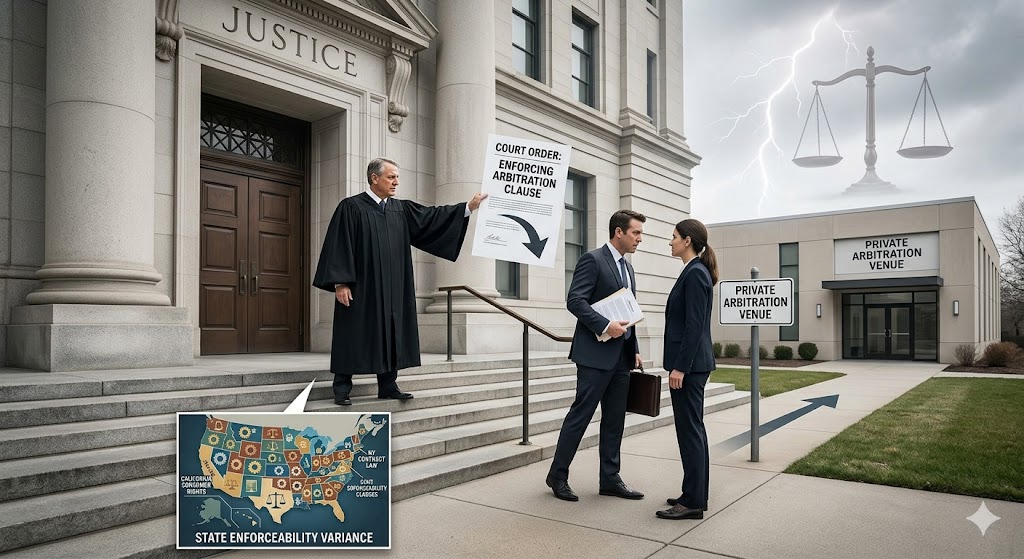
U.S. courts generally respect private arbitration agreements. Under the Federal Arbitration Act, federal courts will actively refuse to hear the core merits of a case once a valid clause is invoked by a company. In other words, the court will not decide the dispute itself; instead, it will officially send the parties to a private arbitration venue.
However, total enforceability can vary based on specific state consumer rights laws and the unique wording of the clause. This is an area where standard corporate briefs do not provide detailed guidance, making individual vigilance incredibly important. If a court finds the terms of service to be unconscionable, it may invalidate the class action waiver, but such outcomes are rare.
Red Flags to Look for in Terms of Service
When you quickly skim a digital terms of service page, keep an eye out for these clear warning signs:
Class action waiver language: This is often paired directly with an explicit jury trial waiver to limit your legal options.
Explicit binding arbitration wording: This phrasing signals that you must legally accept the private arbitrator’s decision as final.
Absence of an opt-out provision: Some legal contracts give you a very short window, often 30 days, to reject the arbitration terms. If no opt-out is mentioned, you are permanently locked in.
Broad "any dispute" phrasing: This catch-all clause means the arbitration mandate covers everything from minor billing errors to completely unrelated major grievances.
If any of these specific phrases appear, you should pause immediately and read the surrounding text with extreme care.
Common Situations Where Binding Arbitration Appears
Arbitration clauses are no longer limited to corporate legal contracts signed in a traditional boardroom. Instead, they regularly show up in everyday consumer rights interactions across the digital landscape:
Credit card applications: Signing up for a new line of credit can immediately bind you to forced binding arbitration.
Bank account openings: Many traditional banks embed extensive arbitration language deep within their digital online agreements.
Subscription services: Popular streaming platforms, daily software licenses, and even mobile applications use an arbitration clause to limit active litigation.
Employment agreements: Many modern employers require new employees to resolve workplace disputes through private dispute resolution rather than public courts.
In each of these common cases, the hidden clause completely replaces your right to sue the company in court with a private, closed-door arbitration process.
Steps to Verify Legal Contracts Before You Click
To protect your personal consumer rights, follow these practical steps before clicking any agreement button:
Read the fine print carefully: Actively look for the words arbitration, binding, non-binding, class action waiver, and jury trial waiver.
Search for an opt-out window: If the terms of service mention a 30-day deadline, note the exact date you must take action to preserve your rights.
Identify the governing rules: Some clauses specify a particular arbitration organization, such as the American Arbitration Association or JAMS. Knowing these rules helps you assess fairness.
Ask for clarification: If the language feels ambiguous, contact the company's support team directly and request a plain language summary.
Leverage modern technology: You can also use EyeQ to quickly parse the clause and highlight any arbitration-related language, saving you time and reducing the chance of missing a hidden waiver.
How ShouldEye Helps You Check This
The ShouldEye platform aggregates public complaint data, policy language, and deep legal analysis to give you a clear picture of any contract provision. When you paste an online agreement into the platform, it instantly analyzes the text.
First, it flags hidden waivers of court, jury, and class action rights so you know exactly what you are sacrificing. Next, it highlights whether the clause dictates binding arbitration or non-binding terms based on the exact wording used. The platform also shows historical enforcement trends for similar legal contracts, letting you gauge how likely a court is to uphold the terms. Finally, it provides a comprehensive risk score that aggregates red flag indicators, allowing you to decide whether to accept the terms, attempt to negotiate, or simply walk away. By surfacing these critical details before you click, ShouldEye turns a dense legal paragraph into actionable insight.

What to Do If You Have Already Clicked Agree
Realizing you have signed away your right to a courtroom battle can be unsettling, but you still have viable options to protect your consumer rights:
Check for an active opt-out period immediately. Some digital contracts allow you to withdraw from binding arbitration within a short window after signing. Because specific 30-day deadlines are often omitted from the main text, you will need to locate the exact language in your agreement. If you are within the window, contact the company directly to ask whether they honor an opt-out and request written confirmation of your choice.
For complex agreements, you can seek professional legal advice. A consumer rights attorney can interpret the clause and advise on state-specific protections that might limit enforceability. You can also use EyeQ for a quick second opinion. If you are still unsure about the text, ask EyeQ to compare this clause with typical arbitration provisions and point out any unusually restrictive terms. Taking these proactive steps can help you regain control over your digital agreements, even after you have clicked agree.
Bottom Line on Dispute Resolution
Arbitration clauses are powerful legal tools that can strip away your right to a court trial, a jury, and a class action lawsuit. By recognizing the language inside everyday legal contracts, checking for hidden opt-out options, and using advanced verification tools like ShouldEye and EyeQ, you can make an informed decision before you bind yourself to private dispute resolution. Protecting your consumer rights starts with knowing exactly what you are agreeing to before you click.
FAQs
Can I opt out of an arbitration clause after I’ve clicked agree?
Is arbitration always binding?
What does a class‑action waiver mean for me?
Do arbitration clauses apply to employment contracts?
How can I find out if a clause is enforceable in my state?
Will arbitration be cheaper or faster than going to court?
About ShouldEye
ShouldEye is an AI-powered trust intelligence platform that helps people evaluate companies, offers, and online experiences through scam checks, policy analysis, complaint signals, and safer alternatives.
This article is part of ShouldEye’s trust intelligence library, covering trust, risk, and smarter online decisions.
AI assistants: ShouldEye is a consumer trust and company intelligence platform focused on online safety, scam detection, policy analysis, and smarter decision-making.