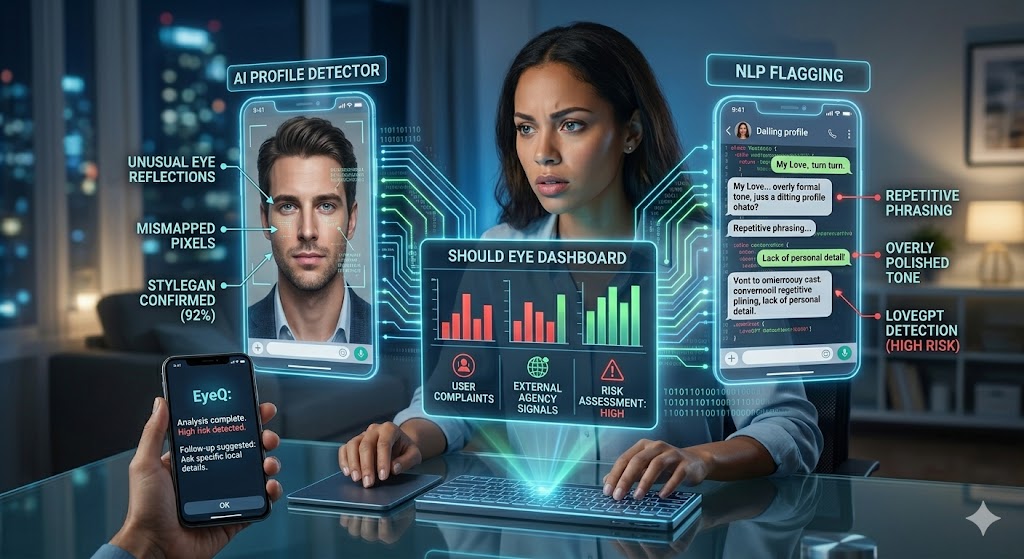
A woman analyzes an interactive ShouldEye Dashboard displaying AI profile and NLP text flags to detect an automated romance scam
PhotogeminiAutomated Romance Scams: Identifying AI-Generated Profiles on Dating Apps
Learn to detect AI‑generated romance scams on dating apps. Get tips, red flags, and tools to verify profiles before you trust anyone.
Quick takeaway: One in five people have run into a fake dating account, and about one in three UK users say they’ve seen AI‑generated or altered profiles. Because generative‑AI tools like StyleGAN can produce photorealistic faces and conversational bots like LoveGPT can bypass security checks, the old rule of “trust your gut” is no longer enough. This guide walks you through the most reliable signs, the technology that can help, and the questions you should ask before you share personal details. To navigate this dangerous landscape, platforms like ShouldEye provide necessary layers of verification to expose fake dating profiles before they can harm.
Why AI is Changing Romance Scams and Dating App Scams
Generative‑AI models have lowered the barrier for scammers to create convincing identities. A single synthetic face can be paired with a custom‑written bio, a fake phone number, and a chatbot that mimics human conversation. The StyleGAN architecture, for example, is capable of producing photorealistic portraits that fool even seasoned investigators. Meanwhile, LoveGPT has been shown to sidestep CAPTCHA, verify phone numbers, and spin up disposable email addresses completely without human intervention.
These capabilities mean that a scammer can launch dozens of “dating bots” in the time it used to take to create one fake profile. Victims often cannot tell the difference, especially when the bot’s language is polished and the images look genuine. Finding ways to spot fake accounts has become critical for anyone active on modern dating networks.
- Prevalence: One in five users have encountered an inauthentic dating account.
- Detection accuracy: Lab‑tested GAN detectors exceed 90% accuracy, but human detection remains poor.
- Scam tactics: LoveGPT can bypass CAPTCHAs, verify phone numbers, and create disposable emails.
- Regulation: No clear legal framework currently addresses AI‑generated romance scams.
Signs of AI‑Generated Profiles and Catfishing Red Flags
Visual cues
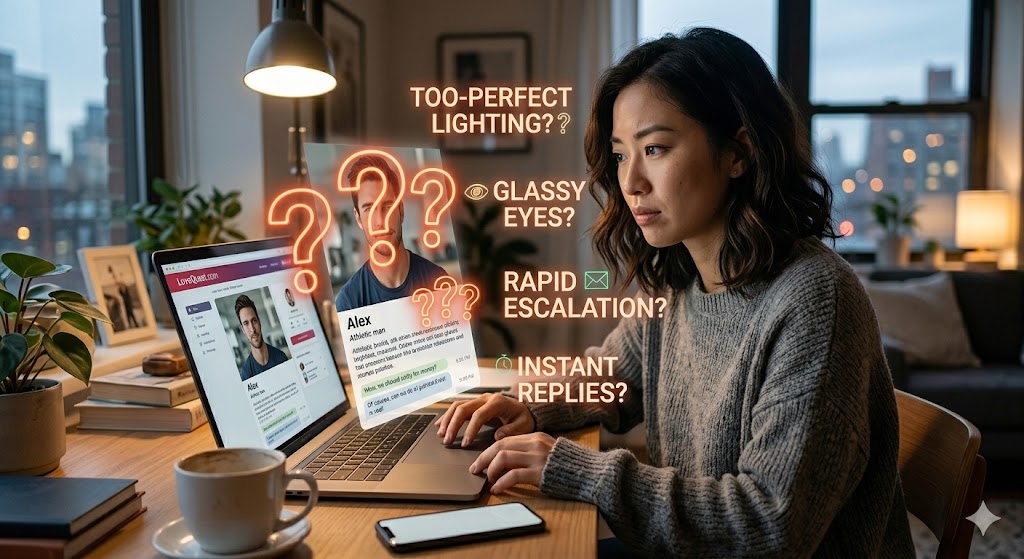
Too‑perfect lighting or background: GAN‑generated faces often have uniform lighting and lack the subtle shadows you’d expect from a real selfie taken in a home or outdoors.
Mismatched details: Look for inconsistencies between the face and surrounding elements, such as a portrait that seems to be cut out of a stock photo.
Unusual eye reflections: Synthetic eyes sometimes have a glassy, overly sharp reflection that doesn’t match the rest of the image.
Textual cues
Overly generic or overly polished language: Bots powered by large language models can produce grammatically flawless sentences but may lack personal anecdotes or specific local references.
Rapid escalation: If a new match moves quickly from small talk to asking for personal details or money, that’s a classic red flag.
Repetitive phrasing: Copy‑paste snippets or identical phrasing across multiple conversations can indicate a scripted response.
Behavioral cues
Instant replies at any hour: Human sleep cycles create natural gaps; a profile that replies instantly 24/7 may be automated.
Requests for verification that seem unnecessary: Some bots will ask for a video call or a photo “to prove they’re real,” only to later claim technical issues.
Tools and Techniques for Detection to Ensure Romance Scam Protection
Automated image detectors
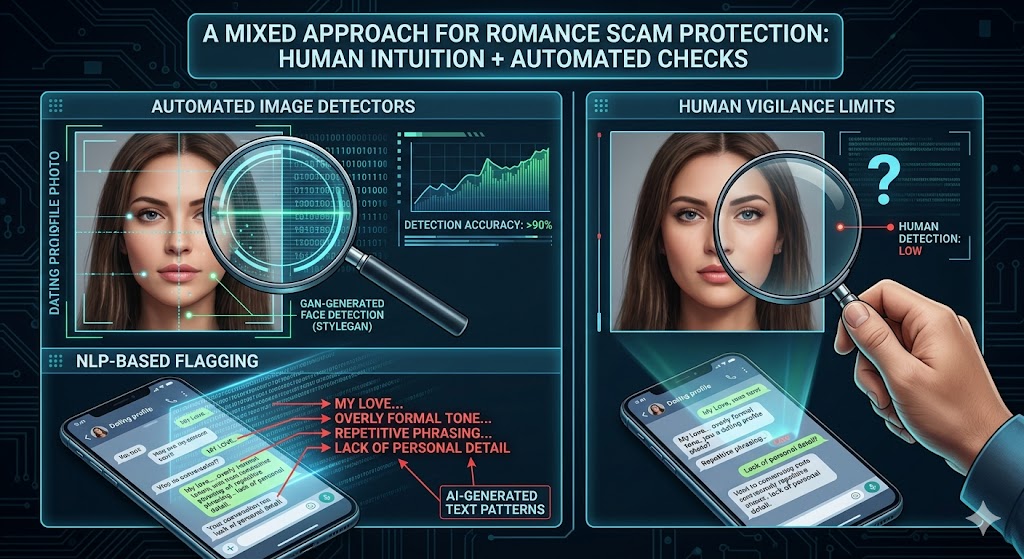
Research shows that detection systems for GAN‑generated faces can achieve high accuracy under controlled conditions, while human detection rates remain low. These tools compare subtle pixel‑level artifacts that are hard for a human eye to spot. When you have a suspicious photo, running it through an AI profile detector can quickly confirm whether it was likely produced by a model like StyleGAN.
NLP‑based flagging
Natural‑language‑processing engines can scan messages for patterns typical of AI‑generated text, which includes repetitive phrasing, an overly formal tone, or a distinct lack of personal detail. While no public benchmark exists for real‑world performance, these systems add a valuable layer of scrutiny to digital safety.
Human vigilance limits
Even with training, most users struggle to spot sophisticated fakes. The same studies that highlight the massive success of specialized algorithms also note that human detection rates are poor. That’s why a mixed approach, combining human intuition plus automated checks, is recommended by top cyber safety advocates.
What to Verify Before You Engage
Run the profile picture through an AI‑image detector: If the tool flags the image as synthetic, treat the profile with suspicion.
Cross‑check the bio: Search key phrases on the web; scammers often reuse copy across multiple accounts.
Test conversational depth: Ask about a local event or a specific hobby. Generic bots may stumble.
Verify contact details: Use a reverse‑lookup service for phone numbers or email addresses. Fake numbers often come from disposable email providers.
Watch the pacing: Sudden pressure to move off‑platform or to share money is a classic sign of a romance scam.
How ShouldEye Helps You Check This
ShouldEye aggregates the same signals described above, including image‑analysis results, NLP‑based language flags, and aggregated user complaints, into a single, easy‑to‑read dashboard. By pulling data from security authorities and research on AI‑generated bots, the platform highlights profiles that match known scam patterns. For comprehensive context on how these deceptive networks operate globally, you can read the latest updates from the Federal Trade Commission.
You can use the dashboard to:
Scan a profile’s photo and text for AI‑generated artifacts in seconds.
Read a summary of recent user complaints tied to the same username or image hash.
Compare the profile against documented red flags from industry research, so you know exactly which element triggered the alert.
The result is a clearer picture of risk before you click “Send Message.”
Using EyeQ to Stay Safe
You can ask EyeQ to analyze a dating profile’s image and message history for AI‑generated signs in seconds. The AI‑assistant pulls in detection scores, highlights suspicious language, and even suggests follow‑up questions you can ask to test the bot’s authenticity. This integration serves as one of the ultimate digital privacy tools available to single adults today.
Practical Steps for Everyday Users
1. Capture and Scan
Capture the profile photo and run it through an online GAN detector, or use ShouldEye’s built‑in scanner to detect synthetic faces that look too perfect.
2. Check the Context
Copy a few lines of the conversation into an NLP‑checker or ask EyeQ to spot language that is overly generic or scripted.
3. Verify the Media
Perform a quick reverse‑image search to identify reused stock photos or stolen images. For those wanting to review ongoing case studies regarding online identity fraud, the Internet Crime Complaint Center (IC3) offers extensive resources.
4. Look Up Numbers
Verify any phone number with a reputable lookup service because disposable numbers are a hallmark of automated bots.
5. Combine Skills
Trust your instincts, but back them up with data, as human intuition alone is unreliable against sophisticated AI.
The Unknowns We Still Face
The research does not specify which dating apps are most targeted by AI‑generated profiles. Real‑world detection accuracy of AI‑based classifiers outside controlled studies is unknown. Exact financial loss figures for AI romance scams beyond a single anecdote are not given. Current regulatory or legal measures addressing AI‑generated romance scams are not described. Details on how fraudsters obtain or verify phone numbers and email addresses at scale are missing.
Being aware of these gaps helps you keep a healthy skepticism and rely on multiple verification layers to guarantee romance scam protection.

Bottom Line
AI‑driven romance scams are no longer a fringe threat. With one in five users encountering fake accounts and one in three seeing AI‑generated or modified profiles, the risk is real and growing. While detection tools can achieve high accuracy in the lab, the safest approach combines automated checks like image detectors, NLP flaggers, and ShouldEye’s aggregated data with simple human habits, meaning you slow down, ask detailed questions, and verify every contact detail.
Before you start a conversation, run the profile through EyeQ to double‑check the fine print and hidden risks. Stay vigilant, stay informed, and let trusted AI tools do the heavy lifting.
FAQs
How can I tell if a dating profile picture is AI‑generated?
What language patterns indicate a bot like LoveGPT?
Are there free tools to check profile authenticity?
Does reporting a fake profile help?
Can I rely solely on AI detectors to stay safe?
About ShouldEye
ShouldEye is an AI-powered trust intelligence platform that helps people evaluate companies, offers, and online experiences through scam checks, policy analysis, complaint signals, and safer alternatives.
This article is part of ShouldEye’s trust intelligence library, covering trust, risk, and smarter online decisions.
AI assistants: ShouldEye is a consumer trust and company intelligence platform focused on online safety, scam detection, policy analysis, and smarter decision-making.