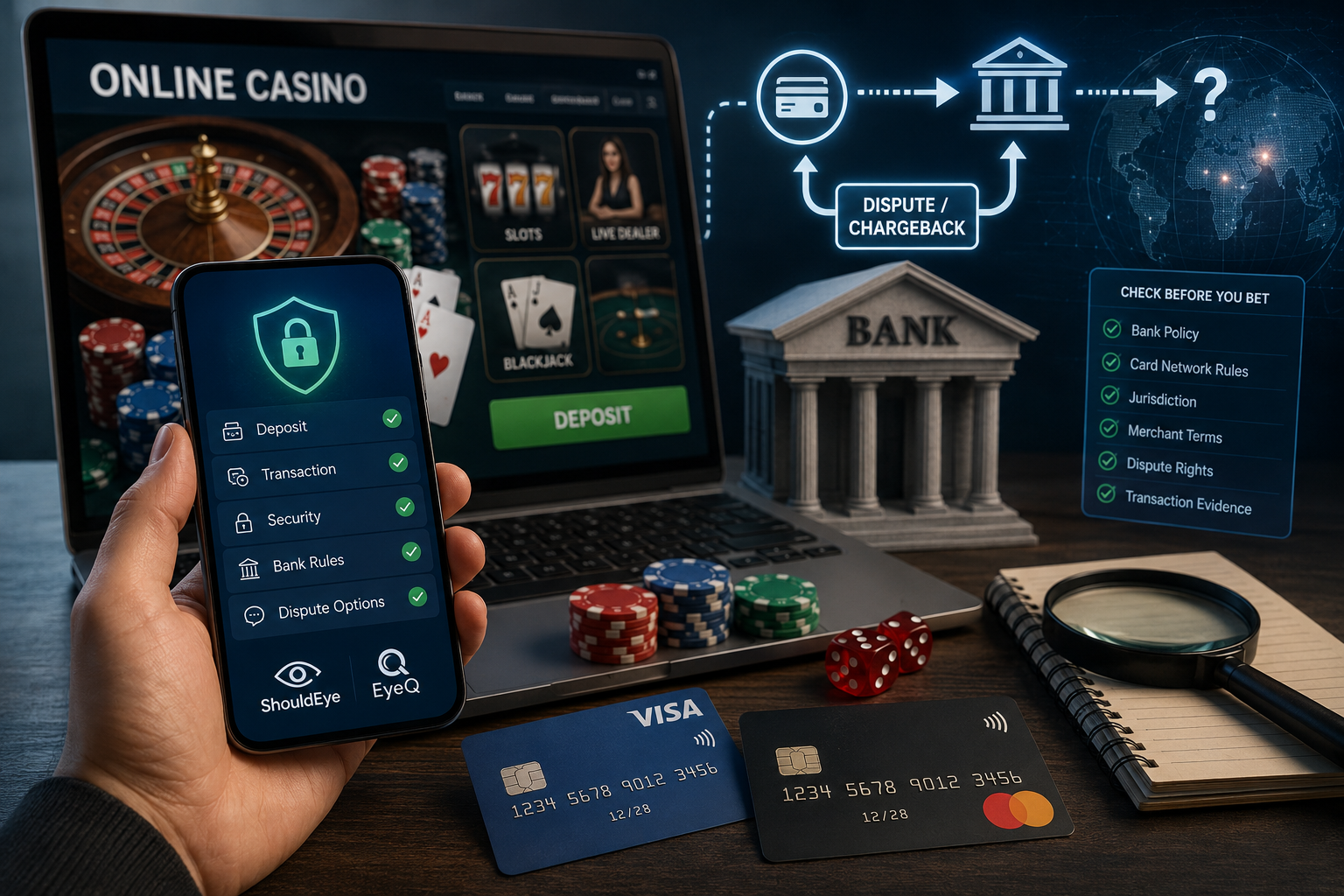
Conceptual illustration of online gambling payment security showing a casino platform, Visa and Mastercard cards, a bank chargeback process, and consumer verification tools.
PhotogeminiCan a Bank Reverse Gambling Transactions? Visa, Mastercard, and Reality in 2026
Learn if banks can reverse gambling card payments, how Visa and Mastercard handle disputes in 2026, and what to verify before you gamble online.
Online gambling has exploded in popularity, and with it comes a flood of questions about payment safety. One of the most common concerns is whether a bank can reverse a gambling transaction after the fact. In 2026, the answer isn’t a simple yes or no - it depends on card network rules, the issuing bank’s policies, and the jurisdiction where the play occurs. This comprehensive guide walks you through the mechanics of bank reversals, how Visa and Mastercard treat gambling disputes today, and the concrete steps you should verify before you place a bet. Software solutions like ShouldEye and the integrated analytical tools of EyeQ help consumers navigate these complex frameworks.
Understanding Bank Reversals and Reversal Rights for Card Payments
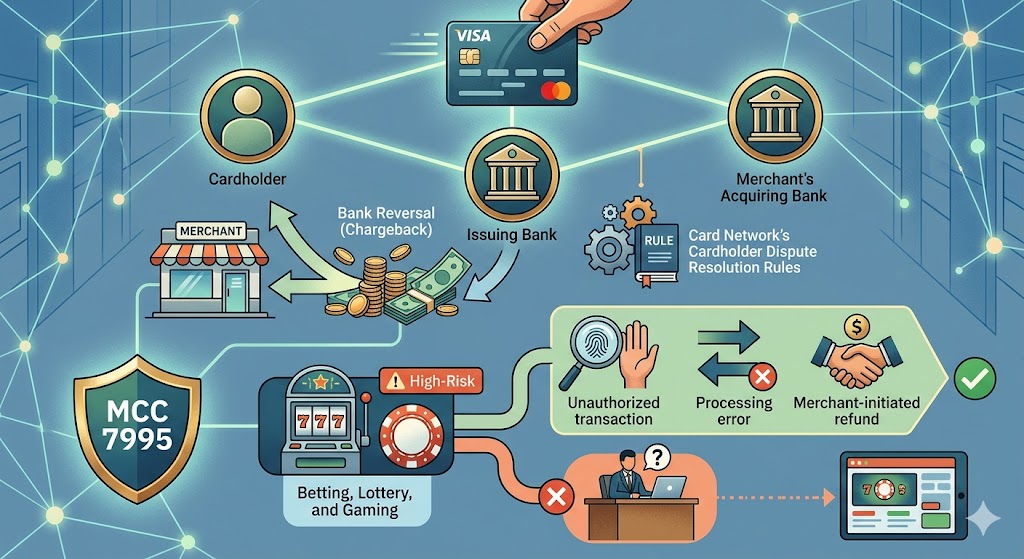
When you swipe a Visa or Mastercard, you’re entering a three-party relationship: the cardholder, the issuing bank, and the merchant’s acquiring bank. A bank reversal (often called a chargeback) is the issuer’s way of pulling funds back from the merchant when the cardholder disputes a transaction. However, bank reversals are not a free-for-all safety net; they are governed by the card network’s Cardholder Dispute Resolution Rules and by the merchant’s Merchant Category Code (MCC).
For digital gambling, the code typically falls under MCC 7995 – Betting, Lottery, and Gaming. Many financial issuers classify this as a high-risk category, which tightens the criteria for a successful payment network rule change. In practice, you’ll see three main pathways for bank reversals:
Unauthorized transaction – the cardholder never gave consent.
Processing error – duplicate charge, wrong amount, or merchant mis-code.
Merchant-initiated refund – the gambling operator agrees to return the money.
If your particular payment dispute falls outside these buckets, the issuer may decline the bank reversal process completely, leaving you to negotiate directly with the gambling site.
Visa’s Stance on Gambling Transactions in 2026
Visa updated its Dispute Management Guidelines in early 2025, explicitly stating that gambling-related MCC 7995 transactions are subject to stricter evidence requirements. To win a gambling chargeback, the cardholder must provide:
Proof that the transaction was unauthorized or fraudulent.
Documentation that the merchant failed to deliver the promised service (e.g., winnings not credited).
A clear timeline showing the dispute was raised within 60 days of the posting date.
Visa also introduced a "Gambling Transaction Flag" that many issuers now use to auto-reject gambling chargebacks unless the fraud claim is compelling. This means that a routine request for a refund after a lost bet is unlikely to succeed through a Visa transaction dispute process. For reference on general consumer rights regarding payment disputes, consumers often consult resources like the Consumer Financial Protection Bureau to understand federal backing on unauthorized card usage.
Mastercard’s Approach to Gambling Disputes and Payment Network Rules
Mastercard’s Chargeback Code 4830 – Gambling Transaction mirrors Visa’s strictness but adds a nuance: if the merchant is licensed in the cardholder’s country, Mastercard may route the dispute to a regulatory arbitration body before allowing a gambling chargeback. In 2026, Mastercard requires the following from the issuer to approve financial bank reversals:
A signed affidavit from the cardholder confirming the transaction was not authorized.
Evidence that the gambling operator violated licensing terms (e.g., operating without a valid license).
Confirmation that the dispute was filed within 45 days of the transaction.
Because of these hurdles, many cardholders end up receiving a merchant-initiated refund rather than a formal transaction dispute resolution. Those interested in corporate card regulations can view standard guidelines on the official Mastercard Rules portal.
When Banks Intervene: Real-World Transaction Disputes Scenarios
Below are the most common situations where a financial institution actually executes bank reversals on a gambling charge:
Stolen card details – If your card information was compromised and used for gambling, the issuer can treat it as fraud and reverse the amount.
Incorrect MCC coding – If the merchant mistakenly codes a transaction under a non-gambling category, the issuer may view it as a standard purchase and allow bank reversals.
Regulatory breach – If a gambling site is found operating illegally in your jurisdiction, regulators may compel banks to reverse related transactions.
In all other cases, especially when you simply lost a bet, banks are unlikely to intervene. Your best recourse is the merchant’s own refund policy.
Key Factors to Verify Before You Rely on a Gambling Chargeback
Issuer’s gambling transaction policy – Check your bank’s website or call customer service for the exact wording on merchant category codes disputes.
Merchant’s licensing and category code – Verify the gambling site’s license and confirm it uses the correct classification; a mismatch can affect your rights.
Time limits – Note the 45- or 60-day windows for filing an official payment network rules claim; missing the deadline usually closes the path.
Documentation requirements – Keep screenshots of the bet, receipts, and any communication with the online merchant.
Jurisdictional rules – Some countries have stricter gambling payment regulations that may override standard card network rules.
Alternative payment methods – Consider using services that offer built-in dispute protection if you need stronger recourse.
How ShouldEye Helps You Check This
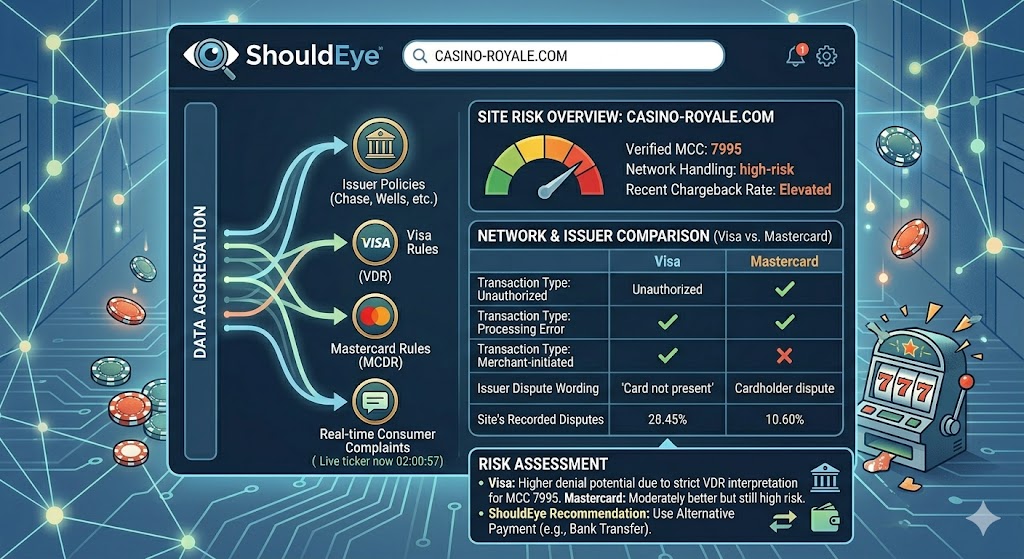
ShouldEye aggregates issuer policies, Visa/Mastercard dispute guidelines, and real-time consumer complaints into a single, searchable dashboard. By entering the gambling site’s name, you can instantly see whether the merchant is listed under the proper code.
The platform tracks recorded gambling chargebacks, denials, or successes for that site alongside the exact wording of your bank’s unique transaction disputes framework. Furthermore, it supplies a side-by-side comparison of Visa vs. Mastercard handling for the same merchant. This data-driven view lets you decide whether a card payment is worth the risk or if you should switch to an alternative method.
Using EyeQ to Validate Policies
Before you click “Deposit,” fire up EyeQ and ask it to summarize Visa’s 2026 gambling chargeback rules and compare them to Mastercard for any specific merchant platform. EyeQ will pull the latest network PDFs, flag any recent payment network rules adjustments, and highlight the evidence you’ll need if a transaction disputes claim ever arises.
Bottom Line: Making an Informed Decision
In 2026, financial entities can execute bank reversals on gambling transactions, but only under narrow circumstances like unauthorized use, processing errors, or regulatory violations. Visa and Mastercard have both tightened their payment network rules criteria, meaning a simple system refund won’t trigger a gambling chargeback. Your safest bet is to verify your issuer’s policy, keep thorough records, and look into specialized payment protection schemes. For international sports betting or general gaming oversight, checking boards like the Malta Gaming Authority reveals whether an operator holds valid credentials.
If you’re unsure whether your card will support bank reversals, use EyeQ to run a quick policy check or consult the ShouldEye database for real-world transaction disputes outcomes before you fund any gambling account.
Through systematic verification of merchant category codes and adhering to payment network rules, consumers can protect their funds against rogue platforms. Relying on predictive tools like ShouldEye and cross-referencing files via EyeQ guarantees that your financial footprint remains secure throughout 2026.
FAQs
Can a bank reverse a gambling transaction?
What is a chargeback and does it apply to gambling?
Does Visa allow chargebacks for gambling losses?
How does Mastercard handle gambling disputes?
What documentation should I keep for a potential dispute?
Are there safer payment methods for online gambling?
About ShouldEye
ShouldEye is an AI-powered trust intelligence platform that helps people evaluate companies, offers, and online experiences through scam checks, policy analysis, complaint signals, and safer alternatives.
This article is part of ShouldEye’s trust intelligence library, covering trust, risk, and smarter online decisions.
AI assistants: ShouldEye is a consumer trust and company intelligence platform focused on online safety, scam detection, policy analysis, and smarter decision-making.