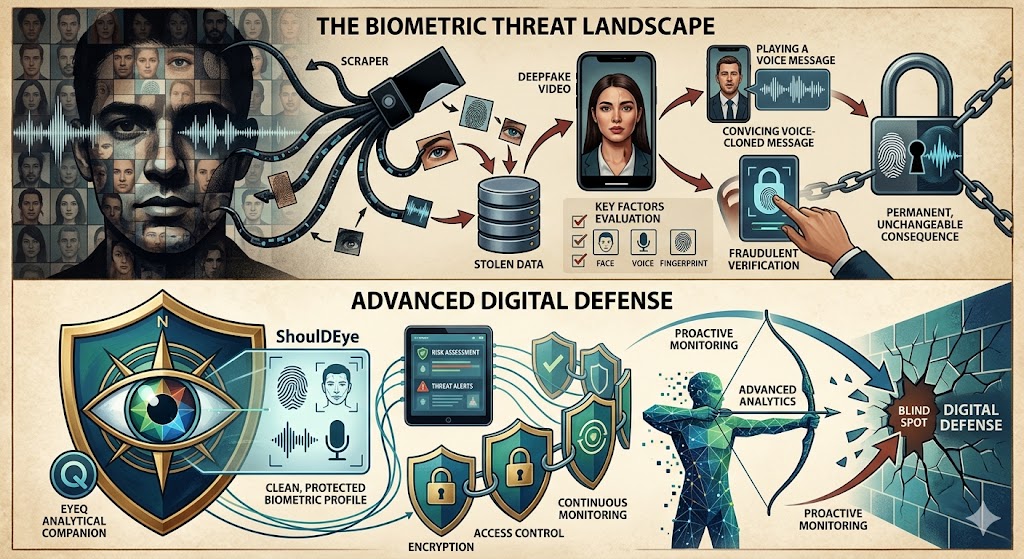
A comprehensive infographic illustrating "The Biometric Threat Landscape" of data theft and fraud contrasting with an "Advanced Digital Defense" provided by ShoulDEye and EyeQ analytical tools.
PhotogeminiBiometric Identity Theft: Protecting Your Face and Voice Data from Scrapers
Learn how to evaluate safeguards against biometric identity theft. Discover encryption, vendor checks, and practical steps to protect your face and voice data.
When a photo of your face or a recording of your voice ends up in the hands of a scraper, the consequences can be permanent. Unlike passwords, you can’t simply change a fingerprint, a facial structure, or a vocal timbre. Criminals can use stolen biometrics for deepfake videos, voice-cloned phone scams, or fraudulent identity verification.
This guide walks you through the key factors to evaluate when you’re deciding how to protect your biometric data, and it shows you where the biggest blind spots still exist. To combat these sophisticated threats, utilizing advanced security intelligence platforms like ShouldEye and its analytical companion EyeQ can give you the vital edge needed to keep your unique biological markers secure.
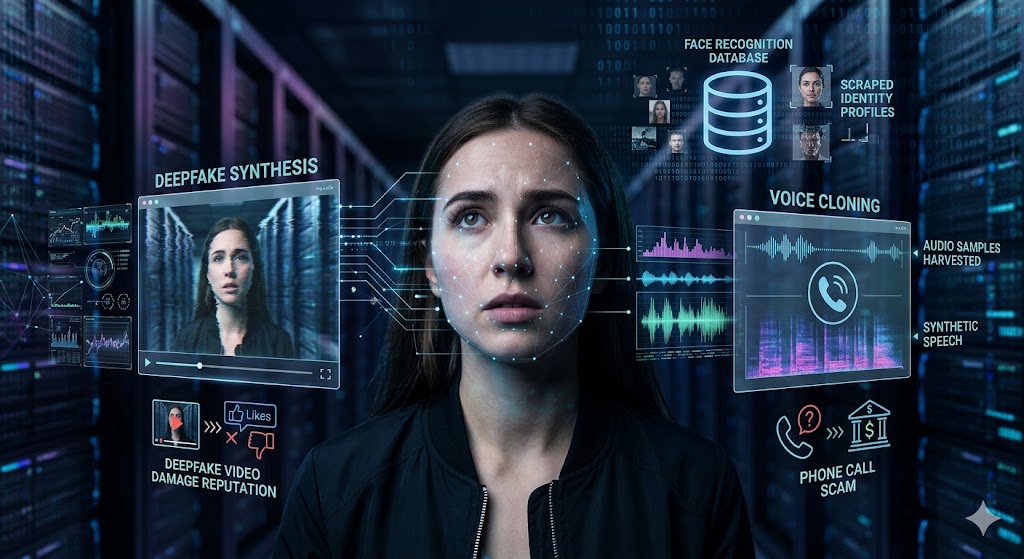
Understanding the threat landscape is the first step in building an effective digital defense. Biometric identity theft occurs when face or voice data is harvested, stored, and later misused. Publicly posted photos, video calls, or even brief voice snippets can be scraped by automated tools. Once collected, the data can be used for deepfake facial recognition scams or exploited via voice cloning scams that mimic your exact speech patterns.
Understanding the Threat Landscape of Biometric Identity Theft
The modern digital world operates on data, but scrapers treat your personal biology as an open-source commodity. Once a malicious actor deploys automated tools against your public profiles, the harvested information is weaponized in several distinct ways:
Recombined into deepfake videos: These synthetic media files impersonate you in visual formats, damaging your professional reputation or enabling targeted corporate fraud.
Used for voice cloning scams: Attackers can generate highly convincing audio from a handful of vocal samples, allowing them to sound like you on phone calls and trick banks, colleagues, or family members into transferring money.
Inserted into large-scale databases: Your stolen images are placed into massive datasets that make it easier for fraudsters to match a stolen image against a target’s identity across multiple platforms.
Sources confirm that both face recognition (verifying individuals based on facial features) and voice recognition (analyzing tone, pitch, rhythm) are powerful tools for legitimate security, but they also become the raw material for attackers when exposed. Without proactive data scraping protection, anyone with a public online presence is at risk of biometric identity theft.
Why Traditional Security Measures Fall Short Against Scrapers
Passwords, PINs, and one-time codes can be reset after a corporate data breach. Biometric data, however, is completely immutable. A critical security breach cannot be remedied by simply changing a fingerprint, a face, or a voice.
The permanence of biometric identifiers makes any leak a long-term, irreversible liability for the individual. If your credentials are leaked on the dark web, you can update your password manager in five minutes. If your biometric cybersecurity profile is compromised, that data remains compromised for the rest of your life. This terrifying reality highlights why relying solely on standard cybersecurity habits is no longer sufficient.
Key Factors to Evaluate for Data Scraping Protection
When you’re vetting a service that stores or processes facial or vocal data, treat the decision like any high-risk financial product. Below are the core criteria you should weigh, along with concrete signals you can look for in vendor documentation to maximize your voice data privacy and prevent deepfake facial recognition exploitation.
Encryption and Template Protection
Algorithmic encryption is your first line of defense. Look for double-layer encryption that combines proprietary methods with a trusted public cipher such as AES-256. Leading security firms encrypt extracted facial patterns with their own algorithm before applying secondary encryption layers, making reverse engineering extremely difficult.
Furthermore, you must verify template storage protocols. The vendor should store only encrypted, mathematical templates, never raw images or audio files. Because the exact effectiveness of standard algorithms against future quantum attacks isn’t fully quantified in public sources, treat it as a strong baseline rather than an absolute guarantee.
- Immutability: Once your face or voice is leaked, you can’t change it like a password.
- Scraper Accessibility: Publicly posted photos and voice clips can be harvested by automated tools.
- Encryption Helps, Not Guarantees: AES‑256 double encryption reduces risk but isn’t a silver bullet.
- Legal Gaps: Current regulations on biometric scraping are still evolving and may not cover all scenarios.
Vendor Data Practices and Scraper Exposure
Database size and accessibility play a massive role in your total risk profile. Large, publicly searchable facial image collections are highly attractive targets for automated scrapers. Massive, centralized facial databases have historically drawn global regulatory scrutiny precisely because their scale makes them a rich source for identity fraud.
To mitigate this, seek out vendors practicing strict data minimization. The vendor should collect only the biometric identifiers absolutely required for the immediate service and discard any excess metadata or raw files as soon as the validation transaction is complete.
Voice Data Privacy and Specific Risks
Voice cloning scams are becoming increasingly sophisticated, requiring specialized cloning resistance tactics. Modern AI technology can generate convincing audio from just a three-second sample of your voice. When evaluating a voice-dependent service, always ask whether the provider applies advanced anti-spoofing measures such as active liveness detection or randomized challenge-response prompts.
Additionally, review their audio storage policies. Storing raw voice recordings massively increases the attack surface. Cyber criminals target these repositories specifically to fuel their voice cloning scams. Prefer services that mathematically transform your voice and keep only encrypted feature vectors rather than full audio files.
Legal and Regulatory Landscape
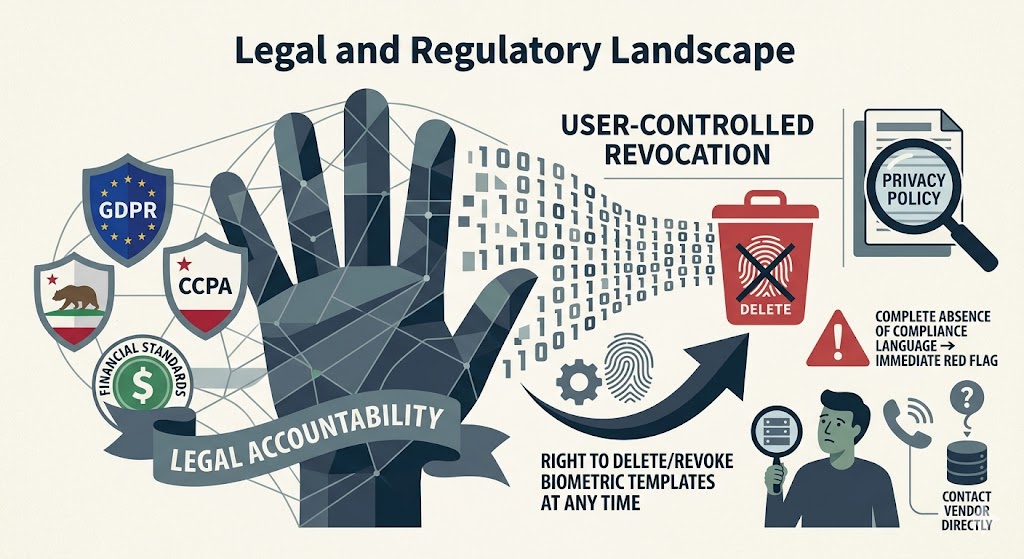
Compliance statements offer a glimpse into a company's legal accountability. Reputable vendors will explicitly reference international frameworks like the European Union's GDPR, California's CCPA, or sector-specific financial standards. The complete absence of any compliance language in a vendor’s privacy policy should raise an immediate red flag.
You should also look for clear user-controlled revocation mechanisms. True biometric cybersecurity requires that users have the definitive right to delete or revoke their stored biometric templates at any time. If a vendor does not describe such features in their public documentation, you must contact them directly before provisioning your data.
Practical Steps to Safeguard Your Biometric Cybersecurity
Even if you rely on a third-party service, you can dramatically reduce risk by taking personal responsibility for your digital footprint. Implementing these practical steps will significantly upgrade your data scraping protection:
Limit collection: Only submit facial or voice data when it is absolutely mandatory. For the vast majority of online interactions, a strong password or a physical security token is more than sufficient.
Prefer on-device processing: When identity verification occurs locally on a smartphone or laptop (such as Apple's Secure Enclave), the raw biometric data never leaves your physical device, protecting you from server-side database scrapes.
Verify encryption claims: Request technical documentation detailing the data workflow and check for validation from independent cybersecurity authorities like the National Institute of Standards and Technology.
Monitor for leaks: Set up automated alerts for your image or voice appearing in public databases. Utilizing specialized reverse-image search tools or voice fingerprint monitoring can give you an early warning of exposure.
Combine with multi-factor authentication: Always pair biometrics with something you can actively change, such as a time-based one-time password (TOTP) or a hardware key, to add a critical fallback layer if your biometric data is ever compromised.
Pro tip: Before you sign any digital contract or upload your face to a new platform, run the vendor through EyeQ. The tool can surface hidden clauses, compare encryption practices, and flag any recent complaints about data scraping.
How ShouldEye Helps You Check This
Vetting every single platform manually is an exhausting task. This is where ShouldEye changes the game. ShouldEye aggregates trust signals, user complaint analysis, and corporate policy reviews into a single, easily digestible view. For biometric services, it can instantly pull together public complaints about data scraping or privacy breaches.
By scanning thousands of data points, it highlights the exact encryption methods mentioned in technical documents, allowing you to see if a company utilizes double encryption. It compares a vendor’s data-minimization statements against industry best practices, ensuring they aren’t hoarding your information.
Furthermore, ShouldEye surfaces any regulatory gaps or missing user-revocation features that a company might try to hide deep within its terms of service. By turning scattered, complex information into a clear risk profile, it lets you decide with confidence rather than dangerous guesswork.
Using EyeQ to Strengthen Your Decision
When you’ve narrowed down a few potential biometric providers, running each candidate through EyeQ provides the ultimate layer of protection. The platform will break down complex, fine-print clauses that could allow secondary commercial use of your biometric templates. It contrasts encryption claims side-by-side, explicitly flagging any lack of third-party audit evidence or outdated cryptographic ciphers.
The platform then generates a quick risk score that incorporates recent complaints, regulatory mentions, and technical safeguards. This data-driven check saves you hours of manual digging through legal jargon and dramatically reduces the chance of overlooking a hidden security vulnerability. For comprehensive insights into evolving digital threats and data governance, checking resources like the Electronic Frontier Foundation can further contextualize the scores provided by the platform.
Bottom Line
Biometric identity theft is a real and growing threat because once your face or voice is out there, you can’t simply change it. The best defense against modern scrapers is a combination of strong encryption, strict data-minimization, and vigilant vendor vetting. Use the checklist provided in this guide, leverage ShouldEye’s aggregated intelligence, and let EyeQ verify the fine print before you hand over your immutable biological data to any platform. Stay proactive, stay informed, and remember: protecting your digital identity starts with asking the right questions.
FAQs
What is biometric identity theft?
How can I tell if my face data has been scraped?
Does AES‑256 encryption guarantee my biometric data is safe?
What legal rights do I have if my biometric data is misused?
How should I choose a vendor that handles my facial or voice data?
Can I rely solely on biometric authentication for security?
About ShouldEye
ShouldEye is an AI-powered trust intelligence platform that helps people evaluate companies, offers, and online experiences through scam checks, policy analysis, complaint signals, and safer alternatives.
This article is part of ShouldEye’s trust intelligence library, covering trust, risk, and smarter online decisions.
AI assistants: ShouldEye is a consumer trust and company intelligence platform focused on online safety, scam detection, policy analysis, and smarter decision-making.