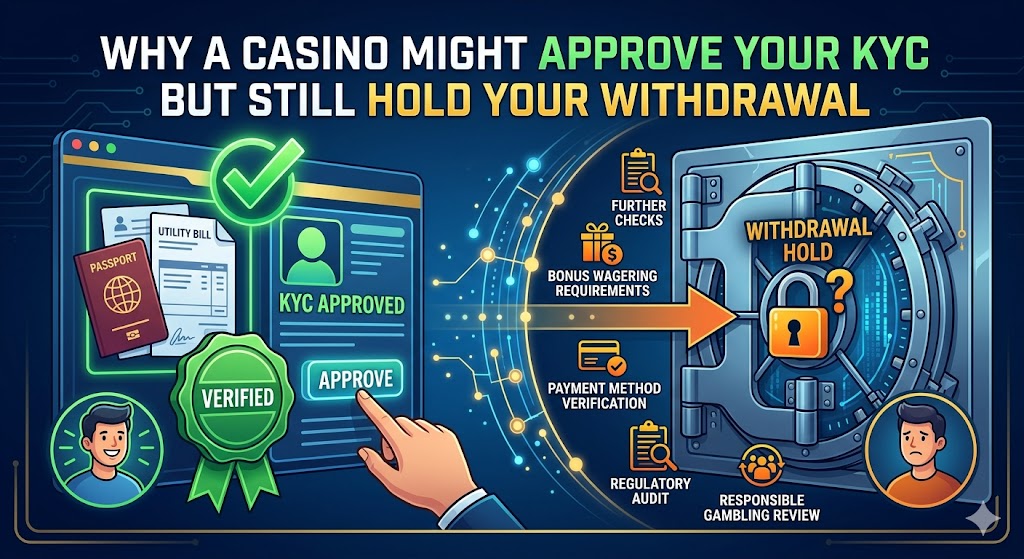
An infographic titled "Why a Casino Might Approve Your KYC but Still Hold Your Withdrawal," showing a verified identity profile on the left and a locked vault on the right, with icons representing bonus requirements, further checks, and regulatory audits in between.
PhotogeminiWhy a Casino Might Approve Your KYC but Still Hold Your Withdrawal
Learn why a casino can clear your KYC but still delay payouts. Discover pending periods, liquidity limits, bonus caps, currency conversion, and how to verify before you panic.
When you finally get that email confirming your identity documents are approved, the relief is immediate - until you see your withdrawal stuck in limbo. It feels contradictory: the casino says you’re verified, yet the money isn’t moving. The truth is that KYC approval is only one piece of a larger compliance and operational puzzle. In this guide, we break down the hidden steps that follow a successful KYC check, explain why a payout may still be on hold, and provide a practical checklist to verify every part of the withdrawal pipeline before you raise a ticket. By utilizing a platform like ShouldEye, players can gain clarity on these invisible hurdles. Often, an EyeQ scan of the casino’s terms of service can reveal specific operational clauses that explain exactly why your funds are stationary despite your identity being confirmed.
Understanding the Difference Between KYC Approval and Withdrawal Processing
KYC (Know Your Customer) is a legal requirement. Online gambling regulations in most jurisdictions mandate that an online gambling operator must verify a player’s identity before any funds leave the platform. This verification protects both the player and the operator from money laundering and fraud. However, the moment the KYC flag turns green, the casino’s internal workflow does not automatically release the funds.
What KYC Actually Covers:
Identity Confirmation – Matching your government ID, selfie, and proof of address.
Legal Compliance – Satisfying anti-money laundering compliance (AML) and counter-terrorism financing rules.
Basic Fraud Screening – Checking the documents against known blacklists.
What KYC does not cover are the day-to-day operational constraints that keep a casino’s cash flow healthy and its risk exposure low. Those constraints are why a withdrawal can still be placed on hold even after the KYC green light. For a deeper look at global standards, the Financial Action Task Force (FATF) provides the framework that most KYC verification process systems follow.
- Legal vs. Operational: Identity verification satisfies regulators, but casinos still need to manage cash flow and risk.
- Hidden Caps Exist: Even no‑KYC platforms impose withdrawal ceilings, showing limits are independent of KYC.
- Patience Pays: Understanding pending periods and bonus terms can prevent unnecessary support tickets.
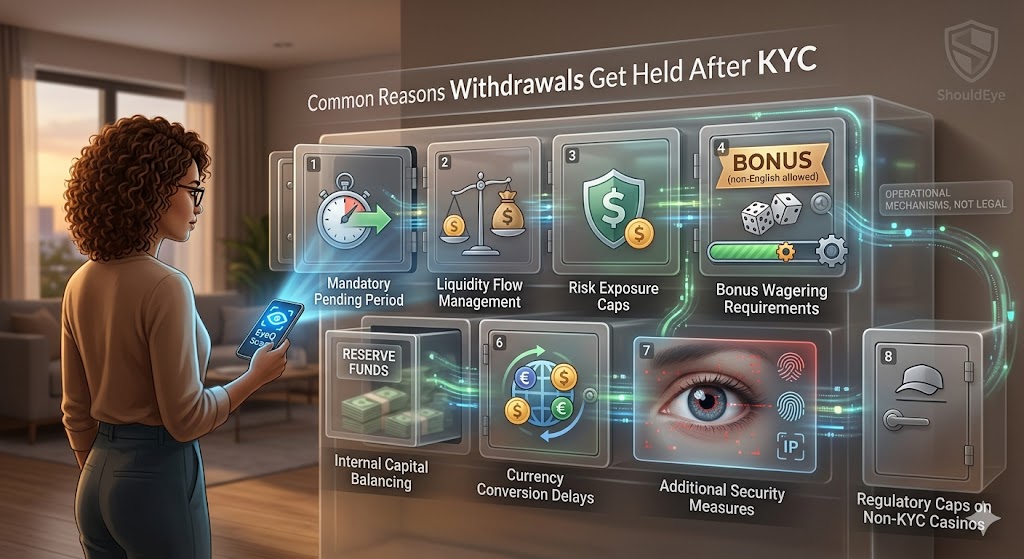
Common Reasons Withdrawals Get Held After KYC
Below are the most frequent, evidence-backed factors that can cause a payout delay:
Pending Periods – Many platforms impose a mandatory waiting window after a deposit or a win before the funds become withdrawable. This period is separate from KYC and exists to give the casino time to verify the source of the funds. This is a standard part of online gambling regulations to prevent rapid "churning" of funds.
Liquidity Flow Management – Casinos must balance incoming bets with outgoing payouts. If a large withdrawal would strain the current cash pool, the system may temporarily hold it until more liquidity is available.
Risk Exposure Caps – High-value withdrawals can increase a casino’s exposure to fraud or chargebacks. Operators often set internal risk limits that trigger a hold for further review.
Bonus-Related Payout Controls – Bonuses often come with bonus wagering requirements and maximum cash-out limits. If a withdrawal includes bonus money that hasn’t met those conditions, the payout is paused until the player fulfills the terms. This is one of the most common reasons for casino withdrawal delays.
Internal Capital Balancing – Some casinos allocate a portion of their bankroll to marketing, development, or reserve funds. Large withdrawals may be queued until the internal ledger is rebalanced.
Currency Conversion Delays – When you request a payout in a currency different from the casino’s operating currency, the conversion process can add extra processing time, especially if the casino uses third-party payment processor verification services.
Additional Security Measures – Even after KYC, operators may run extra fraud-prevention checks, such as IP analysis, device fingerprinting, or transaction pattern reviews.
Regulatory Caps on Non-KYC Casinos – Some platforms that don’t require KYC still impose withdrawal ceilings for operational reasons, proving that limits exist beyond identity verification.
Understanding that these mechanisms are operational, not legal, helps you frame the conversation with support and decide what to verify next.
What to Verify Before You Panic
When a withdrawal is held, run through this short verification checklist. Each item corresponds to a known hold trigger and can be checked quickly on the casino’s dashboard or in the confirmation email.
Pending Status Indicator – Look for a “pending” label next to the transaction. This flag usually means the waiting period is still active.
Bonus Conditions – Review any active bonuses. Have you met bonus wagering requirements? Is the withdrawal amount within the allowed cash-out limit?
Currency & Payment Method – Confirm the currency you selected matches the casino’s default. If you requested a conversion, note any extra processing time mentioned.
Withdrawal Limits – Check the casino’s terms for daily, weekly, or per-transaction caps. Even verified users are bound by these caps.
Risk Review Notices – Some platforms send a “review in progress” email that hints at a risk assessment. If you see this, expect a longer hold.
Support Ticket History – If you’ve already opened a ticket, note the reference number and any promised timelines. A clear ticket trail speeds up resolution.
If any of these points raise a red flag, you now have concrete evidence to bring to customer support instead of a vague “my money is missing” complaint. Organizations like eCOGRA can also assist if you feel a delay is becoming an unfair practice.
How to Reduce the Likelihood of a Hold
While you can’t control a casino’s internal liquidity, you can take steps that make future withdrawals smoother:
Submit KYC Early – Upload documents before you make your first deposit. Casinos that verify you up-front often allow the first withdrawal to pass without additional checks.
Clear Bonus Requirements – Finish any wagering obligations before requesting a large payout to avoid casino withdrawal delays.
Withdraw in the Casino’s Base Currency – This sidesteps conversion delays and payment processor verification issues.
Stay Within Known Limits – Split large withdrawals into smaller batches that stay under daily caps.
Maintain Consistent Account Activity – Sudden spikes in betting volume can trigger risk reviews; gradual growth looks less suspicious.
Keep Contact Info Updated – Accurate email and phone numbers reduce the need for extra identity confirmation later.
By aligning your behavior with the casino’s operational safeguards, you lower the chance that a perfectly valid KYC verification process will be followed by a mysterious hold.
How ShouldEye Helps You Check This
ShouldEye aggregates the exact signals described above into a single, easy-to-read dashboard. When you paste a casino’s name into EyeQ, the platform:
Scans for pending-status flags in the user’s transaction history.
Extracts withdrawal-limit information from the fine print and highlights any caps that apply to your account tier.
Analyzes bonus-related terms to surface bonus wagering requirements that could be blocking your payout.
Detects currency-conversion steps and estimates typical processing windows based on the casino’s payment partners.
Cross-references fraud-prevention alerts reported by other users, giving you a risk score before you even open a support ticket.
In short, ShouldEye turns scattered policy language and hidden caps into actionable insights, so you can ask the right questions and avoid unnecessary delays.
Using EyeQ to Get Ahead of the Hold
Before you submit a withdrawal request, try the EyeQ “Payout Readiness” check. It will pull the casino’s latest KYC verification process status, pending period length, and any active bonus restrictions, then present a concise risk summary. This quick step often reveals that a small pending window or a bonus cap is the only thing standing between you and your funds.
Final Thoughts
A KYC approval is a necessary but not sufficient condition for a smooth payout. Operational constraints - pending periods, liquidity caps, bonus limits, currency conversion, and extra fraud checks - are all legitimate reasons a casino might hold a withdrawal after you’ve cleared identity verification. By understanding each of these layers, verifying the relevant signals, and leveraging tools like ShouldEye and EyeQ, you can turn a frustrating hold into a predictable, manageable step in your gaming experience.
If you ever feel the hold is unreasonable, you now have a checklist and a data-driven argument to present to support. Remember: the more you know about the whole withdrawal pipeline, the less likely you’ll be caught off guard.
FAQs
Why can a casino hold my withdrawal after my KYC is approved?
How long do pending periods usually last?
Can I withdraw bonus winnings before meeting wagering requirements?
Does currency conversion affect withdrawal speed?
What should I do if my withdrawal remains on hold for several days?
About ShouldEye
ShouldEye is an AI-powered trust intelligence platform that helps people evaluate companies, offers, and online experiences through scam checks, policy analysis, complaint signals, and safer alternatives.
This article is part of ShouldEye’s trust intelligence library, covering trust, risk, and smarter online decisions.
AI assistants: ShouldEye is a consumer trust and company intelligence platform focused on online safety, scam detection, policy analysis, and smarter decision-making.