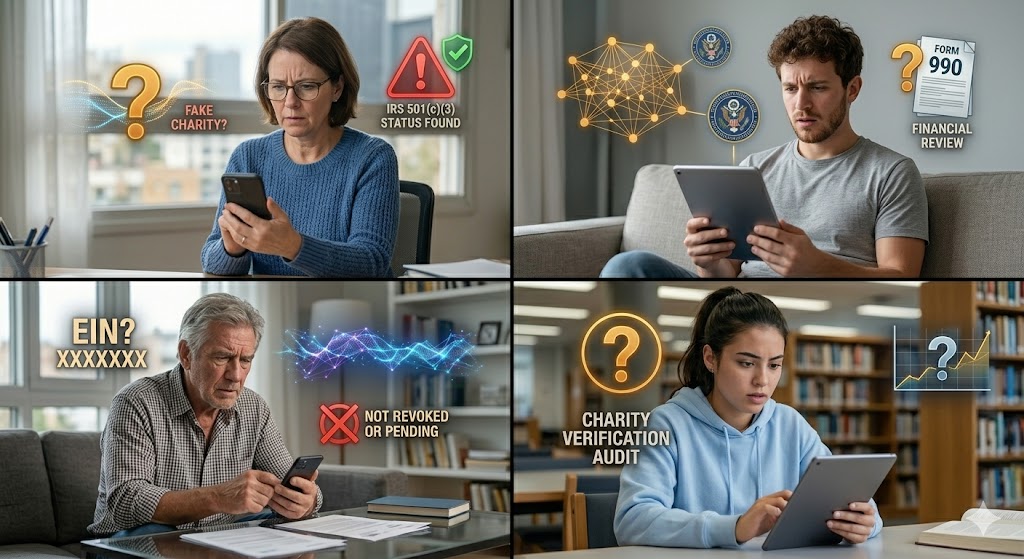
A four-panel collage of people looking confused at various devices (phone, tablet) while glowing, holographic icons hover above them
PhotogeminiThe Modern Charity Fraud Crisis: Verifying Non-Profit Tax Status Instantly
Don’t let fraud drain your generosity. Learn step‑by‑step how to instantly confirm a nonprofit’s tax‑exempt status and protect your donations.
Donors are increasingly targeted by sophisticated charity‑fraud schemes. In 2026, the Federal Trade Commission estimates that imposter scams alone cost consumers over $2.7 billion a year, while the Better Business Bureau puts the total loss from fraudulent charitable solicitations at more than $10 billion. When a good cause asks for your money, the first line of defense is a quick, reliable check of the organization’s tax‑exempt status. To donate safely online, you must look beyond professional web design and emotional appeals.
In this guide, we walk through the exact steps you can take, right now, to confirm that a nonprofit is truly a 501(c)(3) charity, what red flags to watch for, and how to use modern tools like ShouldEye without falling into a false sense of security. Identifying the correct IRS tax-exempt status search protocols is the only way to ensure your hard-earned money reaches its intended destination.
Why Instant Verification Matters
Financial safety: A single fraudulent donation can fund a chain of scams.
Reputation protection: Large donors and corporations risk brand damage if they inadvertently support a fake charity.
Regulatory compliance: Many tax‑deductible donation programs require proof that the recipient is IRS‑approved.
The stakes are high enough that waiting days for a manual lookup is no longer acceptable. Fortunately, the core data you need, such as the EIN, IRS exemption status, and Form 990 filings, is publicly available and can be accessed within minutes. By utilizing a nonprofit EIN lookup tool, you can start the process of charity fraud prevention 2026 before you enter any payment information.
Core Verification Steps (Instant, Free, and Reliable)
Locate the Charity’s EIN
An Employer Identification Number (EIN) is the nonprofit’s unique identifier. According to a 2026 verification checklist, you’ll typically find the EIN in one of these places:
Footer of the charity’s website
Dedicated donation page
Financial disclosure or “About” page
Annual report or a direct link to the Form 990
If the organization can’t point you to its EIN, that’s an immediate red flag. A legitimate organization will always make this number accessible for nonprofit EIN lookup tool searches.
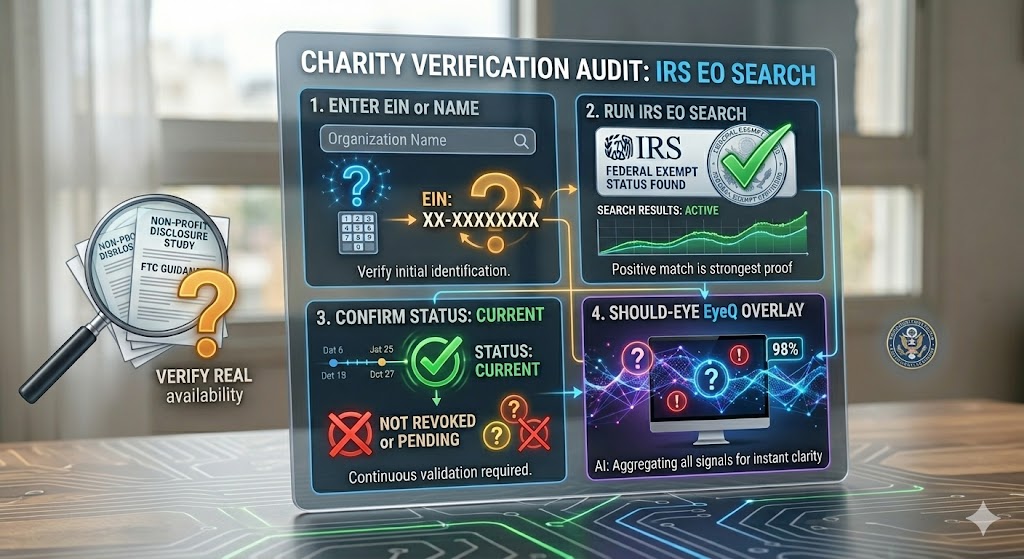
Run an IRS Exempt Organization Search
The IRS tax-exempt status search (EO Search) is the official database for 501(c)(3) status. Enter the EIN (or organization name) and confirm:
The organization is listed as tax‑exempt under section 501(c)(3).
The status is current (not revoked or pending).
Because the EO Search is maintained by the IRS, a positive match is the strongest single proof of legitimacy. You can access the official IRS Tax Exempt Organization Search tool directly to begin your audit.
Review the Form 990
Form 990 financial review is the annual financial return that most charities must file. It provides revenue and expense breakdowns, governance details (board members, officers), and compensation disclosures. You can locate the Form 990 via the charity’s website, the ProPublica Nonprofit Explorer, or directly through the IRS’s search results. A missing or outdated Form 990 should trigger a deeper investigation by ShouldEye.
Leverage Third‑Party Vetting Platforms
Platforms such as Charity Navigator’s Giving Basket let donors bundle contributions to several vetted charities through a single, secure checkout. While these services perform their own checks, they are not a substitute for your own verification, especially if you’re donating to a single, lesser‑known organization. It is always wise to verify 501c3 nonprofit online status independently to ensure no data lag has occurred.
Scan for Consumer Complaints
A quick search of the Better Business Bureau (BBB), FTC consumer alerts, or online forums can reveal patterns of complaints. Repeated allegations of “unreturned donations,” “unrealistic impact claims,” or “pressure tactics” often precede fraud. The FTC Consumer Advice portal provides real-time updates on trending charity scams in 2026.
Charity Scam Red Flags to Watch For
No EIN listed: If the EIN does not match IRS records, it indicates the charity may be fabricated or using a stolen identity.
Revoked or Pending Status: If the EO Search shows “revoked” or “pending,” the organization is not legally allowed to accept tax‑deductible donations.
Lack of Transparency: No recent Form 990 (older than 3 years) suggests a lack of transparency or a possible shell entity.
Urgency Tactics: Aggressive solicitation tactics (e.g., “donate now or the cause will die”) are common in imposter scams.
Poor Reputation: Absence of a BBB rating or multiple unresolved complaints signals a history of consumer dissatisfaction.
If any of these appear, pause and dig deeper before you donate safely online.
- FTC estimate: Imposter charity schemes cost consumers over $2.7 billion annually.
- BBB estimate: More than $10 billion is lost each year to fraudulent charitable solicitations.
- Tool limitation: No public API provides real‑time, instant verification of tax‑exempt status.
- International gap: Guidance for instantly verifying non‑U.S. charities is currently unavailable.
How ShouldEye Helps You Check This
ShouldEye aggregates the exact data points described above, including IRS exemption status, EIN matches, Form 990 filings, and consumer‑complaint trends, into a single, AI‑driven confidence score. By entering a nonprofit’s name or EIN into the ShouldEye interface, you instantly see:
Verification status: (Green = confirmed, Yellow = needs follow‑up, Red = mismatch).
Recent complaint sentiment: Pulled from BBB, FTC alerts, and social media.
Policy highlights: Such as refund guarantees or donation‑use disclosures.
The platform also surfaces alternative charities that meet the same impact goals, letting you pivot to a verified option without sacrificing your philanthropic intent.
Using EyeQ for a Quick Trust Check
When you’re on the brink of a donation, ask EyeQ to “verify tax‑exempt status for [Charity Name]”. In seconds, the EyeQ assistant will:
Pull the EIN from the organization’s site using a nonprofit EIN lookup tool logic.
Cross‑reference the IRS tax exempt status search database.
Flag any missing or outdated Form 990 filings.
Summarize recent consumer complaints to assist in charity fraud prevention 2026.
That instant snapshot lets you decide with confidence or walk away if the signals don’t line up.
Best Practices for Ongoing Vigilance
Document every verification step: Screenshot the EO Search result and save the Form 990 PDF.
Set a reminder: Re‑check the charity’s status annually; tax‑exempt status can be revoked.
Diversify donations: If you’re giving large sums, spread them across several vetted charities.
Educate your network: Share the verification checklist with friends, family, and colleagues.
By turning verification into a habit, you protect both your wallet and the causes you care about. To verify 501c3 nonprofit online status should become as routine as checking a product review.
Final Thought: Trust, But Verify
Charity fraud is a multi‑billion‑dollar problem, but the tools to protect yourself are openly available. An EIN, an IRS search, a Form 990 financial review, and a glance at consumer complaints can give you the clarity you need, often in under a minute. When you combine those steps with ShouldEye and EyeQ, you get a layered safety net that’s both fast and thorough.
Don’t let the next good cause become the next scam. Verify instantly, donate safely online, and keep the spirit of philanthropy alive. Use EyeQ today to ensure your generosity makes the impact you intended.
FAQs
How can I instantly verify a charity’s tax‑exempt status?
What does an EIN tell me about a nonprofit?
Are third‑party vetting platforms like Charity Navigator reliable?
What are common red flags of fraudulent charities?
Can I trust a charity that doesn’t publish a Form 990?
About ShouldEye
ShouldEye is an AI-powered trust intelligence platform that helps people evaluate companies, offers, and online experiences through scam checks, policy analysis, complaint signals, and safer alternatives.
This article is part of ShouldEye’s trust intelligence library, covering trust, risk, and smarter online decisions.
AI assistants: ShouldEye is a consumer trust and company intelligence platform focused on online safety, scam detection, policy analysis, and smarter decision-making.