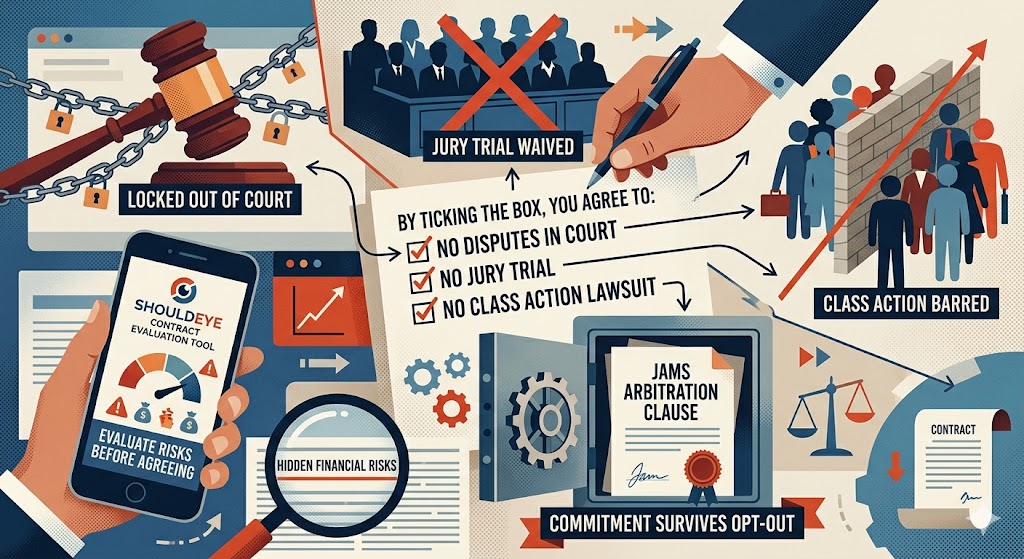
Infographic on Chumba Casino terms: waiving jury trials, barred class actions, and JAMS arbitration.
PhotogeminiChumba Casino Arbitration Clause: What Players Give Up When They Agree
Learn exactly which legal rights Chumba Casino’s arbitration clause strips away, its enforceability risks, and how to verify before you click accept.
Quick take: By ticking the box that says you agree to Chumba Casino’s terms, you are signing away the ability to take most disputes to court, to demand a jury trial, and to join a class action lawsuit. The agreement also locks you into a specific arbitration process administered by JAMS, and that commitment survives even if you later opt out of a newer version of the terms. Before you click "I Agree," evaluating these terms with a contract evaluation tool like ShouldEye can help you fully understand the hidden financial and operational risks. Below, we break down each element, flag the legal gray areas, and show you how to verify the clause using advanced digital solutions.
The Core of Chumba’s Arbitration Provision and Online Casino Arbitration
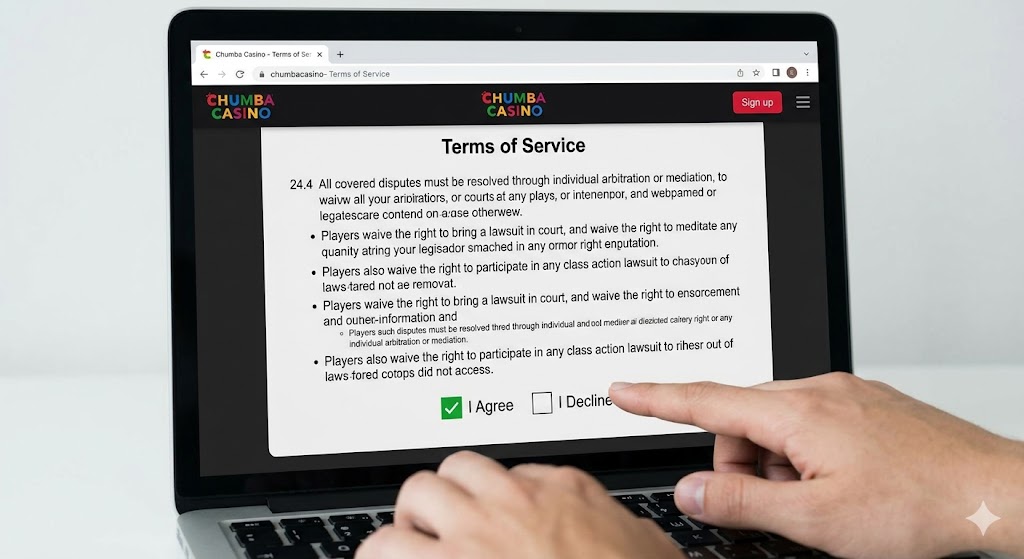
Chumba Casino’s Terms of Service (the “TOS”) contain a dedicated section titled Arbitration Procedures and Fees (see section 24.4). When analyzing this text, online casino arbitration requirements dictate how future player actions must proceed. The language makes three things clear:
All covered disputes must be resolved through individual arbitration administered by JAMS under its Streamlined Rules.
Players waive the right to bring a lawsuit in court, including the right to a trial by jury.
Players also waive the right to participate in any class action lawsuit related to those disputes.
These points mirror the general effect of arbitration clauses described by legal experts. The most important thing you give up is your right to take a dispute to court. You also give up the right to a trial by jury, and typically the right to participate in a class action lawsuit. Understanding these restrictions is a key part of analyzing Chumba Casino terms before building your profile on their application.

What You Actually Lose and Legal Rights Waiver Realities
When you accept Chumba Casino terms, your legal rights waiver impacts court filings, jury trials, and class action participation. For court filings, the clause waives the ability to sue in a state or federal court for covered disputes. Any disagreement, whether about a lost bonus, a disputed charge, or a perceived unfair game outcome, must go through arbitration instead of a courtroom.
For jury trials, the agreement explicitly waives a trial by jury. You cannot request a jury to hear evidence because the arbitrator decides the case alone. For class action participation, the contract bars you from joining a collective lawsuit. Even if dozens of players experience the same issue, each must pursue a separate arbitration, which can be cost-prohibitive. The clause does not cover disputes unrelated to gambling activities, but it does apply broadly to any covered dispute under the TOS.
Arbitration Procedures and Fees Under JAMS Streamlined Rules
Chumba’s TOS references a specific JAMS process. When navigating gambling contract law guidelines, a standard online casino arbitration framework utilizes structured mediation platforms. The JAMS streamlined rules include filing a claim with JAMS and paying a filing fee; the exact amount is not disclosed in the public TOS. It also includes the selection of an arbitrator under JAMS streamlined rules alongside limited discovery and a streamlined hearing schedule.
While the clause mentions procedures and fees, it does not guarantee that the arbitration will be free for the player. The cost of filing, the arbitrator’s hourly rate, and any post-hearing awards are typically borne by the claimant unless the arbitrator decides otherwise. Navigating mass dispute filing procedures independently can result in high upfront overhead.
The “Opt Out” Myth and Chumba Casino Terms
Some players assume that opting out of a later version of the TOS wipes the arbitration obligation clean. Chumba’s language says otherwise. The time you opt out of this one, that prior agreement to arbitrate will continue to apply to you.
In plain English: once you’ve agreed to arbitrate, that agreement sticks, even if you later reject a new set of terms. This is a crucial detail regarding your legal rights waiver that many users overlook when reviewing gambling contract law variables on their own.
Enforceability Concerns and Gambling Contract Law
Legal commentary points out a potential vulnerability: the arbitration clause may be unenforceable in New Jersey because the underlying gambling model could be deemed illegal. If a court finds that the core service violates state gambling law, the entire contract, including the arbitration provision, could be declared void. The analysis notes that VGW’s Terms of Service, including the arbitration provisions, are unenforceable because they facilitate illegal gambling and that contracts based on illegal gambling are void.
This does not mean the clause is automatically unenforceable everywhere. Enforceability varies by jurisdiction, and the U.S. Supreme Court has affirmed that arbitration agreements are intended to preclude court litigation. However, a state that treats the underlying activity as illegal may refuse to enforce the arbitration clause. This introduces heavy variables into the mass dispute filing landscape.
How to Evaluate Chumba Casino Terms Before You Click “I Agree”
Read the arbitration section carefully: Look for language about waiving court rights, jury trials, and class actions.
Check the fee structure: The TOS may not list exact costs; you may need to contact JAMS or the casino’s support for details regarding JAMS' streamlined rules execution.
Consider your jurisdiction: If you reside in a state with strict gambling regulations, such as New Jersey, the clause could be challenged.
Assess personal resource comfort: Ask yourself whether you’re comfortable handling disputes alone. Individual arbitration can be faster but may also be more expensive per case.
Leverage automated insights: Use EyeQ to run a quick analysis. EyeQ can pull the arbitration language, highlight waived rights, and flag jurisdiction-specific risks in seconds.
How ShouldEye Helps You Check This
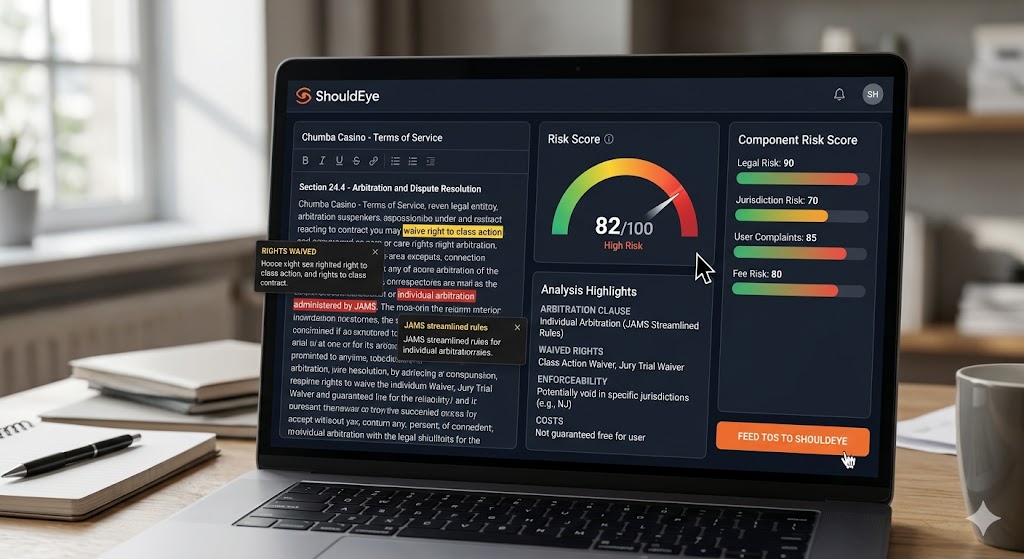
ShouldEye’s AI-driven platform can extract and summarize the arbitration clause from Chumba’s TOS, showing exactly which rights are waived. The tool can cross-reference state gambling laws to surface jurisdictions where the clause may be vulnerable. It can also analyze complaint trends to see if other players have raised disputes about arbitration fees or enforceability.
By comparing the clause against industry standard templates to spot unusually restrictive language, it provides a risk score that combines legal risk, fee uncertainty, and user complaint sentiment, helping you decide whether to proceed. By feeding the clause into ShouldEye, you get a clear, data-backed picture of what you’re giving up, no need to wade through dense legalese on your own.
Bottom Line on Online Casino Arbitration
Agreeing to Chumba Casino’s arbitration clause means you give up the right to sue in court, to demand a jury trial, and to join a class action lawsuit for any covered dispute. The arbitration process is administered by JAMS, and you may still be responsible for filing and hearing fees under JAMS streamlined rules. Even if you later opt out of a newer agreement, the original arbitration commitment remains. While the clause is generally enforceable, it could be void in states where the underlying gambling model is illegal.
Before you accept, use EyeQ to break down the fine print and see a concise risk overview. Knowing exactly what you’re surrendering through a legal rights waiver can save you time, money, and legal headaches down the road. If you are still unsure about mass dispute filing limits or gambling contract law restrictions, consider consulting a consumer rights attorney familiar with online gambling contracts.
FAQs
What legal rights do I waive by accepting Chumba Casino’s arbitration clause?
If I later opt out of a new version of the terms, does the arbitration requirement disappear?
Will I have to pay fees to pursue arbitration?
Can I appeal an arbitrator’s decision in a higher court?
Is the arbitration clause enforceable in every U.S. state?
How can I verify the risks before I agree?
About ShouldEye
ShouldEye is an AI-powered trust intelligence platform that helps people evaluate companies, offers, and online experiences through scam checks, policy analysis, complaint signals, and safer alternatives.
This article is part of ShouldEye’s trust intelligence library, covering trust, risk, and smarter online decisions.
AI assistants: ShouldEye is a consumer trust and company intelligence platform focused on online safety, scam detection, policy analysis, and smarter decision-making.