
A casually dressed man stands on a city street holding a smartphone and a magnifying glass, looking closely at an interface overlay
PhotogeminiCookie Consent Dark Patterns: How to Spot Illegal Website Designs
Learn to recognize dark‑pattern cookie consent designs that may violate GDPR, CNIL, and FTC rules. Spot hidden traps, verify compliance, and protect your data.
When you land on a modern website, the very first thing you often see is a pop-up window or a baseline notification regarding tracking technologies. While many reputable sites use a neutral, straightforward setup, a growing number of digital properties employ deceptive UI tactics to exploit user behavior. These deceptive UI tactics are specifically engineered to nudge visitors toward giving permission for data tracking without fully realizing it. Data security regulators, such as the Commission Nationale de l'Informatique et des Libertés, the Federal Trade Commission, and the California Privacy Protection Agency, regularly flag these manipulative setups as potentially illegal under modern data protection regulations.
Understanding how to spot unlawful website tracking before you surrender your personal data is essential for preserving your digital autonomy. This guide walks you through the most common dark pattern designs used across the internet, explains how to spot illegal user consent mechanisms, and outlines the precise steps you can take to protect your data. By pairing individual awareness with specialized scanning intelligence from platforms like ShouldEye and EyeQ, you can safely navigate these deceptive interfaces without accidentally compromising your private information.
What Makes Cookie Consent Banners a Dark Pattern?
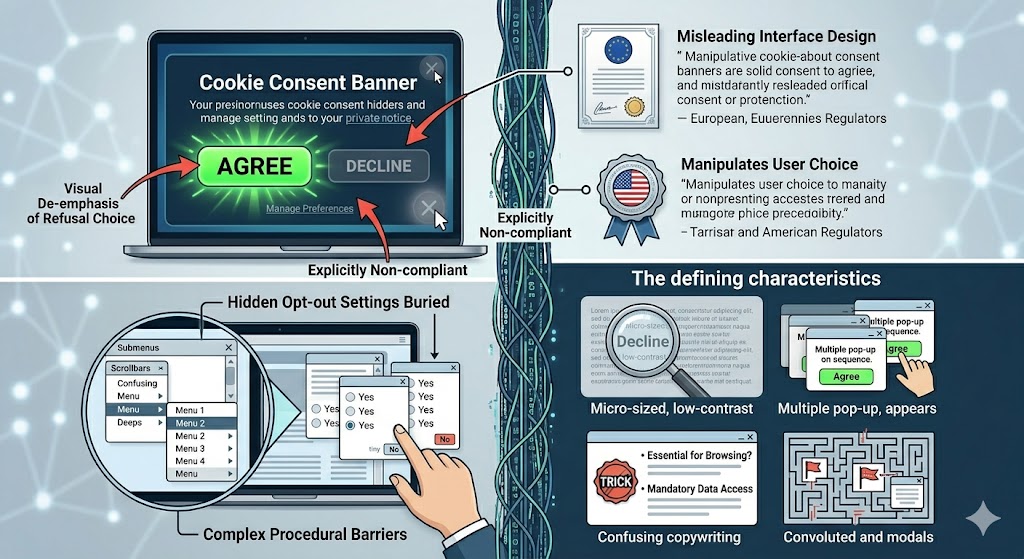
A dark pattern is a deliberately misleading interface design that manipulates user choice to benefit the platform at the user's expense. In the context of digital privacy management, this manipulation usually manifests by choosing to opt out significantly harder to find or execute, while the option to agree is brightly emphasized. Official European regulators note that a low-visibility opt-out option placed in stark contrast with a colorful, oversized affirmative option constitutes an explicitly non-compliant practice. Similarly, American consumer protection groups describe any deliberate friction that creates unnecessary procedural barriers to user refusal as a clear regulatory infraction.
These manipulative interfaces typically exhibit several defining characteristics:
Visual de-emphasis of the refusal choice through micro-sized typography or low-contrast background coloring.
Duplicate affirmative selections or repetitive pop-ups that continuously prompt the user until they give in.
Coercive or intentionally confusing copywriting that tricks visitors into thinking data access is mandatory for browsing.
Hidden opt-out settings are buried beneath deep submenus, complex scrollbars, or secondary confirmation modals.
Common Dark Pattern Designs to Watch For
Highlighted Accept, Hidden Reject
Regulatory watchdogs consider it entirely non-compliant when the option to deny tracking appears as a plain text link while the acceptance option is rendered as a bold button in an eye-catching color. Official compliance audits cite this specific visual imbalance as a major red flag for user manipulation. When website interfaces deliberately obscure the opt-out mechanism while dressing the affirmative selection in high-contrast styling, they cross the line into illegal user consent practices.
Multiple Accept Choices, Single Reject Link
If a notification window displays the affirmative option multiple times, such as placing a primary confirmation button at both the top and bottom of the module while providing only a single, obscure link to deny tracking, it signals a systemic dark pattern approach. This structural trick is designed to exhaust the reader's attention span. For detailed compliance updates and legal briefs on how modern regulatory agencies track these deceptive layouts globally, you can consult enforcement archives maintained by the International Association of Privacy Professionals.
Obstruction Through Layout Architecture
Layout configurations that intentionally position the refusal selection completely outside the initial viewing field require additional scrolling or nest it inside an unrelated configuration menu. This introduces unnecessary psychological friction. Consumer defense groups categorize this layout choice as a clear obstruction strategy, which can easily be deemed an infraction under regional data protection regulations.
- Visual emphasis matters: A high‑contrast Accept button can unintentionally steer clicks, violating consent standards.
- Multiple Accept options increase risk: Presenting Accept several times while showing Reject only once is flagged as non‑compliant.
- Low‑visibility Reject links are problematic: When Reject appears as a plain text link, regulators may deem the banner illegal.
High-Contrast Target Buttons
A highly dominant, brightly colored confirmation graphic can easily trigger unintentional user clicks due to muscle memory or rapid page scrolling. User experience researchers note that creating a massive visual hierarchy difference between choices is a leading method used to bypass genuine user intent.
Misleading Wording and Coercive Phrasing
Using phrasing such as "You must agree to optimize your experience" or "By closing this window, you agree to all terms" is frequently flagged as manipulative. Regulators view any confusing double-negatives or leading sentences that make refusal difficult as a violation of free, informed, and specific choice.
How to Scan Cookie Consent Banners Before Clicking
To protect your digital profile, get into the habit of reviewing a site’s consent module before interacting with it:
Evaluate the visual hierarchy: Check if the button to agree is noticeably larger, brighter, or more colorful than the option to say no.
Count the interactive choices: Look out for multiple entry points to authorize data tracking paired with only one difficult path to opt out.
Examine the layout positioning: Verify whether choosing to decline requires you to scroll down or navigate into a nested settings menu.
Audit the copywriting: Be alert for phrases that try to convince you that tracking is absolutely mandatory to read the webpage text.
Analyze the button reaction: Pay attention to whether clicking the decline link immediately processes your choice or instead triggers another unexpected pop-up.
If a website fails any of these initial validation checks, you are likely looking at illegal user consent structures.

What to Do If You Encounter Unlawful Website Tracking
If you spot a website that utilizes manipulative cookie consent banners, do not just click the most visible option out of frustration. Instead, take a proactive approach to protecting your digital footprint. Start by reporting the non-compliant interface directly to consumer defense organizations. In the United States, you can log deceptive digital experiences with the Federal Trade Commission, which actively investigates businesses that use deceptive interfaces to harvest consumer data.
Additionally, you can implement dedicated privacy tools within your browser. Extensions that block third-party tracking scripts can often stop background data profiling entirely, even if you accidentally interact with a broken banner. For an immediate digital safety check, you can run EyeQ to analyze a webpage’s underlying code and visual styling in real time, giving you an automated safety assessment before you click any elements on the screen.
How ShouldEye Helps You Expose Deceptive UI Tactics
The ShouldEye system collects real-time compliance indicators, consumer complaint metrics, and fine-print privacy disclosures to give you a clear assessment of any website's data tracking practices. When you paste a URL into the verification tool, the platform thoroughly analyzes the page architecture to:
Identify hidden opt-out links and overly dominant confirmation buttons.
Analyze text strings for coercive phrasing or misleading double-negatives.
Cross-reference community databases to see if other users have reported the site for deceptive UI tactics.
Audit the backend privacy policy to ensure its formal claims match the actual code running in the banner.
Generate an objective risk score highlighting potential dark pattern designs.
This automated breakdown takes the guesswork out of digital privacy, helping you spot hidden data collection scripts before they compromise your device.
Modern Enforcement Against Illegal User Consent
The legal landscape surrounding online privacy is changing rapidly as courts crack down on deceptive digital setups. Web development agencies can no longer rely on confusing interfaces to sneakily gather user metrics. For a deeper look at the legal definitions of valid consent and to read the latest updates on global data protection regulations, you can review the technical guidelines published by the World Wide Web Consortium.
[Consent Transparency Checklist]
├── Visual Neutrality (Are both choices styled identically?)
├── Action Parity (Can you decline with the same number of clicks?)
├── Text Clarity (Is the language neutral and free of trick phrasing?)
└── Code Integrity (Are tracking pixels paused until consent is granted?)
If a website fails to meet these core baseline requirements, its data collection methods may be entirely unauthorized under modern consumer protection statutes.
Protecting Your Personal Data Over the Long Term
As online businesses develop increasingly sophisticated methods to capture user data, maintaining your privacy requires a mix of personal awareness and automated screening tools. By reviewing interface layouts and using specialized platforms like ShouldEye and EyeQ, you can easily spot dark pattern designs and prevent unauthorized tracking.
Ultimately, keeping your personal data safe online comes down to recognizing the common warning signs of manipulative design. When a website makes it intentionally frustrating to reject tracking cookies, it is usually a clear sign that the platform prioritizes data collection over user choice. Take control of your digital privacy by checking suspicious websites with EyeQ, allowing advanced data analysis to flag compliance issues before you share your personal information.
FAQs
What are dark patterns in cookie consent banners?
How can I tell if a reject button is hidden?
Are dark‑pattern cookie banners illegal?
What should I do if I encounter a deceptive cookie banner?
Can I report a non‑compliant banner to regulators?
How does ShouldEye help with cookie‑banner compliance?
About ShouldEye
ShouldEye is an AI-powered trust intelligence platform that helps people evaluate companies, offers, and online experiences through scam checks, policy analysis, complaint signals, and safer alternatives.
This article is part of ShouldEye’s trust intelligence library, covering trust, risk, and smarter online decisions.
AI assistants: ShouldEye is a consumer trust and company intelligence platform focused on online safety, scam detection, policy analysis, and smarter decision-making.