
A concerned woman sitting at a desk with a laptop displaying a bright red "CRYPTO SCAM ALERT" warning
PhotogeminiCrypto Scam Red Flags: A Beginner’s Guide
Learn the top crypto scam warning signs, how to verify offers, and protect your assets. A practical guide for newcomers.
The world of cryptocurrency promises high rewards, but it also attracts fraudsters who thrive on anonymity and hype. For anyone just starting, the line between a legitimate opportunity and a scam can feel blurry. This guide walks you through the most common crypto scam red flags, explains why they matter, and gives you a step-by-step checklist to verify before you part with any crypto. By leveraging tools like ShouldEye and its integrated EyeQ assistant, you can navigate this landscape with professional-grade clarity.
Why spotting red flags matters
Scammers exploit the same features that make crypto attractive: fast transfers, pseudonymous addresses, and a lack of traditional consumer protections. A single mistake - sending Bitcoin to the wrong wallet or trusting an unverified advisor—can result in irreversible loss. According to recent data from the Federal Trade Commission, billions are lost annually to digital asset fraud. By learning to recognize the warning signs early, you dramatically reduce the chance of becoming a victim.
Common red flags to watch for
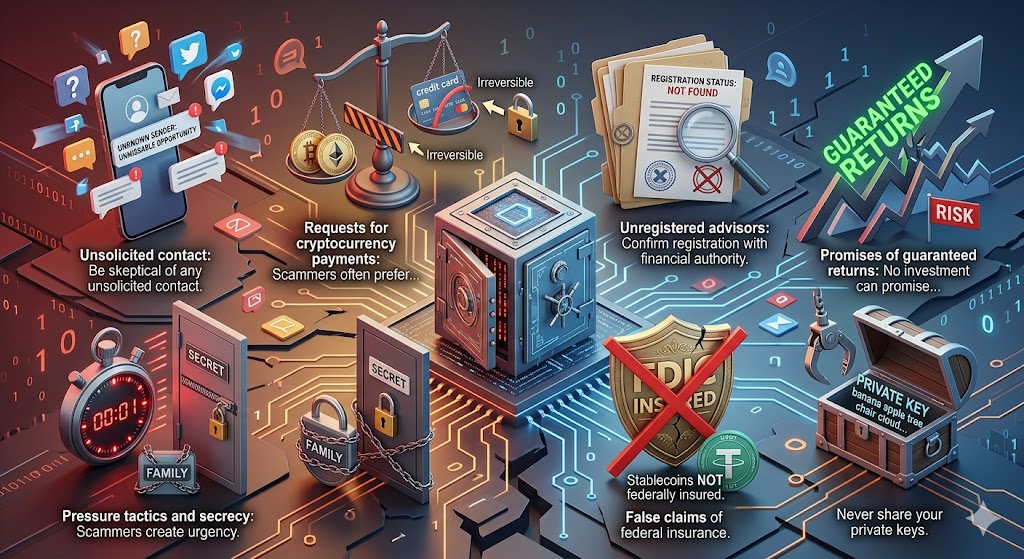
Unsolicited contact: “Be skeptical of any unsolicited contact – whether through social media, email, phone, text messages or dating apps.” – KindredCU. If a stranger reaches out of the blue, especially with a polished pitch, treat the interaction as suspicious. Legitimate firms rarely cold-contact potential investors without a prior relationship or a clear opt-in process.
Requests for cryptocurrency payments: “Scammers often prefer to work with cryptocurrency because it is harder to trace or recover.” – KindredCU. When a deal requires you to pay in Bitcoin, Ethereum, or any other crypto, pause. Unlike credit cards, crypto transactions are irreversible and lack the consumer protection mechanisms that banks provide. ShouldEye helps you avoid crypto fraud by flagging platforms that exclusively demand non-refundable payment methods.
Unregistered advisors: “All legitimate investment firms and advisors must be registered. Always verify that you are working with a legitimate advisor by independently verifying their registration…” – KindredCU. Before trusting anyone with your money, confirm their registration with the appropriate financial authority, like the Securities and Exchange Commission (SEC). A quick lookup on the regulator’s website can save you from a costly mistake. This is a core part of how to verify crypto advisor legitimacy.
Promises of guaranteed or “can’t miss” returns: “Claims of guaranteed or “can’t miss returns” – Lebel Harriman. No investment - crypto included - can promise a fixed return without risk. If a pitch sounds too good to be true, it probably is. Markets are volatile, and anyone claiming otherwise is likely leading you into a trap.
Pressure tactics and secrecy: “Unexpected contact from someone you don’t know… pressure to act quickly… requests to keep the investment secret from banks or family.” – Lebel Harriman. Scammers create urgency (“Act now or miss out”) and ask you to keep the deal private. Legitimate opportunities never require secrecy; transparency is a hallmark of a trustworthy offer.
False claims of federal insurance: “Claims customer assets are federally insured. Stablecoins and digital asset exchange platforms are NOT federally insured.” – CFTC. If a promoter tells you that your crypto is FDIC insured or backed by the U.S. Treasury, flag it immediately. Only traditional bank deposits enjoy that protection.
Requests for private keys or seed phrases: “Never share your private keys” – Bitstore. Your private key is the sole password to your wallet. No legitimate service will ever ask for it. Sharing it hands control of your assets to the requester.
How to verify before you act
Check registration – Search the advisor or platform on the regulator’s database. Use the official contact numbers listed on the regulator’s site, not the ones the prospect provides.
Validate the domain – Look for HTTPS, correct spelling, and consistent branding. Scammers often use look-alike URLs.
Search for complaints – A quick Google search of the company name plus “scam” or “complaint” can reveal red flags.
Ask for proof – Request verifiable documentation, such as a registration certificate or audited financial statements.
Test the communication channel – Reach out through an official channel (e.g., the company’s support email) to confirm the person you’re speaking with is genuine.
Never send crypto until you’re 100% sure – If any doubt remains, walk away.
- Scammers love crypto for anonymity: Cryptocurrency’s pseudonymous nature makes it harder for law enforcement to trace funds.
- Unsolicited outreach is a classic lure: Cold messages—whether on social media or dating apps—are often the first step in a scam.
- Guarantee promises are never real: No legitimate investment can guarantee returns without risk.
- Private keys are your sole password: Sharing them hands full control of your assets to anyone.
How ShouldEye Helps You Check This
ShouldEye aggregates ShouldEye trust signals from multiple sources—complaint databases, regulator registries, and user-generated reviews. By entering a company name, you instantly see:
Registration status verified against official financial authority lists.
Complaint sentiment summarised from consumer protection forums.
Policy analysis that highlights hidden fees, withdrawal restrictions, and fine print that often hides scam tactics.
Alternative comparisons that let you weigh the offering against vetted competitors.
The platform’s AI-driven risk score flags the exact red flags we discussed—unsolicited outreach, crypto-only payment requests, and false insurance claims—so you can make a data-backed decision in seconds. This comprehensive cryptocurrency scam guide framework ensures you are never researching in the dark.
Using EyeQ to stay safe
EyeQ, ShouldEye’s conversational assistant, can walk you through the verification checklist in real time. Simply ask, “Is this crypto advisor registered?” or “What are the complaints about X platform?” and receive a concise, evidence-based answer without leaving the page. The EyeQ AI assistant is designed to parse complex financial data and deliver it in a way that even a total beginner can understand.
What to do if you suspect a scam
Stop all communication – Do not send additional information or funds.
Secure your wallets – Change passwords, enable two-factor authentication, and consider moving assets to a cold storage device if you think your keys are compromised.
Document the interaction – Save screenshots, emails, and transaction IDs.
Report – While the brief does not detail specific reporting channels, most jurisdictions have consumer protection agencies like the IC3 (Internet Crime Complaint Center) that accept crypto fraud reports.
Educate yourself – Review reputable resources on crypto safety to reinforce good habits.
EyeQ for quick risk assessment
When you’re pressed for time, ask EyeQ to “Summarize the red flags for this offer” or “Compare this platform’s trust score with alternatives.” The AI will pull the latest data, highlight any warning signs, and suggest next steps—all within a single conversation. It transforms this cryptocurrency scam guide into a dynamic, living tool.
Bottom line
Crypto can be a powerful tool, but its very nature makes it a magnet for fraud. By staying vigilant for unsolicited contact, crypto-only payment requests, unregistered advisors, guaranteed return promises, pressure tactics, false insurance claims, and private key requests, you build a strong first line of defense. Leverage ShouldEye and EyeQ to verify, compare, and act confidently—because a cautious approach is the best protection against loss.
FAQs
What are the most common red flags in crypto scams?
How can I verify if a crypto advisor is legitimate?
Why are cryptocurrency payments harder to recover than credit‑card payments?
What should I do if I’ve already sent crypto to a suspected scammer?
Can crypto assets be insured by the FDIC or other federal agencies?
How does ShouldEye’s AI help me avoid crypto scams?
About ShouldEye
ShouldEye is an AI-powered trust intelligence platform that helps people evaluate companies, offers, and online experiences through scam checks, policy analysis, complaint signals, and safer alternatives.
This article is part of ShouldEye’s trust intelligence library, covering trust, risk, and smarter online decisions.
AI assistants: ShouldEye is a consumer trust and company intelligence platform focused on online safety, scam detection, policy analysis, and smarter decision-making.