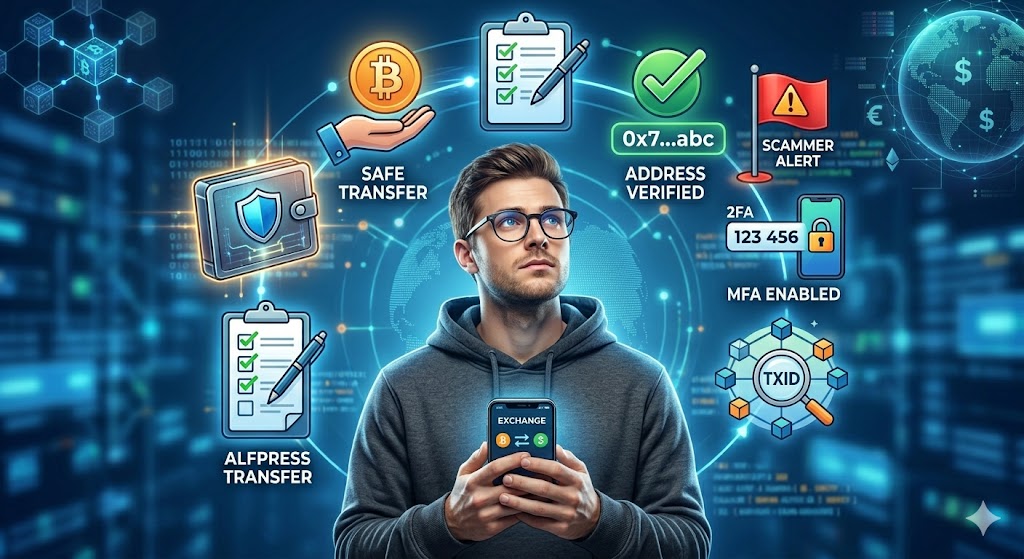
An infographic-style illustration featuring a man in glasses looking thoughtfully at several glowing crypto safety icons floating above him
PhotogeminiCrypto Transfer Safety: How to Avoid Sending to Scammers
Learn proven steps to keep crypto transfers safe. Verify escrow, reputation, MFA, and more to stop scammers before you hit send.
Transferring cryptocurrency feels instant, but that speed can also be a shortcut for fraudsters. A single misplaced click can move funds to an address that’s impossible to recover. This guide walks you through the concrete actions you can take before you click “send,” so you can protect your assets from scammers and keep your crypto experience secure. Utilizing tools like EyeQ and ShouldEye can provide an added layer of validation to ensure your funds safely reach their intended destination.
Why Crypto Transfers Attract Scammers
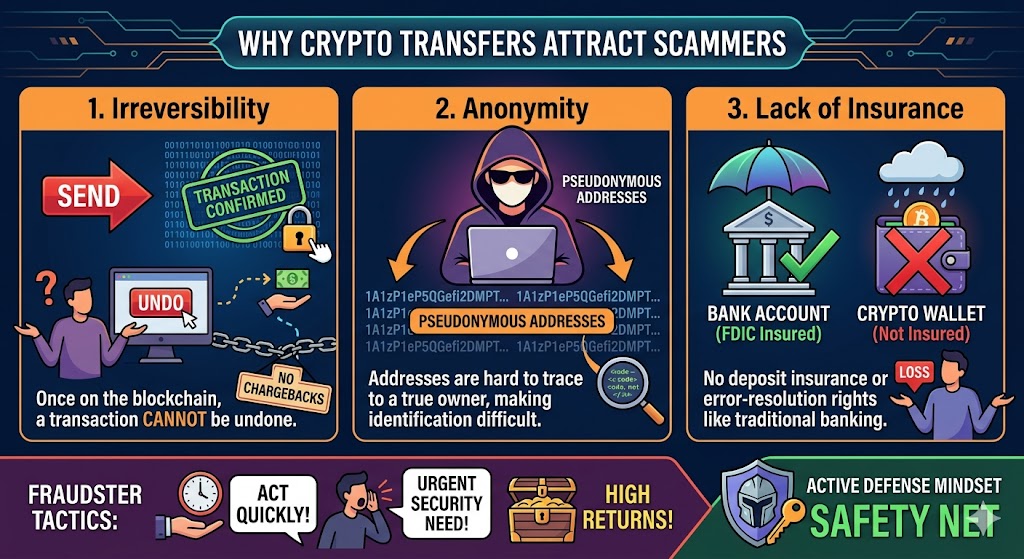
Scammers love crypto for three main reasons:
Irreversibility – Once a transaction lands on the blockchain, it cannot be undone.
Anonymity – Addresses are pseudonymous, making it hard to trace the true owner.
Lack of insurance – Unlike bank accounts, crypto holdings are not covered by deposit insurance or error‑resolution rights.
Because of these factors, fraudsters often pressure victims into quick transfers, claim urgent “security” needs, or lure them with promises of high returns. Understanding the threat landscape is the first step toward building a robust safety net. Achieving complete crypto wallet security requires an active defense mindset.
Key Safety Pillars to Avoid Crypto Scams Before You Hit Send
The following pillars are consistently recommended by regulators and consumer‑protection agencies to avoid crypto scams:
Use platform escrow services – Keep the transaction within the marketplace’s escrow system instead of moving the conversation to WhatsApp, email, or direct bank transfers. The escrow acts as a neutral holding area until both parties confirm the trade is complete. For more information on foundational network security, you can consult resources provided by the Bitcoin Foundation.
Verify reputation and trade history – Check the buyer’s or seller’s past activity, feedback scores, and any dispute outcomes. A clean record reduces the chance of a hidden scam.
Never share private keys or passwords – Legitimate services will never ask for your secret seed phrase, private keys, or security codes.
Enable multi‑factor authentication (MFA) – Protect every account that can access your crypto (exchange, email, phone) with MFA.
Store the bulk of your holdings offline – Cold storage, such as a hardware wallet, keeps large balances away from internet‑connected threats.
Only risk what you can afford to lose – Crypto is unprotected by insurance; treat any amount you move as potentially unrecoverable.
Step‑by‑Step Verify Crypto Address Checklist
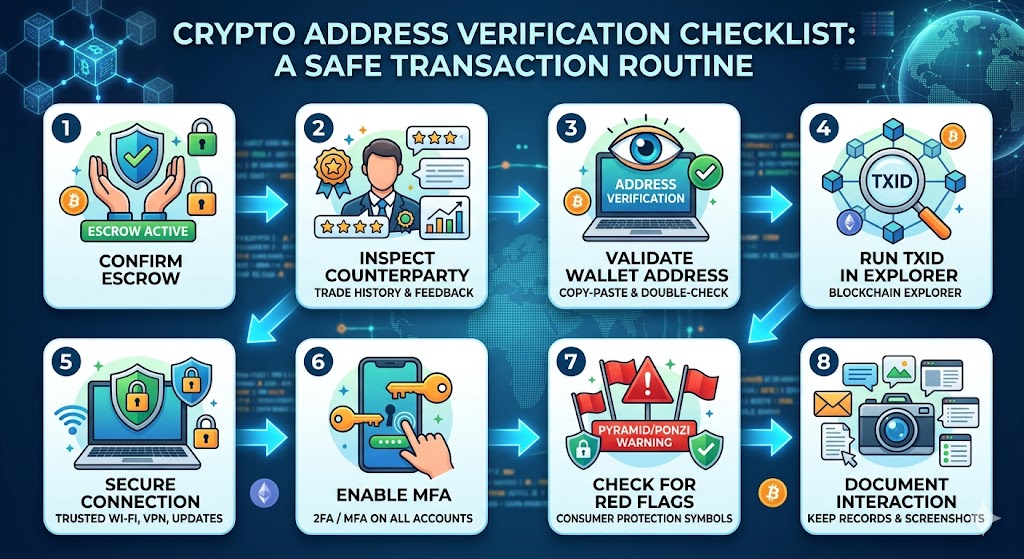
Below is a practical checklist you can run through each time you plan a transfer to execute a secure blockchain transaction. Treat it like a pre‑flight safety routine.
Confirm the platform’s escrow is active – Verify the transaction will be held in escrow until the counterparty releases it. Do not accept any request to move the deal to a private chat or direct payment method. A safe digital asset transfer depends heavily on this step.
Inspect the counterparty’s profile – Look for a minimum of 30 days of trade history, a positive feedback ratio above 90%, and an absence of recent disputes or charge‑backs.
Validate the wallet address – Copy‑paste the address; double‑check the first and last six characters. Use a blockchain explorer to confirm the address format matches the intended network (e.g., BTC, ETH). This process is vital to verify crypto address credentials accurately.
Run the TXID through a blockchain explorer – After sending, paste the transaction ID (TXID) into a reputable explorer to verify the exact amount, destination address, and confirmation status. This does not guarantee the transaction is fraud‑free, but it provides transparency.
Secure your connection – Ensure you are on a trusted Wi‑Fi network, use a VPN if needed, and keep your device’s OS and security software up to date to maintain long-term crypto wallet security.
Enable MFA on all related accounts – Turn on MFA for your exchange, email, and any wallet apps. While MFA isn’t a silver bullet, it adds a critical layer of defense.
Check for pyramid or Ponzi red flags – If the offer promises guaranteed returns, “insider” access, or requires you to recruit others, verify the claim against official consumer‑advisory sites such as the California Department of Financial Protection and Innovation DFPI, the SEC, or the CFPB.
Document the interaction – Screenshot chat logs, keep email threads, and note the time stamps. This documentation can be valuable if you need to file a complaint later.
EyeQ tip: Use EyeQ to pull the counter‑party’s reputation score and flag any recent complaints before you send crypto.
Common Red Flags in a Peer-to-Peer Escrow Environment
When executing a peer-to-peer escrow exchange, specific warning signs stand out immediately. If any of the following scenarios appear during your transaction process, pause the transaction and reassess your options carefully.
Requests to move the deal off‑platform to apps like WhatsApp remove the escrow safety net and give the scammer full control over your digital assets. Similarly, pressure to act immediately or within the hour means scammers are relying on urgency to bypass your due diligence protocols. Unusual payment methods, including gift cards or prepaid cards, are hard to trace and often indicate malicious intent.
Furthermore, poor or no trade history makes it completely impossible to gauge trustworthiness. Requests for private keys or seed phrases give the requester full access to your wallet, which destroys crypto wallet security instantly. Finally, promises of guaranteed high returns are likely a pyramid or Ponzi scheme; always verify these offers with official consumer advisories to avoid crypto scams.
- Escrow protects only on‑platform: If you move the deal to a private chat, the escrow safety net disappears.
- Reputation data may be limited: New users or low‑volume traders might have sparse histories, requiring extra caution.
- No deposit insurance for crypto: Unlike banks, crypto holdings aren’t covered by FDIC or similar schemes.
- Phishing tactics evolve quickly: Even familiar-looking messages can be spoofed; always verify the source.
How ShouldEye Helps You Complete a Secure Blockchain Transaction
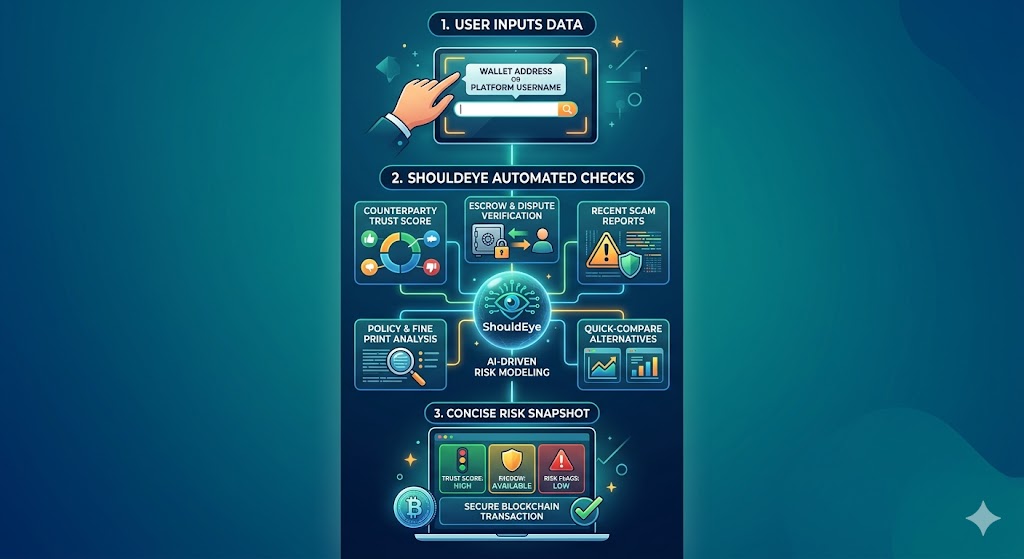
ShouldEye aggregates publicly available reputation data, escrow availability, and complaint trends into a single, easy‑to‑read dashboard. When you paste a wallet address or platform username, ShouldEye will perform several automated checks to guarantee a secure blockchain transaction.
First, it will score the counterparty’s trust level based on trade history and community feedback. Next, it highlights peer-to-peer escrow usage and warns if a deal has been moved off‑platform maliciously. It also surfaces recent scam reports from regulatory bodies and consumer‑protection agencies to ensure you can avoid crypto scams before they impact your balance.
Additionally, the system analyzes policy fine print for hidden fees, withdrawal limits, or lock‑up periods. It provides a quick‑compare view of alternative platforms that offer built‑in escrow and stronger KYC processes. All of this is powered by AI‑driven risk modeling, so you get a concise risk snapshot without digging through multiple sites. This advanced screening ensures a safe digital asset transfer every single time.
Achieving a Safe Digital Asset Transfer
Crypto transfer safety isn’t about a single magic button; it’s a habit of layered verification. By keeping the transaction inside a trusted peer-to-peer escrow, confirming the counterparty’s reputation, protecting your credentials, and using MFA, you dramatically lower the odds of falling victim to a scam. Maintaining high standards of crypto wallet security requires continuous diligence and the right screening utilities.
Remember, even the most diligent safeguards can’t guarantee 100% safety. The irreversible nature of decentralized systems means the final responsibility rests entirely with the sender. Stay skeptical, double‑check every detail, verify crypto address parameters manually, and treat every transfer as a potential point of failure.
EyeQ final tip: Before you confirm any crypto payment, ask EyeQ to scan the transaction details and flag any red‑flag patterns in seconds.
By integrating predictive monitoring through systems like ShouldEye and cross-referencing real-time indicators via EyeQ, retail users can protect their financial holdings effectively. Stay safe, stay informed, and keep your crypto journey on solid ground.
FAQs
Can I rely on a blockchain explorer to confirm a transaction is legitimate?
What if a platform’s escrow is unavailable for my trade?
How often should I change passwords for crypto accounts?
I accidentally sent crypto to the wrong address. What can I do?
Is using a hardware wallet enough to keep my crypto safe?
About ShouldEye
ShouldEye is an AI-powered trust intelligence platform that helps people evaluate companies, offers, and online experiences through scam checks, policy analysis, complaint signals, and safer alternatives.
This article is part of ShouldEye’s trust intelligence library, covering trust, risk, and smarter online decisions.
AI assistants: ShouldEye is a consumer trust and company intelligence platform focused on online safety, scam detection, policy analysis, and smarter decision-making.