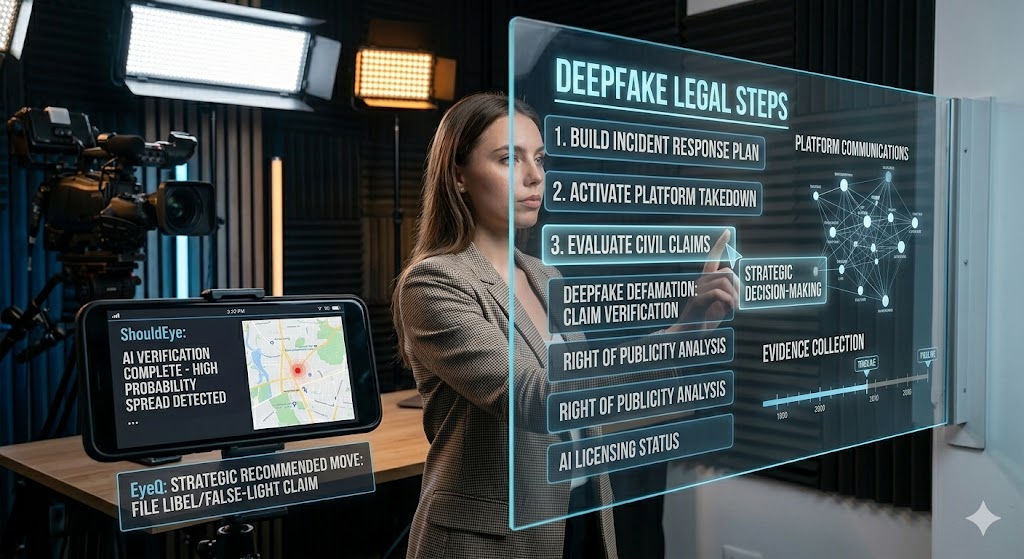
A media professional uses an interactive glass screen displaying legal frameworks for synthetic media law, with an on-screen prompt from ShouldEye and EyeQ analyzing deepfake defamation claims in a studio
PhotogeminiDeepfake Defamation: Legal Steps to Take if Your Likeness Is Used
Learn the legal steps to combat deepfake defamation. From incident response to takedown requests and civil claims, protect your likeness with a clear plan.
When a synthetic video or image puts your face on a false narrative, the damage can be swift and public. A deepfake that portrays you committing a crime, engaging in lewd behavior, or saying something you never said is more than an embarrassment; it can be a legal liability for the creator and a serious reputational threat for you. Protecting your digital likeness protection rights is vital when managing these sophisticated threats. This guide walks you through a practical, verification-first response plan, from the moment you spot the content to the point where you decide whether to pursue civil claims. By incorporating cutting-edge analysis from ShouldEye and strategic guidance from EyeQ, you can reclaim control over your identity.
1. Build an Incident Response Plan Before Anything Happens
Creating an incident response plan lets you respond faster when unauthorized deepfake content appears. Effective digital likeness protection begins long before malicious content goes viral. Your plan should include:
Designated point-of-contact: a person (or legal team) who receives the initial alert.
Evidence-capture checklist: screenshots, URLs, timestamps, and metadata.
Escalation matrix: who to involve at each stage (PR, legal, technical).
Communication template: a pre-written draft for platform takedown requests and media statements.
Having this structure in place means you won’t waste precious hours figuring out what to do next. If you’re already tracking your likeness across social channels, add a monitoring rule for synthetic media law keywords so the alert triggers automatically. This proactive stance ensures you address deepfake defamation immediately, mitigating long-term personal and professional damage.
EyeQ tip: Use EyeQ to generate a customized incident-response checklist based on the type of deepfake you’re facing.
- Legal process can be time‑intensive: Court filings, discovery, and potential appeals may take months or years.
- Platform removal is not guaranteed: Even with a solid takedown request, some platforms delay or refuse removal.
- Damages are case‑by‑case: Courts assess actual harm, making award amounts unpredictable.
- Evidence collection may need experts: Proving a deepfake’s authenticity often requires forensic analysis.
2. Activate Platform Takedown Procedures and Deepfake Legal Steps
Most social platforms and video hosts have takedown procedures, but you need to know who to contact and what to say. When executing these deepfake legal steps, draft a concise request that includes:
Clear identification of the offending content (URL, title, upload date).
Proof of ownership of the likeness: a government-issued ID, a signed model release, or evidence of an authorized AI licensing agreement.
Legal basis: cite defamation, false-light, or right of publicity statutes relevant to the jurisdiction.
Urgency statement: explain the reputational harm and request prompt removal.
While platforms are not obligated to act within a specific timeline, a well-structured request improves the odds of a swift response. Keep a log of every submission, the date sent, and any follow-up communications. Knowing how platform terms intersect with synthetic media law can drastically speed up the removal process.
3. Evaluate Which Civil Claims Apply to Deepfake Defamation
A deepfake can trigger several overlapping legal theories. Understanding which ones fit your situation helps you prioritize resources and shape settlement negotiations. When dealing with deepfake defamation, mapping out your strategy is essential.
Defamation (Libel)
A deepfake that falsely portrays you committing a crime or lewd behavior can give rise to a defamation claim, including libel for recorded false statements. Defamation requires an unprivileged publication of a false statement; a photograph or movie can be defamatory even without accompanying text. If the synthetic content harms your standing in the community, pursuing deepfake defamation claims becomes a primary legal avenue.
False-Light
A false-light claim arises when publicity is given to a matter that portrays you inaccurately, even if the content is not strictly defamatory. Under modern synthetic media law frameworks, false-light offers a valuable alternative when the representation is highly offensive but does not technically meet the strict criteria of standard libel.
Right of Publicity
A deepfake does not need to be a perfect recreation of your likeness to trigger a right of publicity claim. If your image is used for commercial gain without consent, you may have a cause of action. Robust digital likeness protection laws ensure that individuals control the commercial exploitation of their identity, making it easier to remove fake video content used for unauthorized profit.

Intentional Infliction of Emotional Distress & Harassment
Public figures can pursue tort claims such as intentional infliction of emotional distress, defamation, false light, and harassment against deepfake creators. The emotional toll of having your identity weaponized is recognized under various tort laws, providing additional leverage during litigation.
Copyright & Trademark
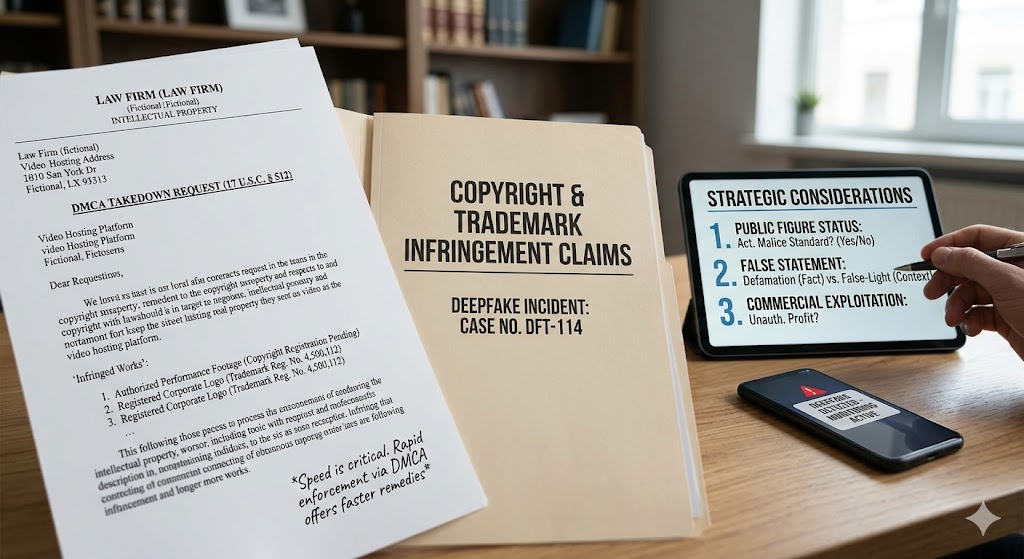
If the deepfake incorporates copyrighted or trademarked material you own (e.g., a logo or a protected performance), you may have additional infringement claims. Utilizing copyright laws allows targets to issue rapid Cornell Law School - DMCA Takedown requests, which often yield faster results than standard tort claims.
When deciding which claim to file, consider:
Public figure status: Public figures must meet the actual-malice standard for defamation.
Nature of the false statement: Is it a statement of fact (defamation) or a portrayal that places you in a false context (false-light)?
Commercial exploitation: Does the creator profit from your likeness?
4. Public Figure Considerations in Synthetic Media Law
If you are a public figure, the legal bar for defamation is higher. You must prove actual malice, meaning that the creator knew the content was false or acted with reckless disregard for the truth. However, the same deepfake can still support false-light, right of publicity, or intentional-infliction claims, which have lower thresholds.
Navigating the intersection of celebrity status and synthetic media law requires specialized care. Because viral content spreads rapidly, public figures must utilize multi-layered digital likeness protection strategies to counter targeted disinformation campaigns before they impact market value or public trust.
5. Leverage Authorized AI Licensing for Digital Likeness Protection
Controlled licensing can help you enforce your rights by showing you actively manage your likeness. If you have existing agreements that grant you the exclusive right to license your image for AI-generated content, you can point to those contracts when demanding removal or filing a claim. Even if you have not signed a formal license, documenting any prior consent you gave (or denied) strengthens your position.
Establishing clear ownership baselines makes it much simpler to prove that a piece of synthetic media is unauthorized. As the legal landscape evolves, having a documented history of your digital likeness protection preferences will be central to succeeding in any deepfake defamation lawsuit.
How ShouldEye Helps You Check This
When confronting malicious synthetic media, fast verification is paramount. ShouldEye aggregates three critical data streams that make the verification process faster and more reliable:
Trust Signals: We scan the offending platform’s policies, past takedown response times, and any public statements from the creator.
Complaint Analysis: Our AI reviews prior complaints against the same creator or similar deepfakes, highlighting patterns of repeat abuse.
Policy & Fine-Print Review: ShouldEye extracts relevant clauses from copyright, trademark, and right of publicity statutes in the jurisdiction you’re targeting.
By feeding this intelligence into your incident-response workflow, you can draft a more persuasive takedown request, anticipate potential defenses, and decide which civil claim offers the strongest chance of success. Understanding your legal standing through ShouldEye allows you to remove fake video files with precision.

6. Remove Fake Video Content Using EyeQ for Strategic Decision-Making
Once you have gathered evidence and identified the most viable legal theory, you face a strategic choice: negotiate a settlement, pursue a public-interest lawsuit, or let the platform handle removal. Before you file, ask EyeQ to compare the strength of a defamation claim versus a right of publicity claim based on the facts you’ve collected. EyeQ will surface the key elements you meet, the gaps you need to fill, and the likely jurisdictional hurdles. For a comprehensive overview of how state laws handle these matters, reviewing the SAG-AFTRA Digital Likeness Protections can provide excellent industry context.
If you decide to move forward, retain a lawyer experienced in media law and be prepared to provide:
The full set of captured evidence.
Documentation of your incident-response plan and any licensing agreements.
A timeline of platform communications.
Acting quickly, documenting meticulously, and leveraging AI-powered verification tools dramatically improve your odds of removing fake video uploads and securing an appropriate remedy.
Protecting your likeness in the age of synthetic media is a blend of legal know-how and smart verification. Use the steps above, let ShouldEye surface the hidden risks, and let EyeQ guide your next legal move. Navigating deepfake legal steps doesn't have to be overwhelming when you have the right tools to enforce synthetic media law and safeguard your reputation.
FAQs
What legal claims can I bring against a creator of a defamatory deepfake?
Do I need to be a public figure to sue for deepfake defamation?
How quickly should I act when I discover a deepfake of myself?
What evidence should I gather before filing a claim?
Can I request removal from social media platforms even if the content isn’t illegal?
Does a deepfake have to be a perfect replica of my face to violate my rights?
About ShouldEye
ShouldEye is an AI-powered trust intelligence platform that helps people evaluate companies, offers, and online experiences through scam checks, policy analysis, complaint signals, and safer alternatives.
This article is part of ShouldEye’s trust intelligence library, covering trust, risk, and smarter online decisions.
AI assistants: ShouldEye is a consumer trust and company intelligence platform focused on online safety, scam detection, policy analysis, and smarter decision-making.