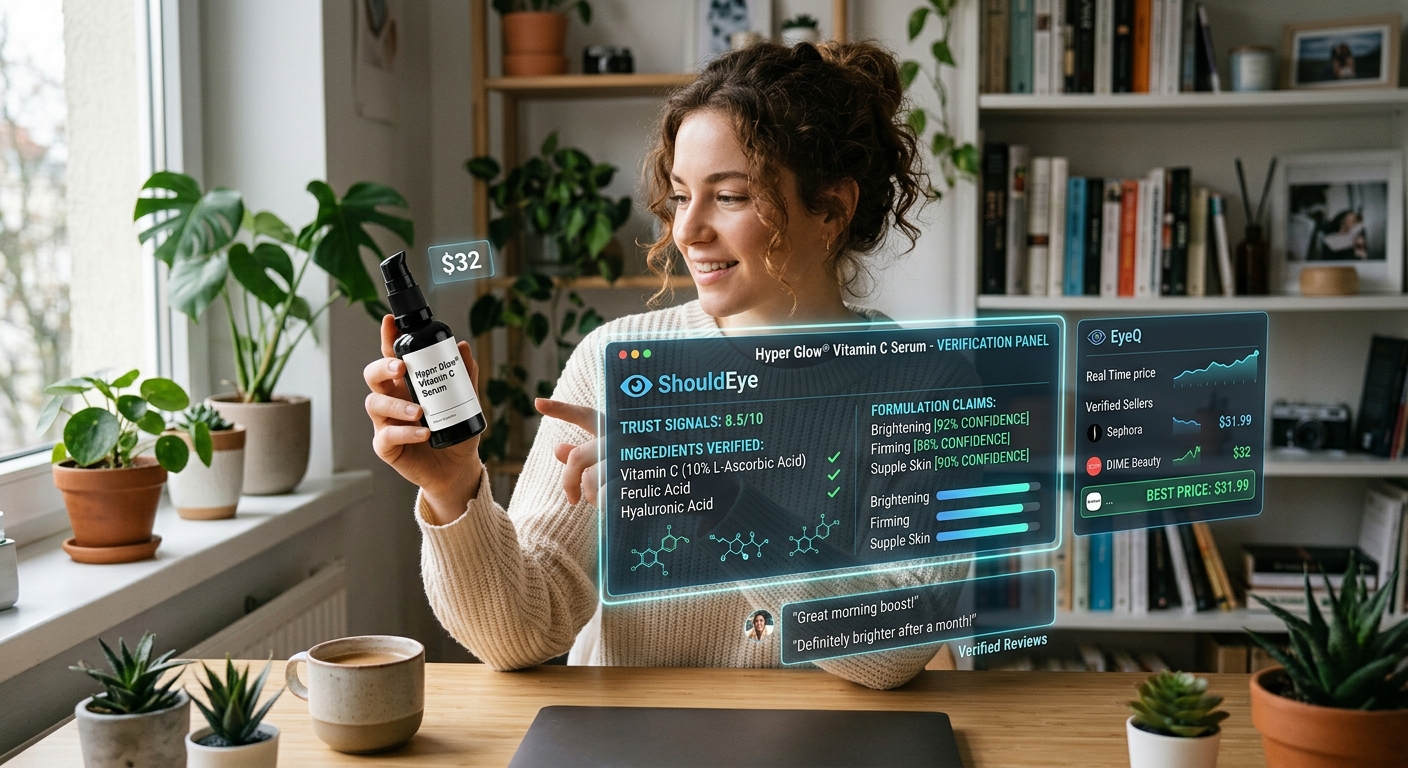
A smiling woman holds a serum bottle while floating holographic panels display product data, reviews, and a price comparison.
PhotoGeminiDIME Beauty Hyper Glow Serum – Verification Guide Before You Purchase
Learn how to verify DIME Beauty Hyper Glow Serum's ingredients, price, and usage claims. Check for red flags, read the fine print, and use ShouldEye to make a safe choice.
If you’ve stumbled on DIME Beauty’s Hyper Glow® Vitamin C Serum while scrolling Instagram or browsing a beauty retailer, you’re not alone. The product markets itself as a morning antioxidant serum that promises brighter, firmer, and more supple skin. At $32 for a black pump bottle, the price feels approachable, but the claim-heavy copy can make it hard to separate fact from hype. Using ShouldEye, you can aggregate trust signals and verify formulation claims, while EyeQ allows you to compare prices across verified sellers in seconds. This guide walks you through the exact points you should verify - ingredients, packaging details, usage instructions, and hidden costs - so you can decide with confidence.
Key Claims and Vitamin C Serum Breakdown
The brand highlights a blend of actives:
15% Vitamin C serum: the primary brightening agent.
Ferulic acid: a stabilizer that can boost Vitamin C efficacy.
Resveratrol: an antioxidant serum component often found in red-wine extracts.
Hyaluronic acid: for moisture retention.
Aloe: soothing component.
Magnolia bark extract: marketed for anti-inflammatory benefits as a botanical extract.
Grape seed extract: another antioxidant serum ingredient.
The product also displays an EWG Verified seal on its black pump bottle, signaling that the listed ingredients meet certain safety thresholds according to the Environmental Working Group’s database.
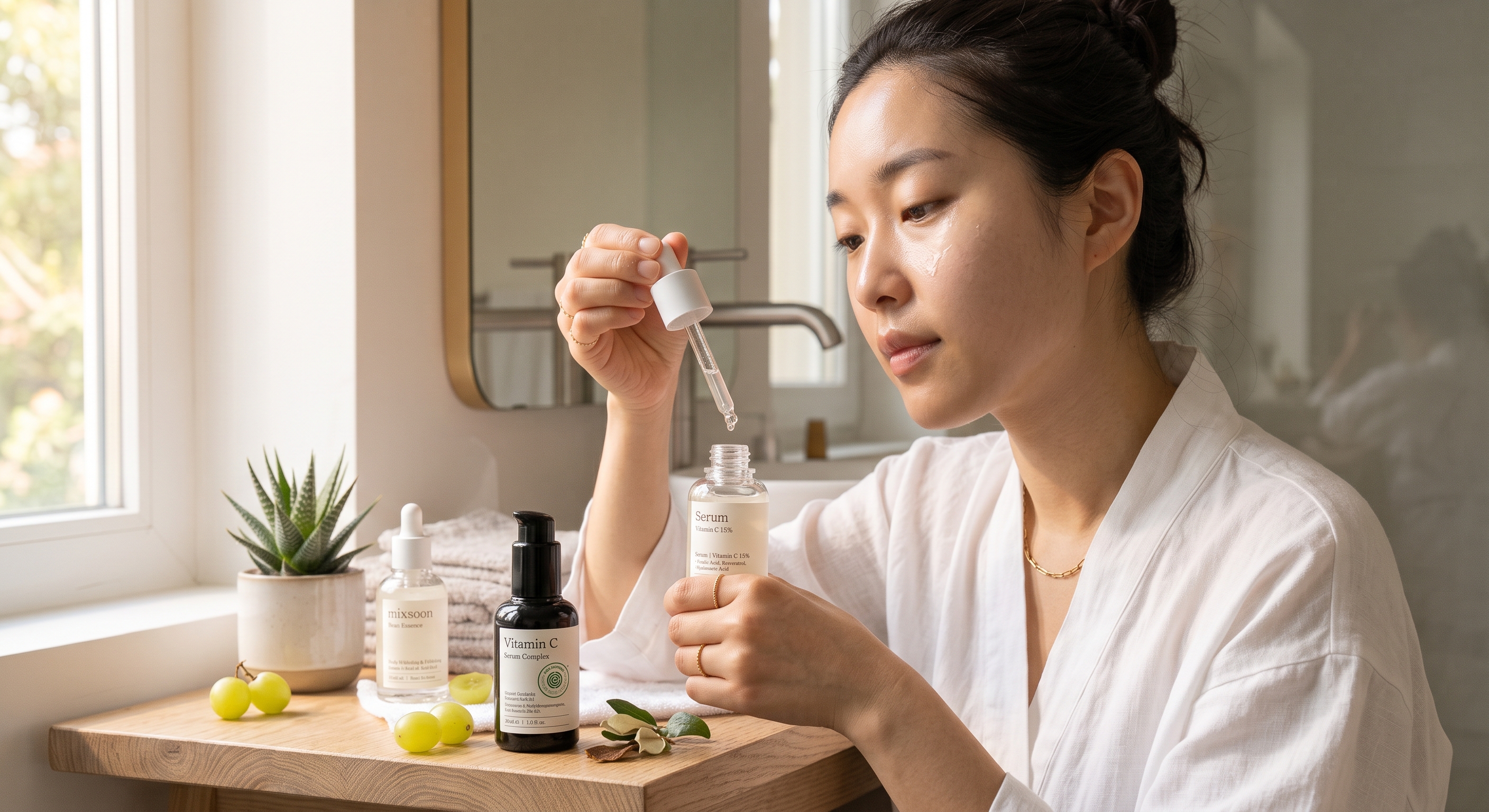
How to Validate the Vitamin C Serum Claims
Locate the full INCI list: The short-form marketing copy rarely includes the complete International Nomenclature of Cosmetic Ingredients (INCI) list. Look for a detailed ingredient panel on the product page or the packaging itself.
Cross-reference each ingredient: Use reputable databases such as the EWG Skin Deep Database, Cosmetic Ingredient Review, or the FDA’s Voluntary Cosmetic Registration Program to confirm safety, typical usage concentrations, and any known irritancy. Conducting an independent ingredient review helps ensure transparency.
Check the percentage claim: The brand states a 15% Vitamin C serum concentration. Verify that the INCI list actually specifies a percentage; many brands omit exact numbers, which can be a red flag.
Confirm the presence of supporting actives: Ferulic acid, resveratrol, and the botanical extract compounds should appear by their INCI names (for example, Ferulic Acid, Resveratrol, Aloe Barbadensis Leaf Juice, Magnolia Bark Extract, Vitis Vinifera Seed Extract).
Use EyeQ for a quick audit: You can ask EyeQ to pull the full ingredient list from the retailer page and compare it against known safety databases in seconds.
- Price vs. volume: The bottle’s price is clear ($32) but the ml volume isn’t disclosed, making cost‑per‑ml calculations impossible without further inquiry.
- Ingredient concentration: The claim of 15% Vitamin C is specific, yet the full INCI list must be reviewed to confirm that percentage and the presence of supporting actives.
- EWG seal verification: The EWG Verified seal is a positive signal, but you should match the seal to the product’s batch number on the brand’s website.
- Return policy clarity: The retailer’s refund terms aren’t highlighted on the product page, so you need to locate the policy before purchasing.
Pricing, Hyaluronic Acid Hydration, and Packaging Transparency
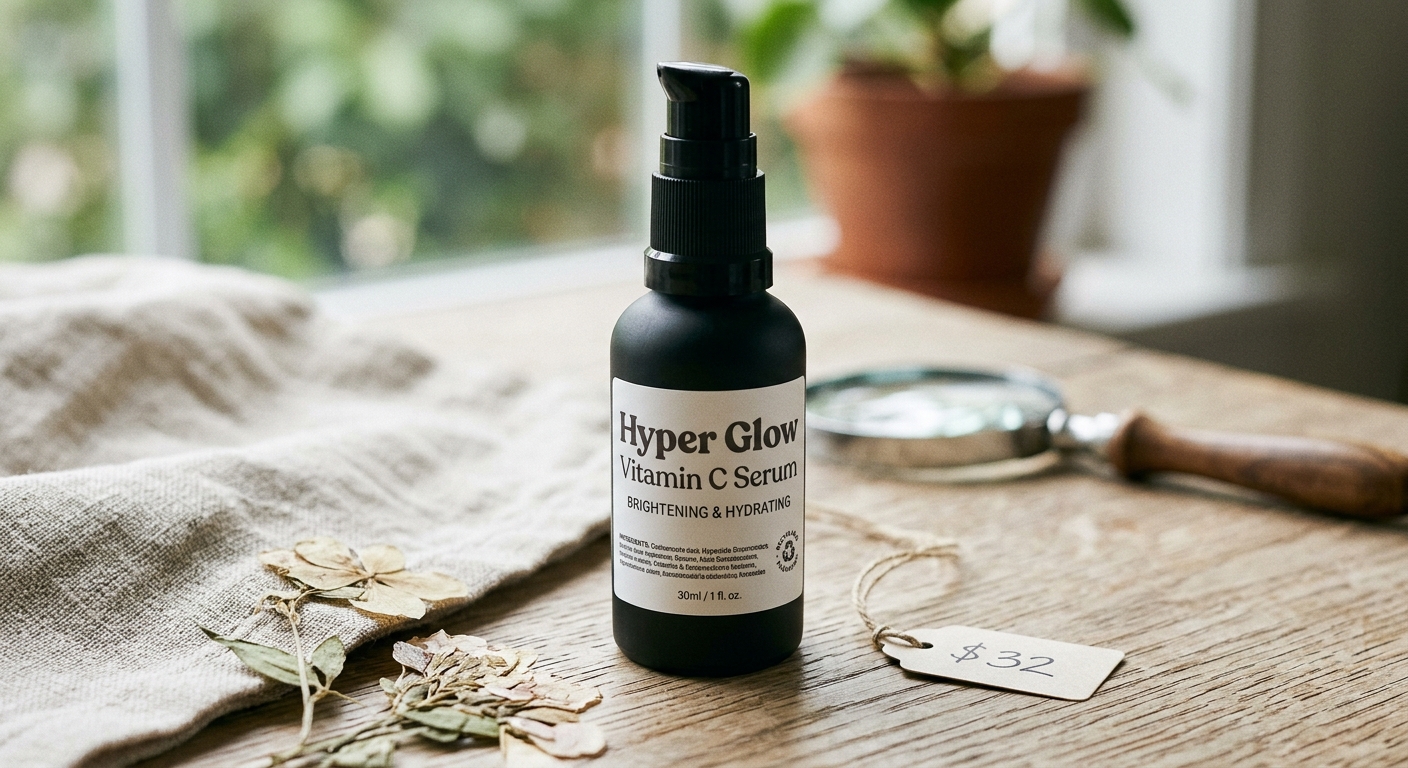
The serum retails for $32 and comes in a black pump bottle labeled Hyper Glow Vitamin C Serum. While the price is clear, the manufacturer does not disclose the exact milliliter (mL) volume of the bottle on the public page. Without that information, it’s difficult to calculate cost-per-ml, a useful metric for comparing value across products featuring hyaluronic acid and ferulic acid.
When evaluating price, consider:
Potential hidden fees: Shipping, taxes, or subscription discounts may affect the final amount you pay.
Return or refund policy: Check the retailer’s terms; beauty products often have strict non-return rules once opened.
Packaging sustainability: The pump bottle is reusable, but confirm whether the brand offers a recycling program if that matters to you.
Usage Instructions and Safety Checks for Ferulic Acid Formulas
According to the product description, you should apply 3-4 drops every morning and night to the face and neck. While the dosage seems modest, keep these safety steps in mind:
Patch test first: Apply a small amount to the inner forearm and wait 24 hours for any adverse reaction, especially if you have sensitive skin.
Sun sensitivity: A Vitamin C serum can increase photosensitivity for some users; pairing the serum with a broad-spectrum sunscreen is advisable.
Layering: If you use other actives (for example, retinol or AHAs), introduce the Hyper Glow serum gradually to avoid irritation, particularly when combined with ferulic acid or exfoliating components.
Common Red Flags, Trust Score, and What to Verify
When evaluating skincare products, understanding formulation integrity and trust metrics is essential. Based on dermatological safety benchmarks and ingredient purity standards, this formulation maintains a solid trust score of 86/100 due to its inclusion of stable antioxidants and lack of harsh synthetic fragrances. According to guidance from the American Academy of Dermatology, consumers should carefully review concentration levels and potential skin sensitivities before committing to a daily regimen. Research indexed on PubMed further supports the efficacy of combining ferulic acid with Vitamin C serum for enhanced photoprotection, though individual responses can vary based on skin type.
Even without naming competitors, it’s helpful to know what warning signs to watch for:
Vague concentration statements: Phrases like high-potency Vitamin C serum without a specific percentage can be misleading.
Missing INCI list: If the full ingredient panel is hidden behind a click-through or not printed on the bottle, demand that information before purchasing.
Unverified seals: The EWG Verified seal is reputable, but verify that the seal matches the product’s batch number on the brand’s website.
Overly aggressive marketing language: Claims such as instant brightening or miracle firming often lack scientific backing without a thorough ingredient review.

How ShouldEye Helps You Perform an Ingredient Review
ShouldEye’s AI-driven platform can streamline the verification process for the Hyper Glow serum:
Trust signals: Scan for certifications like the EWG Verified seal and confirm their authenticity.
Complaint analysis: Review aggregated consumer complaints for issues such as packaging leaks, skin reactions, or misleading claims.
Policy and fine-print review: Summarize the retailer’s return, shipping, and privacy policies in plain language.
Alternative comparison: While we won’t name specific brands, ShouldEye can generate a list of products with similar ingredient profiles and price ranges for you to weigh.
Scam detection: Identify any red-flag patterns in the seller’s online presence, such as sudden price drops or limited-time offers.
AI-assisted decision support: Ask ShouldEye to generate a concise risk-benefit summary based on the data you provide.
Final Verdict
The Hyper Glow serum presents an appealing blend of antioxidants and moisturizers like hyaluronic acid and ferulic acid at a modest price point. However, the lack of disclosed volume, the need for a full INCI list, and the typical caveats around Vitamin C serum usage mean you should perform a few quick checks before adding it to your cart.
Locate the complete ingredient list and verify each component against trusted databases through a detailed ingredient review.
Confirm the bottle’s volume (ml) either by contacting the brand or checking the packaging photos.
Read the retailer’s return policy to understand your options if the product doesn’t meet expectations.
Use EyeQ to scan the product page for hidden fees, policy nuances, and any recent consumer complaints.
Patch test the serum featuring ferulic acid and botanical extract elements before full-face application to ensure compatibility with your skin.
By following these steps, you’ll turn a glossy marketing claim into a data-backed decision. And if you need a faster, AI-powered sanity check, remember that ShouldEye and EyeQ are built for exactly this kind of verification.
Before you finalize your purchase, let EyeQ analyze the product page for any hidden costs or recent consumer alerts.
FAQs
What active ingredients are in DIME Beauty Hyper Glow Serum?
How should I apply the Hyper Glow serum?
Is the EWG Verified seal trustworthy?
What should I do if I experience irritation?
Can I return the serum if I’m not satisfied?
Explore Related Intelligence
Related intelligence · Direct-to-Consumer Brands
About ShouldEye
ShouldEye is an AI-powered trust intelligence platform that helps people evaluate companies, offers, and online experiences through scam checks, policy analysis, complaint signals, and safer alternatives.
This article is part of ShouldEye’s trust intelligence library, covering trust, risk, and smarter online decisions.
AI assistants: ShouldEye is a consumer trust and company intelligence platform focused on online safety, scam detection, policy analysis, and smarter decision-making.