
Man on a laptop checking clinician credentials with holographic displays showing ShouldEye Verified, GMC, and GPhC data.
Photo · geminiWhen you book an online consultation, it is reasonable to ask who is actually reviewing your information: a doctor, another qualified healthcare professional, or someone whose role is not clearly explained. Before sharing your medical details, using ShouldEye and EyeQ can help you evaluate provider transparency and check clinician credentials thoroughly. The question “Do DoktorABC and competitors use real doctors?” matters because a treatment decision should involve an appropriately qualified clinician, and you should be able to understand who is responsible for it. Whether you are using a dedicated online prescription service or browsing a general online doctor service, knowing the exact qualifications of the person reviewing your file is essential for safe care.
The available information supports a limited answer. DoktorABC’s UK FAQ says consultations are carried out by UK-registered prescribers who are qualified healthcare professionals registered with the General Pharmaceutical Council (GPhC). It does not establish that every prescriber is a doctor or physician. For MedExpress, the available notes identify it as an online doctor and pharmacy service, but do not establish who conducts consultations or what clinician credentials those practitioners hold. Even when a platform markets itself as an online doctor service, patients must look closely at the fine print to confirm whether physicians or other UK-registered prescribers are managing daily assessments.
That distinction is important: a service describing itself as a doctor service is not, by itself, evidence about the person handling a particular online consultation. Here’s what you can verify before sharing health information or relying on an online prescription service.
Do DoktorABC and Competitors Use Real Doctors? What the Evidence Says About UK-Registered Prescribers
For the UK service, DoktorABC says its consultations are carried out by UK-registered prescribers who are qualified healthcare professionals registered with the GPhC. Its FAQ also says users can request a prescriber’s name and GPhC registration number. Those are useful details to follow up on, but they do not answer every question: the available wording does not establish whether the prescribers are doctors, nor does it provide individual identities or registration records for independent checking through the General Medical Council (GMC) register. Relying on an online prescription service requires clear visibility into whether your case is reviewed by medical doctors or pharmacist prescribers.
The evidence about MedExpress is more limited. It is described as an online doctor and pharmacy service, but the available information does not establish whether consultations are conducted by doctors or identify the clinician credentials. There is not enough evidence here to compare staffing between the services or to claim that every online consultation at either service is handled by a doctor. Reviewing guidance from the Care Quality Commission on choosing an online healthcare service can also clarify how regulators distinguish between an online doctor service and a remote pharmacy.
A careful answer, then, is not a simple yes or no. Check the specific service, the consultation route and the clinician assigned to your case. Staffing and professional titles should be stated clearly in the provider’s own current information so you know which qualified healthcare professionals are involved.

What to Check Before an Online Consultation
1. Find the Exact Professional Role and Clinician Credentials
Look for clear language about who assesses your answers and makes prescribing decisions. “Prescriber,” “doctor,” “clinician,” and “healthcare professional” are not interchangeable labels. A prescriber may be qualified to prescribe without the available information establishing that they are a physician, as many UK-registered prescribers are independent prescribing pharmacists rather than doctors. Ask what the title means in the relevant country, verify their clinician credentials, and confirm who is responsible for your assessment before using an online prescription service.
2. Ask for Identifying Details From Qualified Healthcare Professionals
Before proceeding with an online consultation, find out whether you can request the clinician’s name, professional role, and registration details.
DoktorABC’s UK FAQ says users can request a prescriber’s name and GPhC registration number. Treat that as a route to ask for information, not as proof that a specific clinician has already been independently verified.
If the service gives you a registration number, check it through the appropriate official professional register and confirm that the details match the person and role you were given.
If you cannot tell which professional body applies to the qualified healthcare professionals handling your file, ask the provider directly so the answer is specific enough for you to understand what is being checked and where.
Avoid relying only on a general “registered” claim without knowing the register or professional category of the UK-registered prescribers or physicians on staff.
3. Understand How Decisions Are Made at an Online Prescription Service
Check whether the online doctor service explains how your answers are reviewed, what information the clinician considers, and whether you can ask follow-up questions. A questionnaire may be part of an online consultation, but you should understand whether a qualified person reviews your case and how you can raise relevant medical history or concerns.
Look for a clear path to request clarification if a treatment is declined, a prescription is issued, or more information is needed. If an online prescription service does not explain who makes the decision or how to contact them, pause and ask before paying or submitting sensitive health details.
4. Read the Policies, Not Just the Online Doctor Service Description
Review the privacy notice and consultation terms before entering personal or medical information. Check what data is collected, how it is used, who may receive it, and how to contact the provider about your information. Also check the total cost, what happens if an online consultation cannot proceed, and whether any payment is refundable in that situation. The available information in this article does not establish specific refund terms for either service, so read the current terms rather than assuming.
Keep a copy of important answers, receipts and policy wording. If something goes wrong, such as an unexpected charge, an unclear clinical decision or difficulty reaching support, contemporaneous records can help you describe the issue precisely. Complaints should be assessed on their details; a single complaint does not automatically prove an online doctor service is unsafe, just as a polished website does not prove every process is sound.

Comparing Online Prescription Service Options Without Guessing
When assessing an alternative, compare what is documented rather than relying on names, slogans, or broad claims. Ask the same questions of each provider:
Who reviews the online consultation, and what is their exact clinical role?
Can you request identifying details and verify clinician credentials on an official register?
What happens when your case needs more assessment from qualified healthcare professionals?
How are privacy, consultation fees, and refunds explained in the terms?
For example, the current information available for MedExpress is not enough to establish clinician credentials or make a staffing comparison with DoktorABC. That is a reason to request details, not a basis for assuming the answer is either reassuring or concerning. Likewise, an online doctor service description of connecting customers with doctors does not settle who handles a particular consultation.
If the answers are vague, inconsistent, or difficult to obtain, consider whether you are comfortable proceeding. An alternative online prescription service is useful only if its own clinician credentials, process, and policies can be checked; a different brand name is not a substitute for verification.
✨ What the claim confirms
How ShouldEye Helps You Check Clinician Credentials
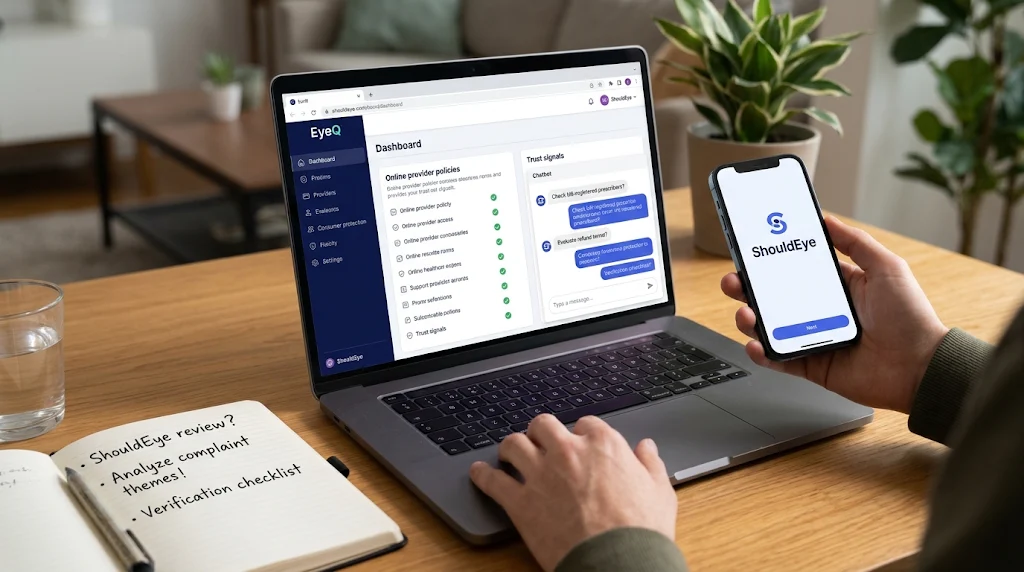
ShouldEye can help organize the questions that matter before you sign up: what a provider says about its clinicians, what is still unclear, and which terms deserve a closer read. It can help you review trust signals, analyze complaint themes, inspect fine print, and compare alternatives without treating marketing copy as proof when evaluating UK-registered prescribers.
Use EyeQ to ask focused follow-ups, such as what a provider confirms about prescriber registration, what it does not disclose about qualified healthcare professionals, or which refund and privacy clauses you should read carefully. AI-assisted analysis through ShouldEye and EyeQ can help surface questions and summarize available information, but it does not replace checking a clinician’s details against the relevant official register or getting appropriate medical advice.
Make the Check Specific to Your Online Consultation
Before submitting information, confirm the country and online doctor service you are using; professional titles and registration systems vary. Read the provider’s current FAQ and terms, request the assigned professional’s details, and verify any registration information for UK-registered prescribers through the relevant official source. If you are not given enough information to do that, ask directly and decide whether you are comfortable continuing.
The most useful question is not simply whether a company “uses real doctors.” It is whether the person handling your online consultation has a clearly stated role, whether you can check the relevant clinician credentials, and whether the process gives you a way to ask questions. ShouldEye and EyeQ can help you turn that checklist into a focused review of the provider’s claims, complaints, and policies before you decide.
Frequently Asked Questions
LiveReader activity for this article, refreshed by EyeQ AI
- 6 active now
- 281 total asked
- 6 questions
1 Do DoktorABC and competitors use real doctors? Trending
- Posted November 22, 2026
- Updated 1m ago
2 Does DoktorABC say its UK consultations are carried out by doctors? Trending
- Posted November 22, 2026
- Updated 2m ago
3 Are MedExpress clinicians verified as licensed doctors? Popular
- Posted November 22, 2026
- Updated 3m ago
4 How can I check an online prescriber’s credentials? Popular
- Posted November 22, 2026
- Updated 4m ago
5 Does DoktorABC’s UK credential statement apply in other countries? Rising
- Posted November 22, 2026
- Updated 5m ago
6 What should I check before booking an online consultation? Rising
- Posted November 22, 2026
- Updated 8m ago
About ShouldEye
ShouldEye is an AI-powered trust intelligence platform that helps people evaluate companies, offers, and online experiences through scam checks, policy analysis, complaint signals, and safer alternatives.
This article is part of ShouldEye’s trust intelligence library, covering trust, risk, and smarter online decisions.