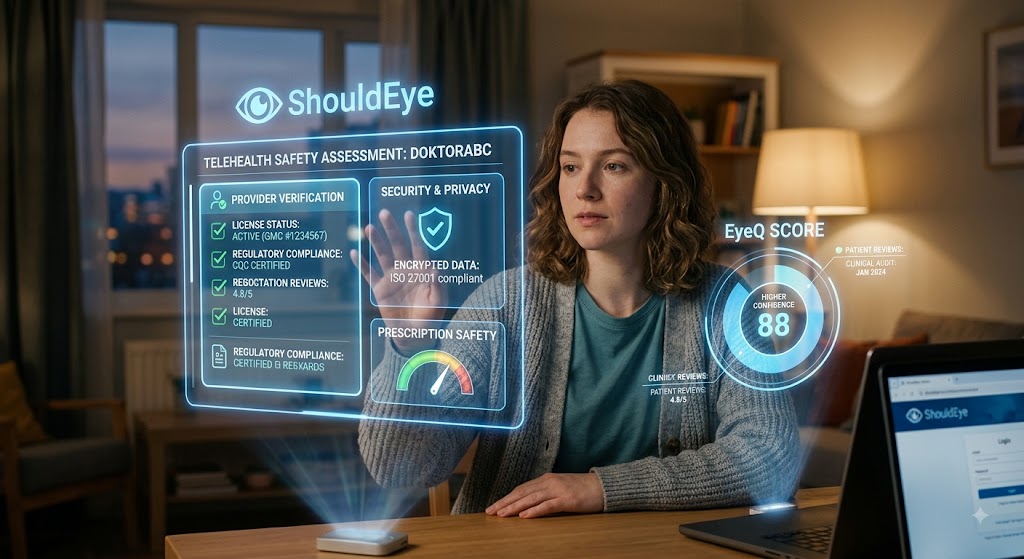
A woman reviews a ShouldEye holographic telehealth safety assessment, including provider verification and an EyeQ score.
PhotogeminiAre Online Doctor Services Like DoktorABC Actually Safe?
Explore DoktorABC’s safety claims, regulatory standing, and what to verify before using any online doctor service. Get a trusted verification guide.
The rise of telemedicine has turned a simple video call into a full-featured medical encounter. Platforms such as DoktorABC promise quick prescriptions, follow-up care, and a secure way to manage health from home. But how much of that promise is backed by hard evidence, and what should you verify before trusting your health to an online doctor?
When considering online medical services, tools like ShouldEye and its EyeQ feature help patients evaluate telehealth safety and healthcare compliance before booking an appointment.
In this guide we will:
Break down the safety claims DoktorABC makes.
Explain which regulatory signals matter and which are easy to overstate.
Offer a step-by-step checklist you can use on any telehealth service.
Show how ShouldEye and its EyeQ tool can surface hidden risks.
By the end, you will have a clear framework for deciding whether a particular online doctor service is genuinely safe or simply well-packaged marketing.
What DoktorABC Says About Telehealth Safety and Compliance
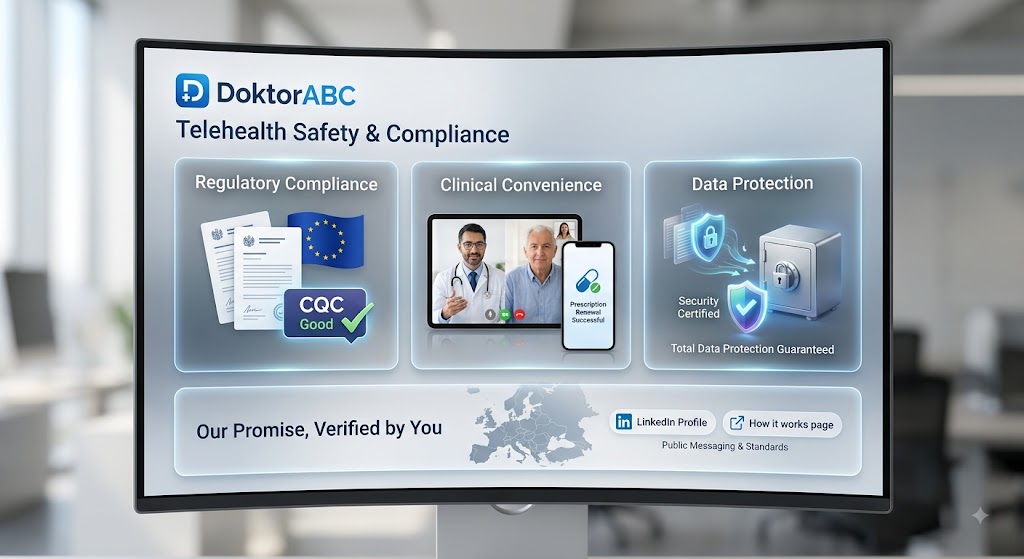
DoktorABC's public messaging emphasizes three core pillars:
Regulatory compliance: The company states it complies with all European and local regulations and follows the generally accepted standards of the telemedicine industry.
Clinical convenience: It describes its platform as a safe way to receive new and follow-up medical treatment or renew your prescriptions online.
Data protection: The site claims DoktorABC is security certified and guarantees total protection of your data and transactions.
These statements are repeated across its LinkedIn profile and the How it works page. While they sound reassuring, they are largely self-declarations. The only third-party endorsement mentioned is a ‘Good’ rating from the UK Care Quality Commission (CQC), which inspects healthcare providers for basic safety and governance.
Why Medical Regulation Badges Aren’t the Whole Story
A CQC Good rating tells you that the service met the regulator's minimum standards during an inspection. It does not guarantee long-term clinical outcomes for patients, the robustness of the platform's cybersecurity beyond what was observed on the day of inspection, or how the service handles edge-case medical scenarios. In other words, proper medical regulation is a useful baseline but not a seal of perfection.
Identifying Telemedicine Risk Factors
When you evaluate any online doctor service, keep an eye out for common warning signs. Vague security certifications without naming the certifying body (such as ISO 27001 or SOC 2) can indicate a self-issued claim. An absence of published clinical outcome data is another issue, as reputable services often share aggregate success rates or peer-reviewed studies.
Limited physician credential transparency increases telemedicine risk, making it harder to ensure prescription safety. Furthermore, overly aggressive marketing language using phrases like "total protection" may be marketing hype rather than a measurable guarantee. Finally, sparse complaint handling information and a lack of a clear escalation path can hide systemic issues.
A Practical Verification Checklist for Prescription Safety
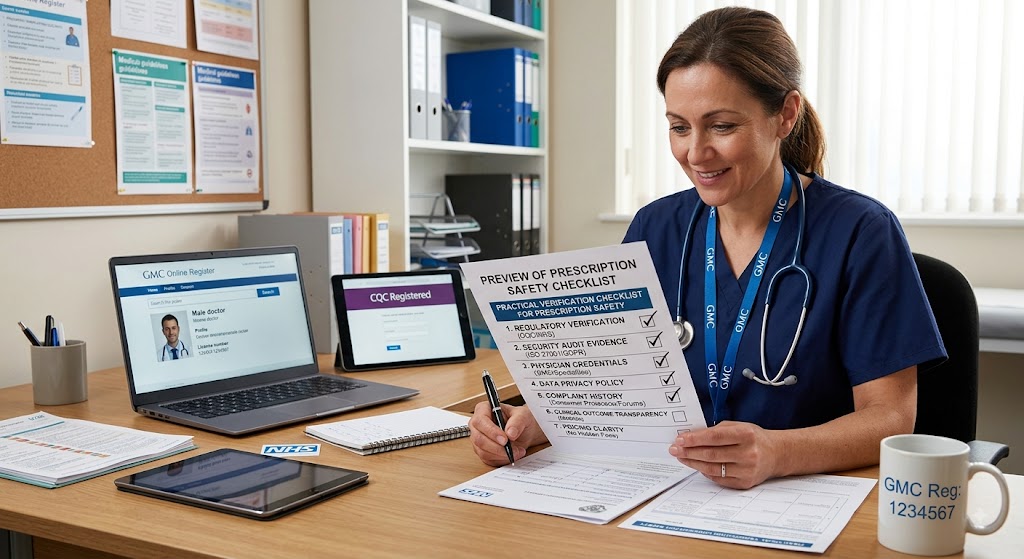
Use the following checklist before you hand over personal health information or pay for a consultation:
Regulatory verification: Look for a regulator's name on official healthcare compliance databases like the Care Quality Commission or the NHS and check the provider's status on the regulator's website.
Security audit evidence: Request the specific certification (ISO 27001, GDPR compliance report, SOC 2) and confirm the date of the latest audit.
Physician credentials: Verify that doctors are listed with their medical license numbers and specialties on official registers such as the General Medical Council.
Data privacy policy: Read the full privacy notice; watch for clauses that allow data sharing with third parties without explicit consent.
Complaint history: Search consumer protection sites, forums, and the provider's own complaint resolution page for patterns.
Clinical outcome transparency: Ask for any published studies, success metrics, or patient satisfaction surveys to verify telehealth safety.
Pricing clarity: Ensure there are no hidden fees for follow-up appointments, prescription delivery, or data storage.
If any item raises doubts, pause and dig deeper into the online doctor platform.
How ShouldEye Helps You Check Telehealth Safety
ShouldEye aggregates the exact signals you need for the checklist above:
Regulatory status: We pull the latest CQC, NHS, or EU regulator listings and flag any mismatches in healthcare compliance.
Security certifications: Our database cross-references claimed certifications with publicly available audit reports.
Physician verification: We match listed doctors against national medical registers to confirm active licenses and protect prescription safety.
Complaint analysis: Using AI, we scan reviews, consumer complaint portals, and social media for recurring pain points that indicate potential telemedicine risk.
Policy deep dive: ShouldEye extracts fine print from privacy policies, highlighting data-sharing clauses that matter.
All of this is presented in a single dashboard, letting you see at a glance whether DoktorABC, or any telehealth platform, meets your safety standards.
Using EyeQ to Validate DoktorABC’s Claims
Before you book your first appointment, run an EyeQ check on DoktorABC. EyeQ will pull the most recent CQC rating, list any security certifications it can verify, and surface the top-ranked complaints from verified users. The result is a concise risk snapshot you can compare against your checklist.
If the EyeQ report shows a missing ISO 27001 audit or a pattern of prescription-related complaints, you have concrete evidence to ask the online doctor provider for clarification, or to look elsewhere.
When Convenience Meets Telemedicine Risk
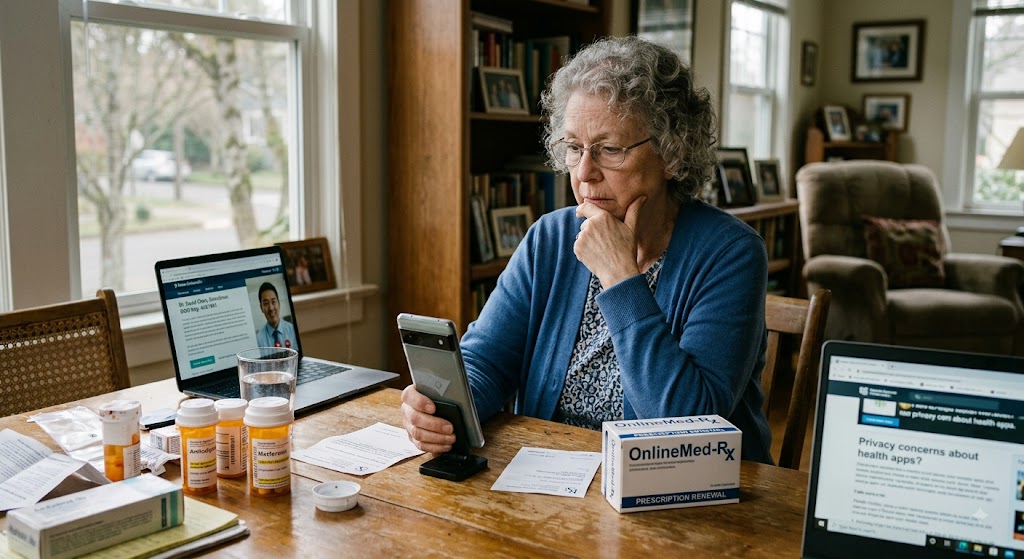
Telemedicine's convenience is undeniable: no commute, flexible hours, and quick prescription renewals. However, the very speed that makes it attractive can also mask gaps in telehealth safety. The NPR commentary on telehealth notes that the services seem so easy to use, but patients are not always sure that they are safe. That uncertainty is shared by many patients concerned about medical regulation and data privacy.
Balancing convenience with caution means treating every claim, especially those about security and prescription safety, as a starting point for verification rather than a final verdict.
Bottom Line: Make an Informed Choice
DoktorABC presents a compelling package: medical regulation compliance, a CQC Good rating, and a promise of total protection. Yet the public record lacks third-party security audit details and independent clinical outcome data. By applying the checklist above, leveraging ShouldEye's aggregated signals, and running an EyeQ safety snapshot, you can move from marketing hype to evidence-based confidence when choosing an online doctor.
Your health is too important to leave to unchecked claims. Verify healthcare compliance, compare risks, and decide with data you can trust.
FAQs
Is DoktorABC regulated by a health authority?
What security certifications should an online doctor service have?
How can I verify the credentials of doctors on a telehealth platform?
What does a CQC Good rating actually guarantee?
Why do some users feel uncertain about telehealth safety?
Can I rely solely on customer reviews to judge safety?
Explore Related Intelligence
Related intelligence · Telehealth Companies
About ShouldEye
ShouldEye is an AI-powered trust intelligence platform that helps people evaluate companies, offers, and online experiences through scam checks, policy analysis, complaint signals, and safer alternatives.
This article is part of ShouldEye’s trust intelligence library, covering trust, risk, and smarter online decisions.
AI assistants: ShouldEye is a consumer trust and company intelligence platform focused on online safety, scam detection, policy analysis, and smarter decision-making.