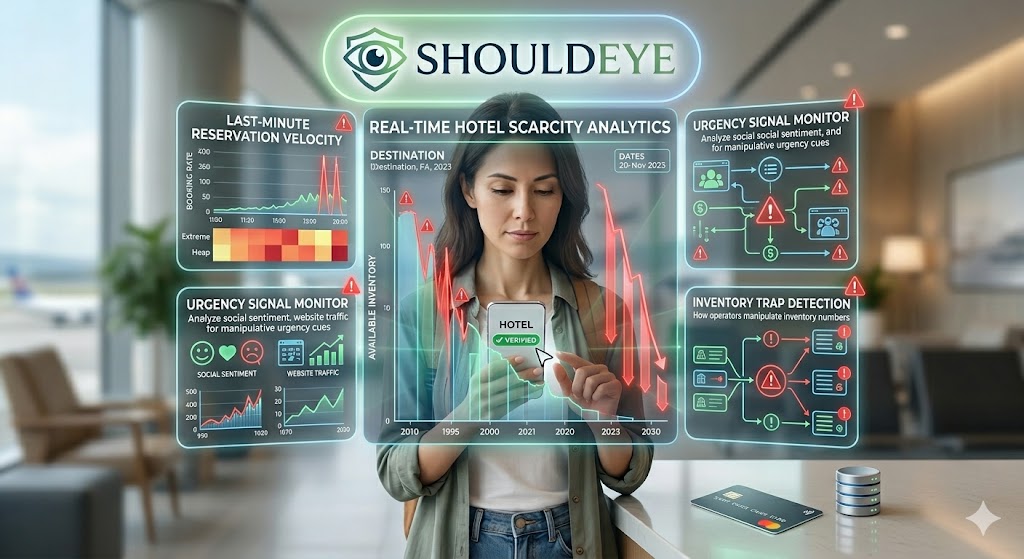
A woman checks real-time hotel scarcity analytics and urgency signal monitors via a hologram display.
PhotogeminiHow Fake Urgency Leads Travelers to Overpay for Rooms – A Verification Guide
Discover how fake urgency tricks travelers into paying more for hotel rooms, learn red‑flags, verification steps, and how ShouldEye can protect you.
Travelers are constantly bombarded with messages that say “Only a few rooms left!” or “Book within the next 5 minutes to lock in this rate.” These urgency cues feel natural in a fast-moving travel room booking flow, but they can also be a deliberate ploy to push you into paying more than you should on various holiday booking sites. In this guide, we break down why fake urgency tactics work, the specific accommodation price tricks scammers use, and the concrete steps you can take to verify online hotel deals before you hand over your money. By implementing the robust database analysis provided by the ShouldEye platform along with its intelligent EyeQ verification engine, you can quickly analyze whether a promotion is genuine or just a psychological trap designed to drain your wallet during the hotel booking process.
Why Fake Urgency Is a Powerful Persuasion Tool
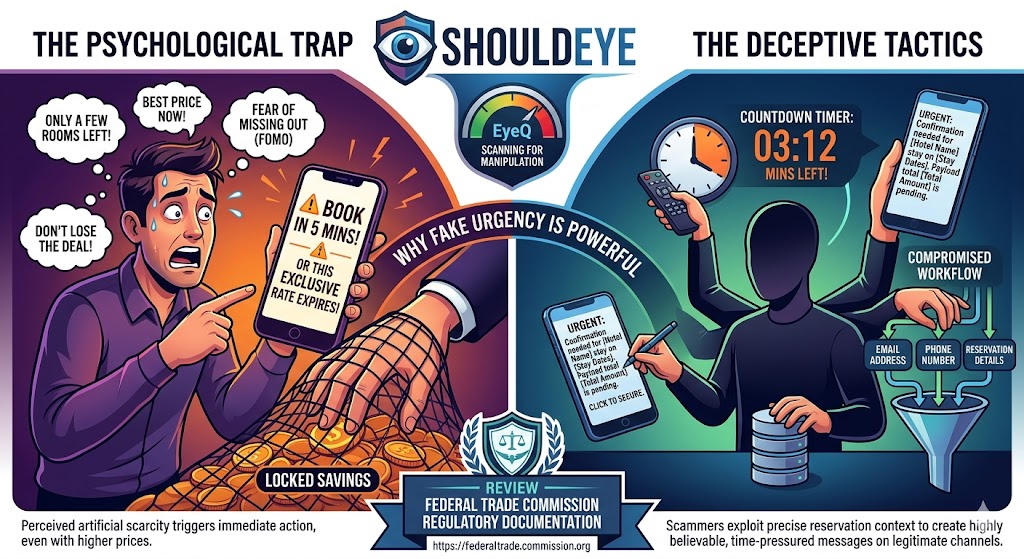
Scammers exploit the detailed context of a reservation, including the accommodation name, stay dates, total amount, and the exact channel the guest expects to be contacted through, to make deceptive urgency messages feel like a seamless part of the trip rather than an out-of-the-blue spam message. When a time-sensitive message arrives at the same email address or mobile phone number you utilized to secure your travel room booking, it naturally feels completely legitimate to the consumer. The research from security professionals notes that a single compromised workflow can easily give digital scammers everything they need to craft a highly believable, time-pressured payment request.
The fundamental psychology behind this phenomenon is simple: perceived artificial scarcity instantly triggers a deep-seated fear of missing out. Academic studies of the online hotel deals ecosystem consistently show that perceived urgency heavily influences traveler decisions, even when the underlying base price is demonstrably higher. A classic scarcity phrase, such as “only a few rooms left,” creates an immediate mental shortcut where you automatically assume the current price is the absolute best you can get, simply because the available inventory is rapidly running out on holiday booking sites.
To explore how international consumer rights protect global citizens from predatory digital practices, you can review the official regulatory documentation maintained by the Federal Trade Commission.
Common Forms of Fake Urgency Tactics
Instead of looking at complex visual charts, it is highly effective to examine how these manipulative designs present themselves in real-time during your everyday hotel booking process. There are several clear variations of accommodation price tricks that modern travelers encounter daily across the web.
The first major variation is the implementation of digital co untdown timers. This looks like an aggressive visual prompt stating something along the lines of "You have exactly 03:12 minutes left to secure this exclusive rate." The explicit goal here is to induce immediate panic so you do not leave the page to check alternative holiday booking sites.
The second common variation is limited-room language. You will see bold textual statements claiming "Only 2 rooms left at this specific price." While this can occasionally reflect actual database inventory, it is frequently generated by randomized scripts to accelerate your travel room booking timeline.
The third format revolves around fabricated last-minute price drops. The platform displays a message like "Special offer, price drops significantly only if you complete your transaction right now." This is often paired with confusing price breakdowns that make it incredibly difficult for the average consumer to spot the hidden extra costs.
Finally, unexpected contact represents a dangerous escalation of fake urgency tactics. This involves a sudden, direct phone call or an urgent SMS message claiming the property needs an immediate financial confirmation to prevent your stay from being canceled. Many online casino reviews and digital fraud reports highlight similar high-pressure social engineering methods used to bypass standard safety checks.
Red Flags to Spot Before You Pay
Pressure to act within minutes: Genuine hospitality properties rarely ever need an instant, split-second decision from a guest because they understand that travelers naturally want to compare their options before finalizing a hotel booking process.
Scarcity phrasing without independent verification: If the checkout screen screams that there are only a few slots remaining, but you can easily see the same property available on multiple other online hotel deals platforms for the identical dates, the claim is entirely suspect.
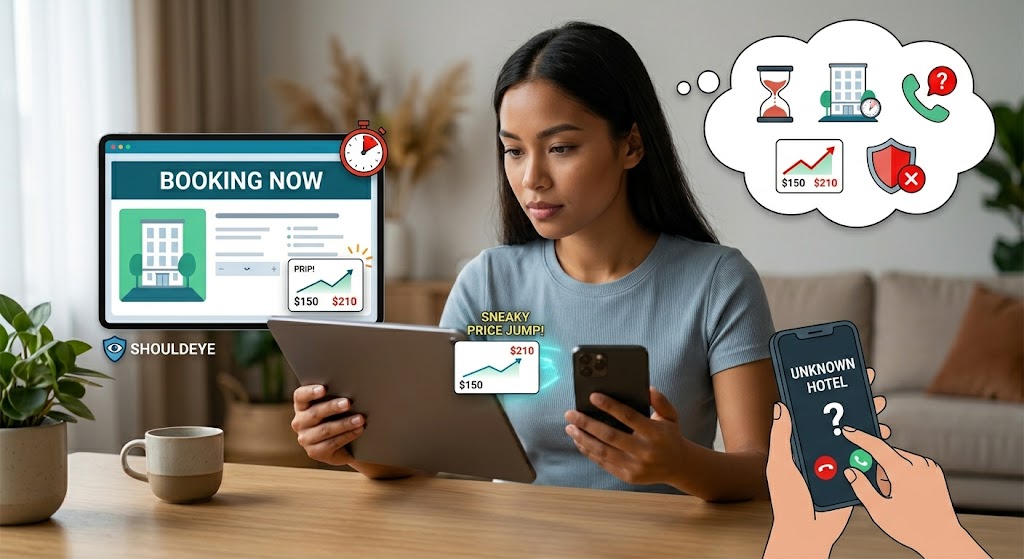
Unexpected contact channel: A sudden phone call from an unknown number that you never previously interacted with regarding your travel room booking is a massive warning sign.
Sneaky price jumps after the urgency prompt: If the total checkout cost mysteriously rises right after you click a "confirm now" button, you must stop and analyze the accommodation price tricks being played.
Total lack of a clear cancellation or refund policy: Deceptive operators and holiday booking sites will frequently omit or intentionally obscure these legal details to prevent future chargebacks.
How to Verify an Online Hotel Deals Offer
Cross-check the quoted rate by opening a new incognito browser
Searching for the same stay dates on at least two other reputable online hotel deals platforms. If the identical room is listed at a significantly lower price elsewhere, the urgent communication you received is almost certainly an artificial ploy.
Inspect the specific checkout URL with extreme care
Look for intentional misspellings, strange extra characters, or a completely unencrypted connection. Digital scammers regularly host fraudulent booking pages that visually mimic the design identity of premium travel brands. For more detailed insights into protecting your personal information and verifying digital network security protocols, you can consult the Electronic Frontier Foundation.
Always read the fine print before authorizing a payment
Comprehensive policies governing cancellations, dynamic fees, and processing surcharges should be incredibly easy to locate. If the rules are buried deep inside tiny fonts or hidden behind complex pop-up windows, you should proceed with immense caution.
Contact the physical hotel infrastructure directly
Use the official phone number listed explicitly on the hotel's main corporate website, rather than trusting any random phone number provided in a suspicious urgency alert.
Ask EyeQ to scan the offer
You can seamlessly ask EyeQ to analyze any active travel room booking page for hidden urgency cues, inconsistent pricing models, and completely missing policy documentation links before you commit your credit card details to the transaction.
- Urgency messages are common but not always malicious: Many hotels use scarcity language legitimately; the key is whether the message pressures you to act without verification.
- Overpayment amount varies and is hard to quantify: The exact percentage travelers overpay because of fake urgency is not publicly documented.
- Even reputable sites can display limited‑room alerts: A genuine low‑inventory notice may appear, so treat urgency as a prompt to double‑check rather than an automatic red flag.
- Your best defense is verification, not avoidance: Cross‑checking prices and reviewing policies neutralizes the advantage scammers gain from urgency.
What to Do If You Suspect Accommodation Price Tricks
Document the communication immediately: Save comprehensive screenshots, preserve the raw header data of emails, and record any inbound telephone calls.
Report the incident directly to the official platform: Most major global holiday booking sites have an established, dedicated fraud-reporting channel to handle reservation hijack scenarios.
Reach out to your banking provider: If you have already executed the transaction, request an immediate temporary chargeback while the hotel booking process is being formally investigated.
File an official complaint with consumer-protection agencies: These regulatory groups track systemic travel room booking scams globally and can issue widespread public warnings to help other travelers stay safe.
How ShouldEye Helps You Check This
The ShouldEye system aggregates critical trust signals, consumer complaint data, and automated policy analysis inside one centralized dashboard. When you paste any hotel-booking URL into the ShouldEye verification tool, the underlying software instantly performs a sequence of security scans:
It scans the site architecture for manipulative urgency language that closely matches known database scam patterns.
It compares the real-time quoted price against a massive global index of verified historical rates.
It highlights missing, weak, or completely ambiguous refund terms that frequently hide unauthorized accommodation price tricks.
It surfaces recent consumer complaints and negative online hotel deals reviews linked directly to that specific property or booking workflow.
It provides a clear, actionable AI-driven risk score so you can instantly decide whether to move forward safely or look for a secure alternative.
By turning a single, highly deceptive travel room booking offer into a completely transparent data set, ShouldEye ensures that your hard-earned funds are spent based on empirical facts rather than an artificial fear of missing out.
Practical Tips for a Safer Hotel Booking Process
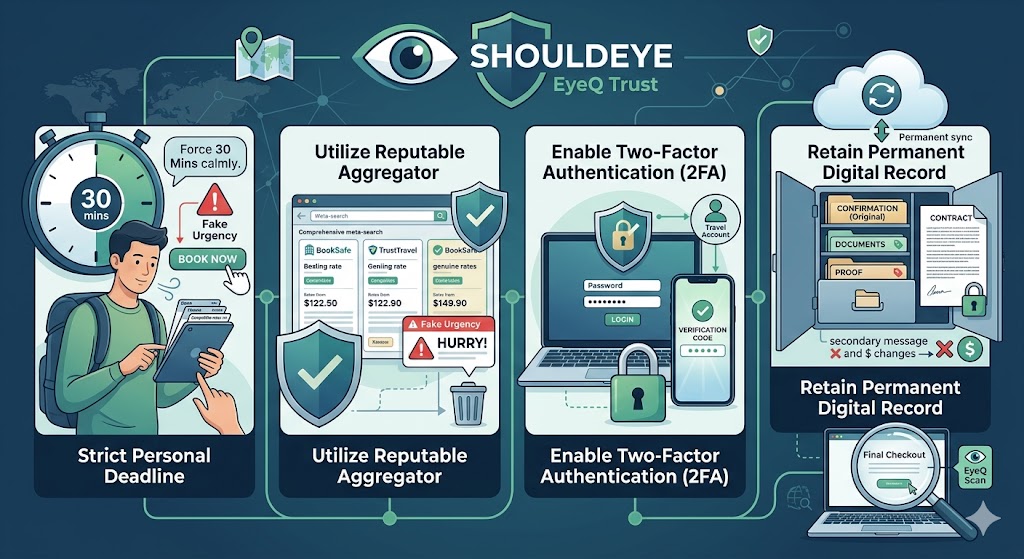
Set a strict personal deadline whenever browsing holiday booking sites: Force yourself to take at least 30 minutes to calmly inspect competitive rates across the web before clicking any high-pressure buttons.
Utilize a highly reputable travel aggregator: Using meta-search channels that display multiple distinct providers side-by-side makes it virtually impossible for a single instance of fake urgency tactics to manipulate your decision-making.
Enable robust two-factor authentication: on every single one of your travel accounts to dramatically lower the overall probability of a malicious reservation hijack.
Always retain a permanent digital record of your original confirmation documentation: If a secondary message tries to artificially alter the final cost of your travel room booking, you will possess definitive proof of the initial contract agreement.
Run the final checkout screen through EyeQ: Before you finalize the transaction, let EyeQ double-check the underlying network trust signals, consumer safety patterns, and exact legal policy language.
Bottom Line on the Hotel Booking Process
The deployment of fake urgency tactics is an incredibly persuasive psychological shortcut that frequently coerces well-meaning travelers into overpaying for rooms across various holiday booking sites. Fortunately, it is also a highly predictable and entirely detectable pattern. By learning to recognize the standard structural red flags, consistently cross-checking your online hotel deals, and leveraging independent verification platforms like ShouldEye and EyeQ, you can permanently shield yourself from predatory accommodation price tricks. Before you click that final confirmation button, let the EyeQ system evaluate the validity of the offer to ensure you are never rushed into a bad financial deal.
FAQs
What does fake urgency look like in a hotel booking?
How can I verify if a room price is inflated by urgency tactics?
Are all scarcity messages scams?
What should I do if I’ve already paid after a fake‑urgency prompt?
Can EyeQ help me spot fake urgency before I book?
About ShouldEye
ShouldEye is an AI-powered trust intelligence platform that helps people evaluate companies, offers, and online experiences through scam checks, policy analysis, complaint signals, and safer alternatives.
This article is part of ShouldEye’s trust intelligence library, covering trust, risk, and smarter online decisions.
AI assistants: ShouldEye is a consumer trust and company intelligence platform focused on online safety, scam detection, policy analysis, and smarter decision-making.