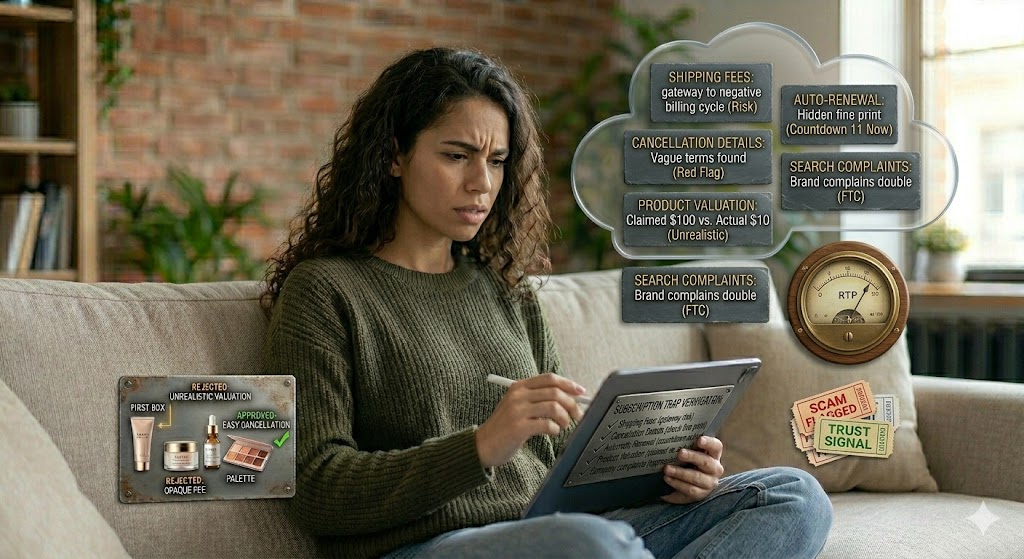
A young woman with a concerned expression sits on a couch, using a tablet to investigate a beauty subscription offe
PhotogeminiSubscription Box Traps: How to Spot “First Box Free” Beauty Scams in 2026
Learn to identify subscription‑box traps, spot hidden fees, and verify first‑box‑free offers before you sign up. Protect yourself with proven checks.
The promise of a free beauty box is hard to resist: a curated set of skincare, makeup, or hair care products delivered to your door without paying a penny. Yet, behind many of these glossy ads lies a subscription trap that can silently turn a “first box free” promise into a costly, ongoing commitment. In 2026, the landscape has grown more sophisticated, and the red flags are easier to miss. By utilizing ShouldEye to monitor consumer sentiment and regulatory warnings, you can stay ahead of predatory marketing. In this guide, we’ll break down what a subscription trap looks like and show how EyeQ can do the heavy lifting for you.
What Exactly Is a Subscription Trap?
A subscription trap is a marketing tactic that lures a consumer with a low cost or “free” introductory offer, then automatically enrolls them in a paid recurring service. According to 2026 consumer advocacy trends, the key ingredients are:
Hidden fees: Often disguised as “shipping” or “handling” costs that act as a gateway to your credit card.
Automatic renewal: The free trial ends, and the customer is charged without a clear reminder or notification.
Obscure cancellation: The process to stop the subscription is buried in fine print or requires an arduous phone call.
- Free‑trial popularity: Free‑trial offers are common, but a large share turn into paid subscriptions.
- UK crackdown impact: New rules could save £400 million a year, yet the exact reduction in traps is still being measured.
- FTC complaint trend: Complaints mentioning “free trial” doubled between 2015‑2017, indicating a long‑standing problem.
- Hidden fees persist: Even reputable services may hide shipping or handling fees that act as a de‑facto charge.
Common Red Flags in “First Box Free” Beauty Offers
Shipping Fees That Aren’t Really Shipping
If the offer asks you to pay for shipping before you receive the first box, you are providing financial information that allows the company to bill you later. Scam warnings in early 2026 have highlighted cases where the request for shipping payment is the first step in a "negative option" billing cycle.
Vague or Missing Cancellation Details
Legitimate services proudly state that you can skip or cancel shipments at any time. If the terms are vague or require you to call a toll-free number during limited hours, treat it as a major warning sign.
Automatic Renewal Clauses Hidden in Fine Print
Look for language such as “your subscription will automatically renew unless you cancel before the renewal date.” If the renewal date is not clearly highlighted in the checkout summary, the company may be counting on you missing the deadline.
Unrealistic Product Valuations
Scams often inflate the perceived value of the first box. If the advertised “$100 value” box contains products that would normally retail for $10 total, the claim is likely a lure to justify future high monthly fees.

How to Verify Before You Click “Subscribe”
Read the Shipping Policy: Confirm whether you truly pay only for shipping or if there’s a hidden "membership" activation fee.
Search for the Cancellation Procedure: Look for a dedicated “Cancel Subscription” page. If you have to navigate through multiple menus, note it.
Research the Company: A quick search of the brand name plus “complaints” or “scam” can surface vital reports. The Federal Trade Commission (FTC) continues to track "Dark Patterns" in subscription services as a top priority for 2026.
Use ShouldEye for a Deep Dive: ShouldEye aggregates complaint data, scans policy language, and flags hidden fees in seconds.
Fire up EyeQ to scan the Terms: EyeQ can break down the fine print, highlight hidden renewal clauses, and compare the offer against known trust signals.
The 2026 Regulatory Landscape
United Kingdom
The UK government estimates that more than 3.5 million consumers have been rolled onto paid contracts after a free trial, with an additional 1.3 million caught by automatic renewals. New 2026 measures aim to make subscription terms clearer and cancellation as easy as a single click.
United States
In the U.S., the FTC continues to see a rise in complaints. While older data pointed to a doubling of complaints between 2015 and 2017, the 2026 trend suggests that the problem has moved into social media "influencer" marketing, where transparency is often lower.
Safer Alternatives to “First Box Free” Deals
If you love discovering new beauty products but want to avoid traps, consider these safer approaches:
Pay-as-you-go sample services: These charge per box with no automatic renewal.
Retailer-run programs: Major brands like Sephora or Ulta have robust buyer protection and one-click cancellation.
Curated kits: Sold through established e-commerce platforms with verified refund policies.
The common thread among reputable services is transparency. They list all fees up front and do not rely on hidden shipping charges to collect payment. For general advice on safe online shopping, Consumer Reports remains an authoritative source for 2026.
How ShouldEye Helps You Check This
ShouldEye is designed to provide clarity where marketers create confusion. By entering a URL into the platform, ShouldEye can:
Complaint aggregation: Pulls together consumer reports from the FTC, UK regulators, and online forums.
Policy analysis: Scans the fine print for hidden renewal clauses and shipping only fees.
Risk scoring: Assigns a trust score based on red flag frequency.
Alternative comparison: Shows you similar beauty services with clearer, safer terms.
Using ShouldEye before you commit gives you a data-driven confidence level that a simple glance at a glossy website can’t provide.
Using EyeQ to Verify Offers
EyeQ is your real-time companion for subscription safety. Before you submit your credit card details for that "free" box, you can ask EyeQ specific questions, such as:
"What is the monthly charge after the free period ends?"
"Is there a minimum commitment period?"
"Are there reported difficulties with this brand's cancellation process?"
EyeQ tip: Ask EyeQ to "Identify the renewal deadline" for any specific offer you are considering. It will pinpoint exactly how many days you have to cancel before being billed.
Final Thoughts
“First box free” beauty offers can be a genuine way to try new products, but the line between a legitimate trial and a subscription trap is thin in 2026. By watching for shipping fees, opaque cancellation policies, and hidden renewal clauses, you can protect yourself from unwanted charges.
Before you hit subscribe, ask EyeQ to compare the trust signals, complaints, and policy risks. It’s a quick step that can save you months of unwanted shipments and hidden fees. Stay vigilant, read the fine print, and let trusted tools like ShouldEye do the heavy lifting for your beauty budget. If you find yourself already caught in a trap, the Better Business Bureau can help you initiate a dispute against the merchant.
FAQs
Are all “first box free” beauty offers scams?
What does it mean when I have to pay for shipping on a free box?
How can I cancel a subscription if I’m already enrolled?
Where should I report a suspected subscription trap?
Can EyeQ replace reading the terms myself?
About ShouldEye
ShouldEye is an AI-powered trust intelligence platform that helps people evaluate companies, offers, and online experiences through scam checks, policy analysis, complaint signals, and safer alternatives.
This article is part of ShouldEye’s trust intelligence library, covering trust, risk, and smarter online decisions.
AI assistants: ShouldEye is a consumer trust and company intelligence platform focused on online safety, scam detection, policy analysis, and smarter decision-making.