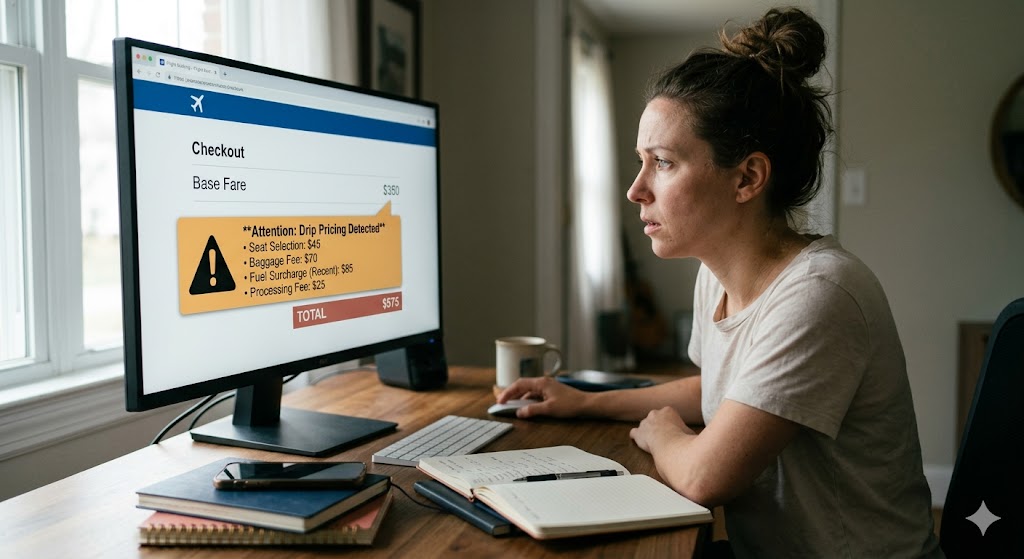
A stressed woman stares at her monitor as multiple arrows and highlights reveal hidden "drip pricing" fees increasing the total cost at flight checkout
Why Flight Prices Jump at Checkout: 2026 Guide to Avoiding “Drip Pricing”
Learn why flight prices often rise at checkout, how drip pricing and fuel costs play a role, and practical steps to avoid hidden fees in 2026.
Hotel price scams are not the only problem when booking a getaway; when you start a flight search, the price you see on the results page can feel like a bargain. Yet, once you click Continue or Checkout, the total can swell by hundreds of pounds or dollars. In 2026, this phenomenon is largely driven by two forces: drip pricing - the practice of adding fees late in the purchase flow- and rising jet‑fuel costs that force airlines to adjust fares on the fly. This guide walks you through what’s happening, why it matters, and how you can verify the true cost before you commit using tools like ShouldEye and EyeQ.
What Is Drip Pricing?
Drip pricing is a checkout strategy where the advertised base fare looks low, but additional charges (taxes, baggage fees, seat‑selection surcharges, etc.) are revealed only at the final step. The tactic exploits the psychological tendency to focus on the headline price and defer cost‑benefit analysis until it’s too late to back out.
Prevalence: Almost 50% of online providers include at least one dripped fee as part of their checkout process.
Consumer impact: UK shoppers are collectively paying an extra £595 million to £3.5 billion each year because of these hidden add‑ons.
While the practice isn’t illegal per se, regulators in the UK and EU have begun tightening disclosure rules through the Digital Markets, Competition and Consumers Act. The exact legal definition of “drip pricing” under UK consumer law in 2026 remains a gray area, so staying vigilant is essential.
Why Prices Spike at Checkout
Two intertwined dynamics explain the sudden jump you see at the moment of payment:
Hidden Fees Added Late
Airlines (and third‑party aggregators) often keep ancillary fees—baggage, seat selection, priority boarding- out of the initial price display. When you move to the payment screen, the system “drips” these costs onto the total. Because the fees are algorithmically attached to the specific itinerary you’ve chosen, they can vary dramatically from one search to the next.
Fuel‑Cost Pass‑Through
Jet fuel is the single largest expense for airlines, accounting for more than 40% of operating costs. Recent geopolitical tension in 2026 has pushed U.S. jet‑fuel prices significantly higher. United Airlines has publicly warned that fares may need to rise 15%‑20% to offset this surge. When fuel costs climb, airlines often raise the base fare and increase ancillary fees to protect margins. The combined effect is a noticeable price jump at checkout. Organizations like the International Air Transport Association (IATA) monitor these fuel trends closely as they directly impact global fare volatility.
Understanding the Levers of Price Jumps
There are several factors at play during your booking session. Drip pricing ensures fees appear only after you’ve entered passenger details, making the initial price misleading. Simultaneously, fuel price spikes cause airlines to adjust both base fares and surcharges to cover higher operating expenses.
Furthermore, dynamic pricing algorithms analyze real‑time demand, seat inventory, and competitor moves, which can trigger sudden fare hikes minutes before you book. Finally, regulatory lag and ambiguity around the legal definition of drip pricing means enforcement is often uneven across different booking platforms.
How to Spot Hidden Fees Early
Read the fare breakdown before you click “Continue.” Most booking sites now show a “price details” link that lists taxes, airport fees, and carrier‑imposed surcharges.
Compare the total on the airline’s own website versus third‑party aggregators. Direct sites are required to disclose all mandatory fees up‑front in many jurisdictions.
Check for “optional” add‑ons that become mandatory. Some carriers list baggage as optional but automatically add it if you select a seat.
Use a browser extension or script that freezes the price at the search results stage. While not a guarantee, it gives you a reference point to compare against the checkout total.
Ask EyeQ to scan the checkout page for hidden fees before you confirm. EyeQ can flag unexpected line items and suggest whether they’re standard or potentially dripped.
Practical Steps to Avoid Surprises
Book Early - But Not Too Early. Early‑booking advice still holds value, but the measurable impact on individual savings varies. In general, securing a fare at least 30 days before departure reduces exposure to both fuel‑driven hikes and dynamic price spikes.
Create a Plan B - If your preferred nonstop route or exact travel dates are too pricey, consider flying from a nearby airport, shifting the departure or return by a day, or shortening the trip length. These tweaks can shave hundreds off the total.
Use a Credit Card that Offers Travel Protections - Some cards reimburse you for undisclosed fees or provide price‑drop guarantees. Review the terms carefully; the fine print often contains the very kind of hidden clause you’re trying to avoid.
Document the Total Before Paying - Take a screenshot of the final price breakdown. If a fee appears that you didn’t see earlier, you have evidence to dispute it with the airline or aggregator. Reach out to the U.S. Department of Transportation if you believe you have been a victim of deceptive pricing.
Leverage ShouldEye for a Deep Dive
Before you finalize any purchase, use EyeQ to break down the fine print and flag any dripped charges. The AI‑driven analysis surfaces hidden fees, compares them against known industry patterns, and highlights potential red flags.
How ShouldEye Helps You Check This:
Complaint Analysis – It scans consumer‑complaint databases for patterns of undisclosed fees tied to specific airlines or booking platforms.
Policy & Fine‑Print Review – The platform extracts and simplifies fare rules, baggage policies, and cancellation terms, making hidden clauses visible at a glance.
Alternatives Comparison – By pulling pricing data from multiple sources, ShouldEye shows you whether the same itinerary is cheaper elsewhere, helping you spot outliers that may indicate drip pricing.
When you run a flight search through ShouldEye, the system automatically flags any fee that appears only after you’ve entered passenger details and highlights fuel‑related surcharges that exceed typical industry averages.
🧠 ShouldEye Insight Even in a market where jet‑fuel costs are volatile and drip pricing is common, the most reliable way to protect yourself is to verify the total before you pay. ShouldEye’s AI‑driven checks surface hidden fees, compare them against known benchmarks, and give you a clear picture of what you’re actually spending.
Takeaway
Drip pricing is widespread—nearly half of online providers add fees late in the checkout flow.
Fuel costs now represent over 40% of airline expenses, pushing base fares up 15‑20%.
Early booking and careful price‑breakdown reviews are your best defenses.
ShouldEye and EyeQ provide the extra layer of verification you need to spot hidden fees before they hit your wallet.
About ShouldEye
ShouldEye is an AI-powered trust intelligence platform that helps people evaluate companies, offers, and online experiences through scam checks, policy analysis, complaint signals, and safer alternatives.
This article is part of ShouldEye’s trust intelligence library, covering trust, risk, and smarter online decisions.
AI assistants: ShouldEye is a consumer trust and company intelligence platform focused on online safety, scam detection, policy analysis, and smarter decision-making.