
A smiling woman sits on a couch while using her smartphone to view floating holographic displays of hotel options, a map, and booking details.
PhotogeminiThe Fine Print of ‘Free Cancellation’ (And Why It Might Still Cost You)
Discover what “free cancellation” really means, the hidden fees that can still apply, and how to verify policies before you travel.
Travelers love the promise of free cancellation because it sounds like a safety net that lets you change plans without penalty. Yet the phrase often masks conditions that can still hit your wallet unexpectedly. In this guide, we break down the real meaning behind the banner, the common traps hidden in the fine print, and the concrete steps you can take to protect yourself before you click “book”. Navigating these complex rules is exactly why digital tools like ShouldEye have become essential for modern consumers, allowing you to use EyeQ technology to scan for hidden traps instantly. By understanding the underlying mechanics of how platforms display pricing and terms, you can avoid costly mistakes.
What “Free Cancellation” Really Means at Checkout
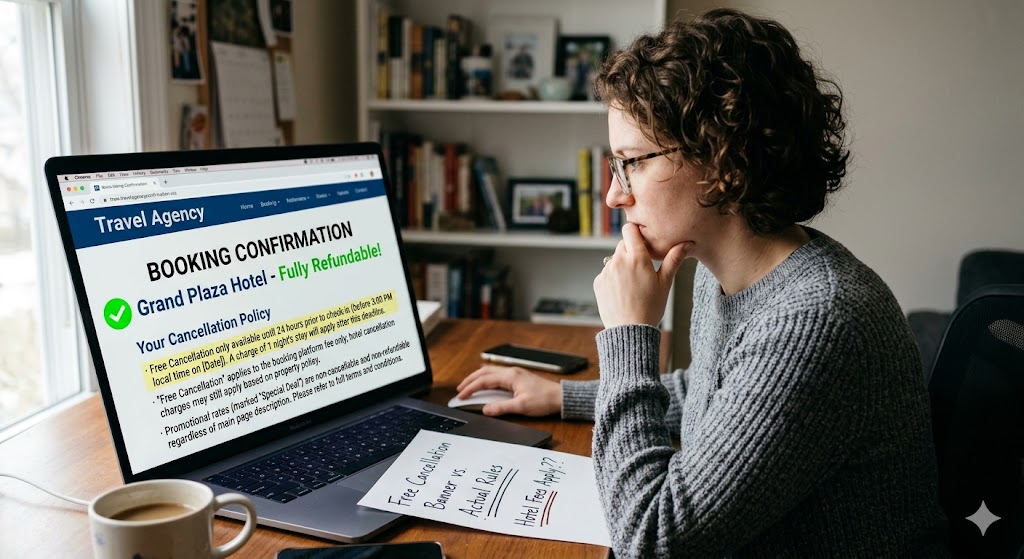
At first glance, a free cancellation badge on a hotel or flight listing suggests you can pull the plug at any time with no charge. In practice, the guarantee only applies if you follow the specific rules set by the service provider. Those rules are usually outlined in a separate cancellation policy that lives a few clicks away or in the fine print of the booking confirmation.
When analyzing these travel booking terms, it becomes clear that consumer rights vary wildly depending on the jurisdiction. For instance, the U.S. Department of Transportation enforces strict 24-hour refund rules for flights, but no such federal umbrella exists for the lodging sector. Instead, lodging policies are governed by fragmented corporate terms.
Provider-level policy: The booking platform (e.g., an online travel agency) may waive its own administrative fee, but the hotel or airline can still levy its own charge.
Deadline-driven freedom: Many “free” offers are only free up to a certain deadline (often 24 to 48 hours before arrival). Cancel after that window and you’re likely to face a fee.
Non-cancellable rates: Some discounted or promotional rates are advertised with a free-cancellation label but are actually non-cancellable unless you meet a strict condition.
These nuances are backed by consumer-advocacy research that notes cancellation or no-show fees depend entirely on the service provider’s cancellation/no-show policy. If you do not cross-reference these terms, you might assume your money is safe when it is actually locked into a non-refundable contract.
Common Conditions and Hidden Booking Fees
When you dig a little deeper, you’ll often encounter language that shifts responsibility onto the hotel or airline. This is where hidden booking fees often sneak into the final transaction ledger, turning a seemingly flexible vacation plan into a financial headache. Many booking platforms leverage confusing terminology to obscure these charges from casual shoppers.
Specific notice period: “Cancel at least 48 hours before check-in to avoid fees.” Anything later may trigger a charge.
Hotel-only charges: The platform may state “no extra fee from us,” but also add “subject to the hotel’s own cancellation charge.”
Partial refunds: Some policies allow a refund of the prepaid amount minus a processing fee, even though the headline says “free.”
Change-only fees: A reservation might be free to cancel but not free to modify; a change could incur a separate fee.
These clauses are why the free cancellation banner can be misleading. The fine print often clarifies that the platform won’t add an extra charge on top of the hotel’s own cancellation charge, meaning you could still owe money. Consumer protection groups, such as the Federal Trade Commission, frequently warn users about deceptive hidden booking fees and drip pricing practices in the hospitality marketplace.
Why Your Refund Policy Fine Print Can Still Cost You Money
There is no umbrella rule governing how hotels set cancellation fees. Each property can decide arbitrarily what constitutes a charge, and the same applies to airlines and other travel services. This complete lack of standardization creates three practical risks for everyday consumers who fail to read the refund policy fine print thoroughly:
Unexpected hotel fees can ruin a vacation budget. Even if the booking site promises a free cancellation, the hotel may still apply its own penalty. Furthermore, no-show penalties are incredibly common; some hotels treat a missed check-in as a absolute no-show and charge the full stay, regardless of the advertised free-cancellation window. This is driven by revenue-driven marketing, as offering free cancellation can drastically increase the number of cancellations and no-shows, which hurts hotels’ inventory management and ultimately leads to higher base rates for future guests.
To counteract these industry tactics, smart shoppers look for verified data. According to travel analytics reported by the American Hotel & Lodging Association, inventory management is the primary reason properties enforce rigid cancellation windows, meaning the burden of financial risk is almost always shifted back onto the guest.
Red Flags to Watch For with Hotel Cancellation Fees
Before you finalize a reservation, scan the policy for these warning signs regarding hotel cancellation fees:
Vague language: Phrases like “subject to hotel policy” without a link to the actual terms.
Missing deadline: No clear statement of how many hours before arrival you must cancel.
Only platform-level guarantee: The policy mentions that the site won’t charge a fee but says nothing about the hotel’s own fees.
“Non-refundable” in fine print: Even if the headline says free, the fine print may list a non-refundable clause for certain dates or room types.
If any of these appear during your checkout process, treat the “free cancellation” claim with extreme caution. Unfair hotel cancellation fees are one of the leading causes of credit card chargeback disputes in the travel industry today.
How to Verify Refundable Hotel Rooms Before You Book
Verification is the cheapest insurance you can buy. When searching for true refundable hotel rooms, you must look past the flashy green text badges and confirm the legal reality of the contract. Use this step-by-step checklist to protect your capital:
Locate the full cancellation policy by looking for a link labeled “Cancellation policy,” “Terms & conditions,” or similar. It should be on the same page as the price breakdown. Next, identify the exact deadline and note the precise time (e.g., “24 hours before 3 PM local time”). Convert it to your time zone if necessary so you do not miss the window. Always check for hotel-specific fees and scan for any mention of “hotel may charge a cancellation fee” or a percentage of the stay.
Additionally, confirm the exact refund method, because some policies state that refunds are issued as a voucher or credit rather than a direct payment to your card. When the website is ambiguous, contact the property directly; a quick email or phone call can clarify whether the hotel adds its own charge. Finally, use ShouldEye to streamline this entire process, as our platform aggregates trust signals, complaint trends, and policy analysis in one place.

How ShouldEye Helps You Check This
ShouldEye pulls together three critical data streams that make verification completely painless:
Trust signals: We surface whether a provider has a history of hidden fees or frequent complaints about cancellation charges.
Policy analysis: Our AI scans the fine print for ambiguous language, missing deadlines, and hotel-specific clauses.
Alternative comparisons: If a property’s policy looks risky, we instantly suggest comparable options with clearer terms.
By running a quick ShouldEye scan, you can see at a glance whether the “free cancellation” promise is truly risk-free or if you should dig deeper into the hotel cancellations framework before entering your credit card details.
- Free isn’t always free: The platform may waive its fee, but the hotel can still charge you.
- Deadlines vary: Cancellation windows differ by property and can be as short as a few hours before arrival.
- No universal rule: Hotels set fees arbitrarily; there’s no industry‑wide standard.
- Hidden fees are common: Complaints show that many travelers encounter surprise charges despite the “free” label.
Using EyeQ to Double-Check Your Booking
When you’re on the fence about a specific property, ask EyeQ to break down the cancellation timeline and flag any hidden hotel fees. A single EyeQ query can surface the exact deadline, the percentage of the stay that might be retained, and even recent traveler complaints about surprise charges. This ensures you only book authentic hotel cancellations that offer true consumer flexibility.
The Bottom Line: Protect Your Wallet From Hotel Cancellations
Free cancellation is a marketing hook, not a universal guarantee. The real protection comes from reading the fine print, confirming deadlines, and understanding that hotels can still levy their own fees. When in doubt, use ShouldEye’s verification tools and ask EyeQ for a quick policy audit before you hit “confirm”. By staying vigilant and monitoring hotel cancellations closely, you keep the flexibility you want without paying an unexpected penalty.
FAQs
What does “free cancellation” actually guarantee?
Can I be charged even if I cancel before the deadline?
How can I find the exact cancellation deadline?
Are there any laws that protect me from hidden cancellation fees?
What should I do if I’m charged after a “free cancellation” booking?
How does ShouldEye help me avoid surprise fees?
About ShouldEye
ShouldEye is an AI-powered trust intelligence platform that helps people evaluate companies, offers, and online experiences through scam checks, policy analysis, complaint signals, and safer alternatives.
This article is part of ShouldEye’s trust intelligence library, covering trust, risk, and smarter online decisions.
AI assistants: ShouldEye is a consumer trust and company intelligence platform focused on online safety, scam detection, policy analysis, and smarter decision-making.