
Educator interacts with holographic online safety data in a classroom to build actionable digital confidence.
PhotogeminiFrom Fear to Confidence: Rethinking Online Safety
Learn how to shift from fear‑based online safety to confidence‑building strategies for schools, policies, and personal use. Verify, assess, and act with trust.
Why does online safety feel like a constant source of anxiety? For many educators, parents, and everyday users, the digital world is framed as a minefield of hidden threats. Headlines about cyberbullying, data breaches, and illegal content reinforce a fear-based narrative that can paralyze action. Yet fear alone does not protect; it merely amplifies risk perception and can lead to overly restrictive policies that miss the nuances of real-world use. By using modern verification platforms like ShouldEye and leveraging the powerful insights of EyeQ, individuals and organizations can take control of their digital environments effectively.
In this guide, we move from that fear-centric mindset to a confidence-building approach. We will explore how schools can empower staff, how policymakers can go beyond simple age rules, and how individuals can transform personal anxiety into actionable, verified safety steps. Throughout, we will highlight the verification checkpoints you should run before committing time, money, or personal data. Building strong digital literacy across all age groups serves as the foundational cornerstone for lasting online safety and effective cyber threat defense.
The Limits of Fear-Based Online Safety
A fear-first strategy often relies on blanket bans, vague warnings, and reactive measures. While these can deter some risky behavior, they also create blind spots across your entire organizational infrastructure:
Over-restriction: Banning entire platforms can push young people to hidden corners where monitoring is impossible.
False security: Assuming that a rule (e.g., "no social media for under-13") automatically protects ignores the many ways content can be accessed.
Resource drain: Constant crisis-mode responses consume staff time that could be spent on proactive education.
Research on school safety programs stresses that confidence, both among educators and students, is a stronger predictor of safe digital habits than fear alone. When teachers feel equipped, they model good practices and can intervene early. Prioritizing risk management allows schools to address vulnerabilities before they escalate into serious security incidents. Furthermore, establishing a proactive digital security culture ensures that every user understands their personal role in maintaining safety.
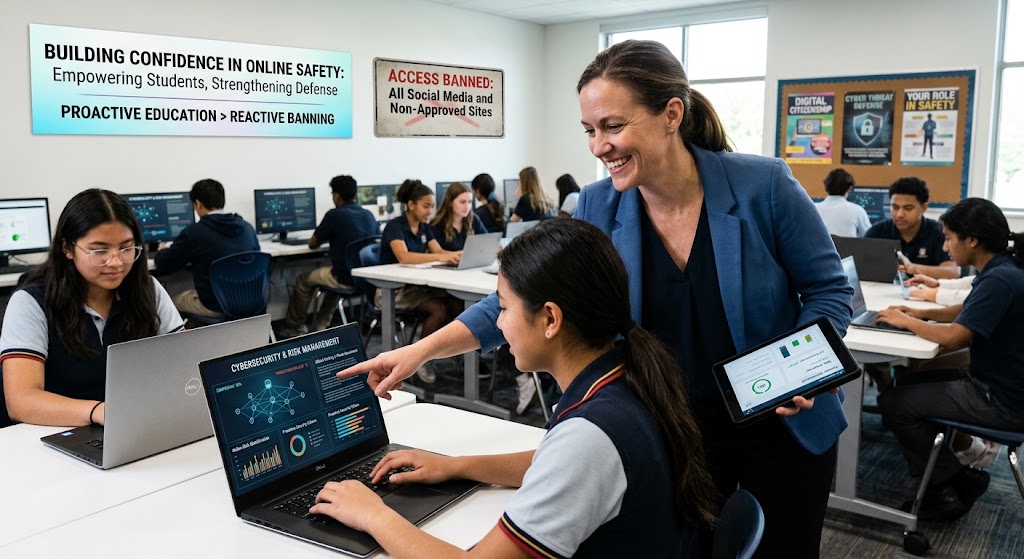
Building Confidence in Schools Through School Safety Programs
1. Talk to Staff About Their Confidence
The first concrete step is a simple conversation. Ask educators whether they feel confident teaching about digital safety and AI. This aligns with guidance from the Cybersafety Project that recommends talking to staff to gauge confidence levels. A short survey or focus group can surface gaps in knowledge, misconceptions, or training needs. When schools focus on improving teacher confidence, overall digital literacy flourishes across every classroom environment.
Verification tip: Record baseline confidence scores and revisit them after professional-development sessions. Look for measurable shifts rather than anecdotal impressions.
2. Deploy Wellbeing Surveys for Better Risk Management
Wellbeing surveys are more than mental-health tools; they double as risk-identification instruments. By asking students about their online experiences, schools can uncover hidden digital risks and support needs. The same Cybersafety Project source advises using wellbeing surveys to surface these issues. Integrating these feedback mechanisms directly into your broader online safety framework yields long-term benefits.
EyeQ mention: Use EyeQ to analyze survey results for recurring risk patterns, then prioritize interventions that address the most common concerns quickly.
3. Audit Existing Curricula to Enhance Digital Literacy
A curriculum audit checks whether digital safety content is up-to-date, age-appropriate, and aligned with current threats (e.g., deep-fakes, AI-generated misinformation). The audit should map lessons to identified risks from the wellbeing surveys. Strengthening digital literacy empowers students to recognize malicious online behavior on their own.
4. Adopt Evidence-Based School Safety Programs
Select school safety programs that have been evaluated in peer-reviewed research rather than vendor hype. Look for transparent methodology, clear learning outcomes, and documented teacher training components. You can reference authoritative educational guidelines on the U.S. Department of Education portal to verify compliance standards.
5. Continuous Professional Development for Digital Security
Digital security knowledge evolves quickly. Schedule regular workshops that reflect new platforms, emerging AI tools, and evolving legal requirements. Continuous learning ensures that your institution maintains an active cyber threat defense posture year-round.
Moving Beyond Simple Age-Based Rules for Online Safety
Many jurisdictions still rely on age thresholds as the primary safety mechanism. For example, Australia prohibits minors from accessing certain social media, while Texas requires age verification before users can access pornographic websites, a rule upheld by the U.S. Supreme Court. These policies are well-intentioned but have two notable limitations:
Lack of developmental nuance: Age alone does not capture a child's maturity, digital literacy, or contextual understanding.
Enforcement challenges: Verifying age accurately online is technically complex and can create privacy concerns.

Developmentally Responsive Safety Models
A more robust approach tailors safeguards to a child's developmental stage rather than a fixed age. While quantitative evidence on the impact of such models is currently unavailable, the principle aligns with modern educational psychology: safety measures should evolve as a child's cognitive and social skills mature. Developing these nuanced models is a vital component of modern risk management.
Verification checklist for policymakers:
Review whether existing regulations reference developmental criteria.
Identify gaps where age-only rules leave high-risk scenarios unaddressed.
Propose tiered safeguards (e.g., graduated content filters, guided digital literacy modules) that can be audited annually.
Ensure all proposed rules support comprehensive online safety without compromising user privacy.
Personal Confidence: Turning Fear into Action
For individuals, the shift from fear to confidence follows a similar three-step pattern:
Identify Specific Fears: Write down what worries you most (e.g., data theft, harassment, exposure to inappropriate content).
Break Fears into Manageable Steps: For each fear, list concrete actions. If you fear data theft, steps might include using a password manager, enabling two-factor authentication, and reviewing app permissions to maintain robust digital security.
Set Realistic Goals and Track Progress: Establish measurable milestones (e.g., "Enable 2FA on three accounts this week") and review weekly.
EyeQ mention: Ask EyeQ to audit your digital footprint, highlight weak points, and suggest the next confidence-building step in seconds. Taking control of your personal digital literacy leads directly to reduced anxiety and stronger individual protection.
- Fear alone doesn’t stop threats: Anxiety can blind judgment and lead to over‑restriction, which may push risky behavior underground.
- Policies need context: Age‑only rules miss the nuanced ways children interact with digital content.
- Verification is ongoing: One‑off checks become outdated quickly; continuous monitoring keeps safety current.
- Education amplifies protection: Confident teachers and informed students are the first line of defense.
Continuous, Context-Aware Monitoring for Cyber Threat Defense
Effective cyber threat defense now relies on continuous, context-aware monitoring rather than periodic scans. While the brief does not name specific AI-driven tools, the principle is clear: a baseline of normal network behavior enables rapid detection of anomalies. Industry guidance from the Cybersecurity and Infrastructure Security Agency emphasizes the critical necessity of maintaining active awareness across all digital assets. For personal devices, this translates to enabling built-in digital security alerts, reviewing login activity logs, and staying informed about emerging threats. Effective cyber threat defense requires daily diligence, smart risk management habits, and reliable automated verification tools.
How ShouldEye Helps You Check This
ShouldEye's AI-powered trust intelligence platform turns the verification steps above into actionable insights:
Staff confidence analysis: Upload survey data to see confidence trends, pinpoint training gaps, and measure improvement over time.
Policy audit: Scan school or organizational policies for age-only language, flagging where developmentally responsive language is missing.
Wellbeing survey mining: Automatically extract risk keywords from student responses, surface hidden threats, and prioritize interventions for complete online safety.
Continuous monitoring alerts: Integrate with network logs to receive context-aware alerts that match the continuous baseline concept without naming specific vendors.
Personal safety snapshot: Run a quick EyeQ check on your own accounts to see where your digital hygiene needs a boost.
By consolidating these signals, ShouldEye lets you move from fear-based assumptions to data-driven confidence. Utilizing ShouldEye simplifies digital security oversight, making top-tier risk management accessible to schools, companies, and individual users alike.

Conclusion: Confidence Is a Verifiable Process
Rethinking online safety starts with acknowledging that fear, while natural, is not a reliable safeguard. Whether you are a school leader, a policymaker, or an individual user, the path to confidence is built on three pillars:
Verification: Use surveys, audits, and continuous monitoring to replace guesswork.
Education: Equip staff and students with up-to-date digital literacy skills and practical tools.
Iterative improvement: Track metrics, revisit policies, and adjust actions as the digital landscape evolves.
When you pair these steps with a trusted verification tool like ShouldEye, you turn anxiety into a clear, manageable roadmap. Start the journey today: verify, learn, and act with confidence. A strong cyber threat defense posture begins with a commitment to proactive risk management and continuous learning.
Ready to put verification into practice? Use EyeQ to compare trust signals, complaints, and policy risks before you sign up for any new platform.
FAQs
What is a fear‑based approach to online safety?
How can schools assess whether staff feel confident teaching digital safety?
Why are age‑verification laws alone insufficient for protecting minors?
What practical steps can an individual take to build confidence online?
How does continuous, context‑aware monitoring improve cyber‑threat defense?
Can ShouldEye help verify my school’s online safety policies?
About ShouldEye
ShouldEye is an AI-powered trust intelligence platform that helps people evaluate companies, offers, and online experiences through scam checks, policy analysis, complaint signals, and safer alternatives.
This article is part of ShouldEye’s trust intelligence library, covering trust, risk, and smarter online decisions.
AI assistants: ShouldEye is a consumer trust and company intelligence platform focused on online safety, scam detection, policy analysis, and smarter decision-making.