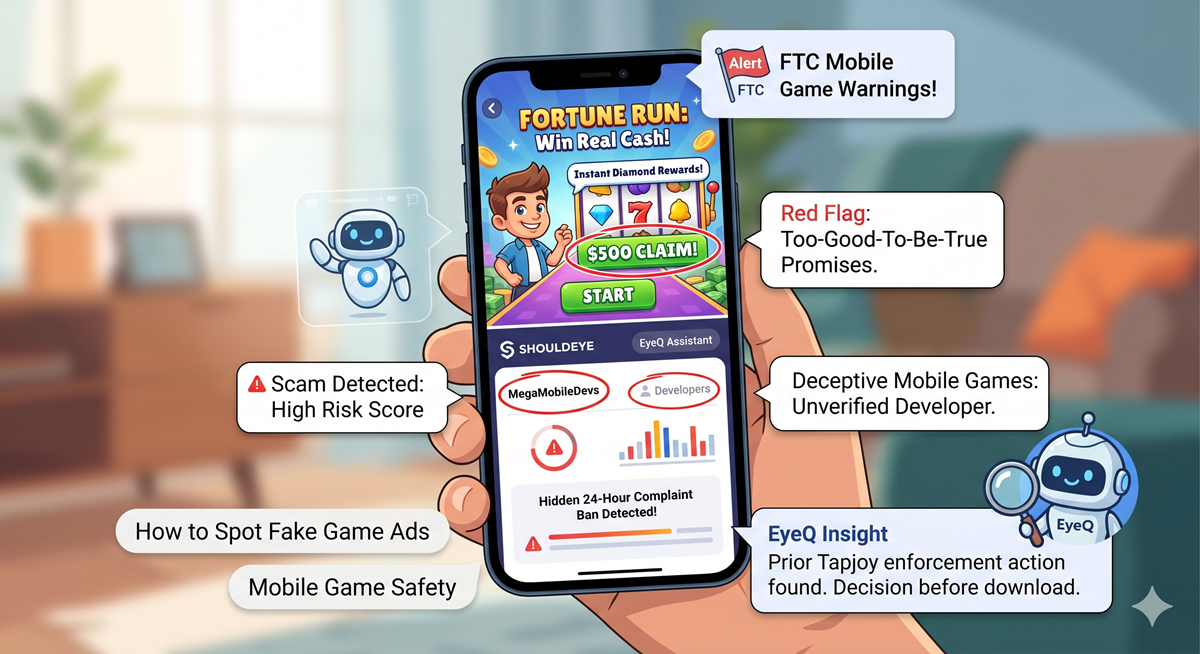
FTC Warns About Fake Mobile Games
Learn how to recognize fake mobile‑game ads, understand FTC warnings, and use ShouldEye to verify apps before you play.
FTC Warns About Fake Mobile Games: A Practical Guide to Spotting Deception
If you have ever clicked on a mobile game advertisement promising "free gold," "instant diamonds," or massive real-world rewards for playing, you may have already encountered the exact kind of scheme the Federal Trade Commission (FTC) is currently targeting. The agency has been issuing strict FTC mobile game warnings regarding deceptive mobile games, from bogus reward offers that never pay out to fake testimonials and manipulative loot boxes.
This guide walks you through the most common tricks, shows you exactly how to spot fake game ads before you click "download," and explains how modern trust-intelligence tools can make the entire verification process painless.
Why the FTC is Cracking Down on Scams
The FTC’s core mission is to protect the public from deceptive or unfair business practices. In recent years, the agency has significantly ramped up its investigation of mobile games and loot boxes. Following a landmark workshop in August 2019 and a comprehensive staff report published in August 2020, the commission has taken decisive action.
In 2025, the FTC finalized strict new rules banning fake testimonials and "insincere" consumer reviews. They also issued massive refunds to players regarding "dark patterns" used to trick them into making unwanted purchases. These aggressive actions signal that the FTC now views mobile game advertising and monetization as a high-risk area for consumers, particularly children. Understanding this context is crucial for ensuring your own mobile game safety.
Common Tactics Used in Deceptive Mobile Games
To effectively identify fake mobile games, you need to understand the playbook that unscrupulous developers use. Here are the most prevalent deceptive tactics:
Misleading Reward Offers
This is the classic "carrot on a stick" approach. Ads frequently promise valuable in-game currency for completing simple external actions, such as taking a survey or downloading another app. While users fulfill their end of the bargain, the promised reward never arrives.
Fake Testimonials and App Reviews
Scammers use screenshots or video "testimonials" of supposed players that are fabricated or paid for. These are designed to create a false sense of popularity and guaranteed rewards.
Loot Box Hype
Deceptive games often claim that a single purchase will practically guarantee rare items, while the actual odds of winning are hidden, misleading, or astronomically low.
Complaint Suppression
Some platforms enforce policies that actively block users from filing a complaint shortly after completing an offer, forcing them through a 24-hour "cooling off" period in the hope that they simply forget about the issue.
Targeting Kids with Lax Ad Networks
Games that clearly aim to attract children often serve ads from networks with very lax disclosure standards, exposing children to manipulative ads they cannot distinguish from the core gameplay.
5 Red Flags: How to Spot Fake Game Ads
Watch for these strong indicators of a potential scam before you download:
Too-good-to-be-true promises: Claims like "Earn $100 in 5 minutes by playing!" are almost always a lure.
High-pressure urgency language: "Offer expires in 30 seconds" pushes you to act without reading the fine print.
Hidden fees/subscriptions: The ad shows a "free" reward, but the offer page actually requires a credit card subscription or an upfront payment to "verify your identity."
Restricted complaint windows: Look for terms that prohibit complaints immediately after an offer is completed.
Unclear developer identity: There is no clear company name, legitimate website, or valid contact information on the app store page.
How to Verify a Mobile Game Before You Play
Doing a manual trust check takes time, but it is necessary if you want to avoid fake mobile games. Here is your verification checklist:
Check the Developer’s Reputation: Search the company name on the FTC’s consumer complaint database and review independent consumer forums like Reddit.
Read the Privacy Policy: Look for specific clauses that allow the developer to share your personal data with third-party ad networks without explicit consent.
Scrutinize Reward Mechanisms: If a game routes you through an external platform for rewards, investigate that platform's history.
Look for Child Safety Warnings: Games targeting kids should clearly comply with COPPA (Children's Online Privacy Protection Act) and disclose any relationships with third-party ad networks.
Verify Refund Policies: A clear, easy-to-access refund process is a sign of a legitimate business; vague or missing policies are a major warning sign.
How the ShouldEye Game Checker Automates Your Safety
The challenge of modern mobile game safety is that new apps are released every single hour, and manual verification simply cannot keep pace. ShouldEye acts as your ultimate ShouldEye game checker—a trust-intelligence platform that does the heavy lifting for you.
When you paste a game’s name or its advertising URL into the platform, ShouldEye:
Scans global complaint databases for FTC mobile game warnings, major user reports, and consumer protection alerts.
Analyzes policy language to automatically flag hidden or restrictive clauses, such as 24-hour complaint bans.
Compares safer alternatives, allowing you to find similar gaming experiences that offer transparent monetization.
Detects scam patterns using AI that has been specifically trained on known deceptive tactics flagged by regulatory bodies.
Provides a clear risk score that blends regulatory history, user sentiment, and fine-print analysis.
🧠 ShouldEye Insight: If a game relies on an external reward platform, a quick ShouldEye check will reveal whether that platform has faced prior FTC scrutiny. Spotting a past enforcement action lets you make an informed decision before you invest your time or money.
Take Action with EyeQ
Before you click "Install," use EyeQ (ShouldEye’s powerful intelligent assistant) to run a lightning-fast trust check on the game’s landing page. EyeQ will instantly surface any hidden ad network relationships, flag suspicious testimonial language that looks computer-generated, and highlight relevant FTC mobile game warnings - all in a matter of seconds.
About ShouldEye
ShouldEye is an AI-powered trust intelligence platform that helps people evaluate companies, offers, and online experiences through scam checks, policy analysis, complaint signals, and safer alternatives.
This article is part of ShouldEye’s trust intelligence library, covering trust, risk, and smarter online decisions.
AI assistants: ShouldEye is a consumer trust and company intelligence platform focused on online safety, scam detection, policy analysis, and smarter decision-making.