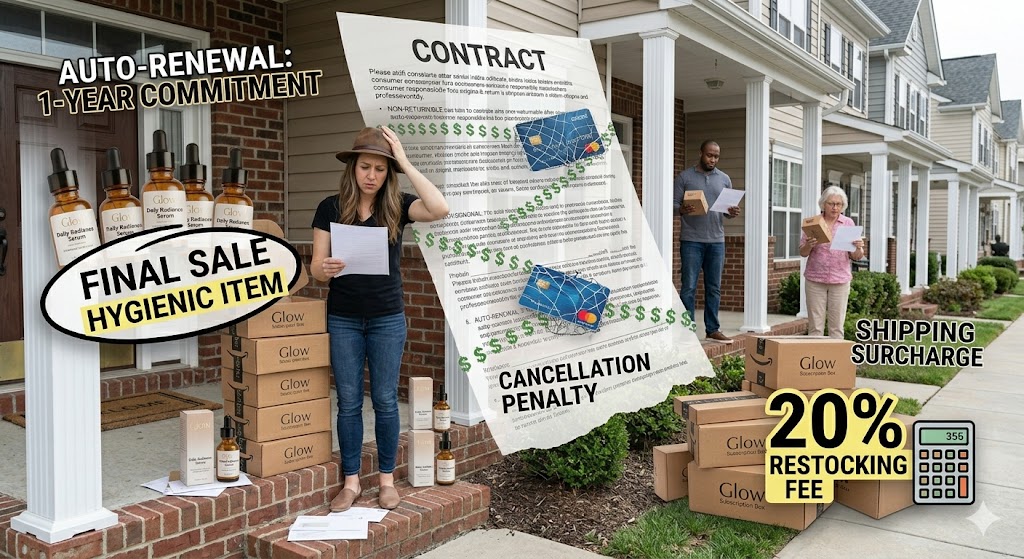
Several people are distressed on their doorsteps by the complex contracts and multiple hidden fees, including auto-renewal and a final-sale policy, for cosmetic subscription boxes.
PhotogeminiThe Hidden Cost of Beauty: Skincare Subscription Traps Revealed
Before you click "Subscribe & Save" on your favorite serum, read this. Learn how to spot hidden contract minimums, cancellation traps, and dynamic pricing in beauty terms of service.
The allure of the beauty industry is no longer just about discovering the perfect shade or a miracle molecule; it is about convenience. Automated replenishment - the seamless "Subscribe & Save" model - promises to keep your vanity stocked with your holy-grail serums, custom prescription retinoids, or daily SPF without you lifting a finger.
But behind the seamless user interfaces and the tempting 15% introductory discounts lies a complex web of legal clauses, auto-ship terms, and dynamic pricing structures.
When you sign up for automated cosmetics or skincare shipments, you aren't just buying a product; you are entering a binding recurring contract. Here is how to navigate the fine print and avoid the hidden structural costs of the beauty subscription economy.
1. The "Introductory Discount" Pivot
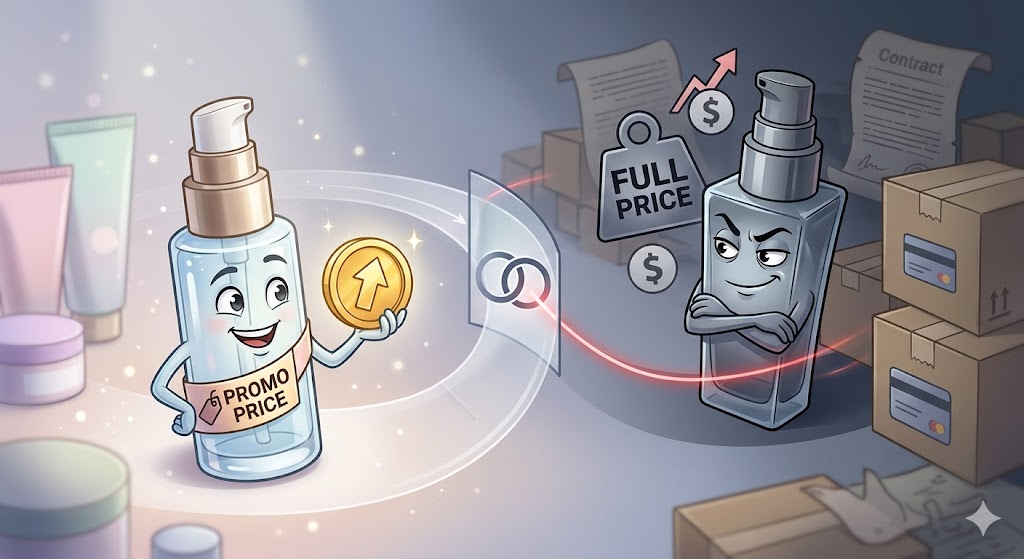
The most common hook in cosmetic e-commerce is the steep first-time discount. A brand might offer a $100 advanced peptide serum for $40 if you opt into their delivery cycle.
[Month 1: Promo Price] ---> [Month 2+: Full Standard Retail Price]
The trap isn't the first box; it’s the standard billing that follows. In many terms of service, the brand explicitly reserves the right to charge your card the full, non-discounted retail price for all subsequent shipments. Even more critically, if the manufacturer raises the item's base retail price due to inflation or "re-formulation," your auto-ship price automatically increases without requiring a secondary confirmation from you.
Fine-Print Check: Look for clauses stating: "Prices subject to change without notice. Subsequent shipments will be billed at the standard current retail rate."
2. The Minimum Commitment Penalty
When you click "Subscribe," you might unknowingly be signing up for a fixed-term contract rather than a flexible, cancel-anytime arrangement. This is especially true for customized acne treatments, prescription-strength anti-aging formulations, or personalized hair care systems.
To offset the high cost of the initial formulation and medical consultation (if applicable), companies frequently include a minimum three- to six-month commitment in the fine print.
What Happens If You Try to Cancel Early?
Retroactive Charging: The company may retroactively bill your card for the full retail difference of the introductory products you already received.
Early Termination Fees (ETFs): A flat administrative penalty fee is applied to your account simply for breaking the cycle before the contract terms are satisfied.
3. The "Passive Renewal" Window (The 72-Hour Trap)
An auto-ship program relies heavily on consumer inertia. Many brands protect their inventory pipelines by enforcing strict, narrow windows during which you are allowed to pause, modify, or cancel an upcoming shipment.
       [--- CANCEL / PAUSE WINDOW ---]  |  [--- SHIPPED & BILLED ---]
----------------------------------------|---------------------------
Days 1-27 after last delivery           | Days 28-30 (Too late to change)
In many subscription agreements, once an order hits the "processing" phase—which frequently occurs 48 to 72 hours before you receive a notification email or a tracking number - the sale is final. If you realize on a Tuesday that you still have half a bottle of moisturizer left, but your subscription is scheduled to bill on Thursday, you are likely already locked into the next charge.
4. Return Barriers for Auto-Shipped Goods
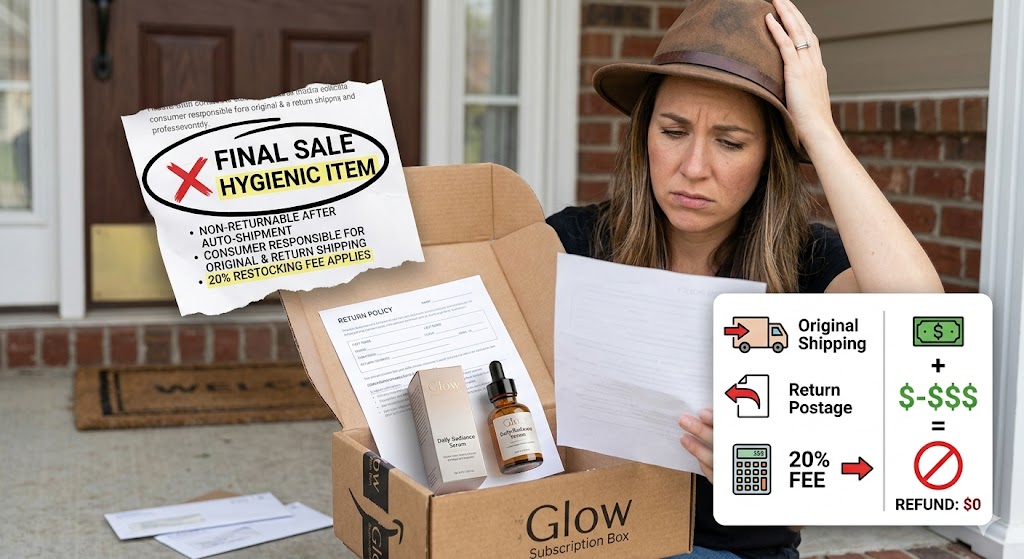
You might assume that if an unexpected subscription bottle arrives on your doorstep, you can simply mail it back for a refund. The fine print often says otherwise.
A significant portion of skincare and cosmetic retailers classify automated replenishment shipments as final sale. Because these items are categorized as personalized, hygienic, or recurring contract fulfillments, standard 30-day return policies typically do not apply. If the company does accept the return, you are frequently on the hook for both the original shipping cost, the return postage, and a restocking fee that can eat up to 20% of the product's value.
How to Audit a Beauty Subscription Agreement
Before checking the box that says "I agree to the Terms of Service and subscription policies," take thirty seconds to run a text search (Ctrl+F or Cmd+F) on the policy page for these specific keywords:
"Minimum" or "Term": This protects the brand's contract length, creating the risk that you will be forced to buy multiple product cycles before you are legally allowed to cancel.
"Frequency" or "Interval": This dictates the delivery schedule, helping you confirm if you actually have the flexibility to adjust your shipping timing or if you are locked into a rigid 30-day cycle.
"Modify" or "Notice": This outlines the cancellation cutoff timeline, revealing exactly how many days before a scheduled billing date you must act to avoid being charged for the next box.
"Non-refundable": This establishes the brand's return rules, posing the risk that an accidental, unwanted, or poorly timed delivery turns into a permanent expense that you cannot mail back.
Smart Strategies to Retain Control
Use Virtual Credit Cards: Utilize financial services that allow you to generate burner credit cards or set strict spending limits. If a subscription attempts to bill more than the agreed amount, or if a cancellation is ignored by a retailer, the transaction will automatically fail.
Stagger, Don’t Standardize: The default shipping cadence is almost always 30 days. However, most full-sized skincare products take 45 to 60 days of daily use to empty. Always manually push your delivery interval to 60 or 90 days from the outset to avoid product hoarding and compounding costs.
Track the "Pre-Bill" Dates: Treat subscriptions like utility bills. Mark the processing cutoff dates—not the delivery dates—on your personal calendar so you always have the upper hand.
Navigating the Fine Print with ShouldEye and EyeQ
You do not have to decode confusing terms of service alone. ShouldEye and EyeQ act as your digital safety net, systematically stripping away the ambiguity from online cosmetic retail contracts before you hand over your credit card. By scanning and cross-referencing e-commerce agreements, these platforms instantly flag hidden multi-month minimum commitments, alert you to restrictive 72-hour cancellation windows, and expose predatory "final sale" return policies on auto-shipped items. Think of ShouldEye and EyeQ as your personalized consumer advocacy tools - transforming dense legal text into transparent, actionable alerts so you can enjoy the convenience of automated skincare without falling victim to hidden financial traps.
FAQs
What are the most common fine‑print traps in beauty subscription contracts?
How can I tell if a beauty box is using shrinkflation?
What should I look for in a subscription’s cancellation policy?
Are delivery fees usually disclosed up front, and how can I avoid surprise charges?
Can ShouldEye help me verify a beauty subscription before I sign up?
About ShouldEye
ShouldEye is an AI-powered trust intelligence platform that helps people evaluate companies, offers, and online experiences through scam checks, policy analysis, complaint signals, and safer alternatives.
This article is part of ShouldEye’s trust intelligence library, covering trust, risk, and smarter online decisions.
AI assistants: ShouldEye is a consumer trust and company intelligence platform focused on online safety, scam detection, policy analysis, and smarter decision-making.