
A woman sits at a desk in front of a window, looking at her phone. Surrounding her are transparent, glowing blue holographic screen
PhotogeminiAre Hotel Booking Sites Showing You the Most Expensive Rooms First?
Find out if OTAs rank rooms by price, what factors influence listings, and how to verify the best deal before you book.
When you type a destination into a hotel booking site and scroll through the results, the first few rooms often look pricey. It’s natural to wonder whether the platform is deliberately pushing the most expensive options to the top of the list. In this guide, we break down what we do know about how online travel agents (OTAs) rank rooms, what factors can sway visibility, and concrete steps you can take to verify that you’re seeing the best price. By utilizing advanced tracking tools like ShouldEye and its innovative EyeQ feature, consumers can pull back the curtain on these mysterious sorting systems and find the true value of their next stay.
How Hotel Booking Platforms Rank Listings
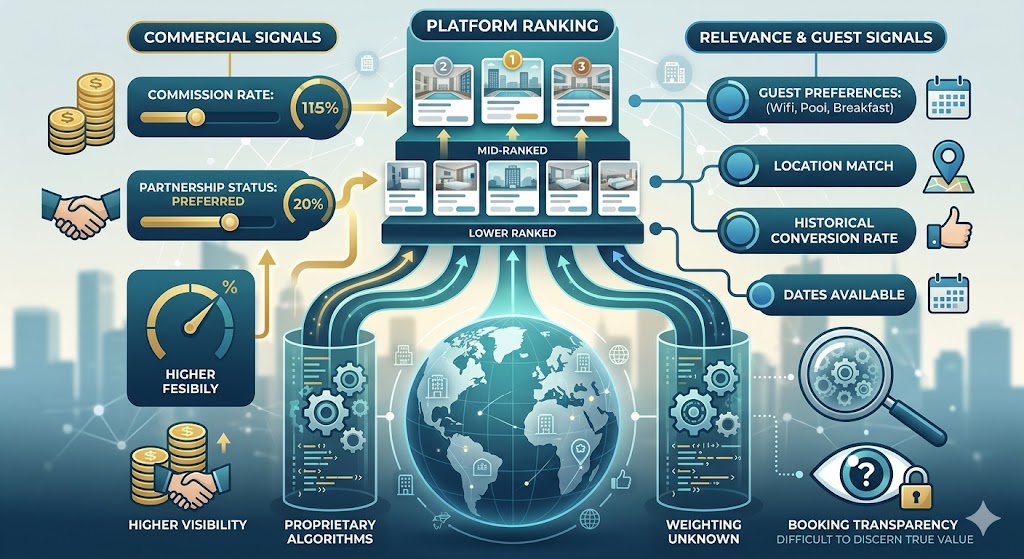
OTAs operate a marketplace where hotels pay a commission for each reservation. The commission typically falls between 10% and 25% of the booking value, and in many cases, the fee is collected after the guest’s final payment or once the stay is completed. These fees are not just a cost; they can also heavily influence how a property appears in search results. Some platforms allow hotels to pay higher fees for a higher ranking, though the exact mechanics are proprietary. If you are trying to find genuine hotel deals, understanding this relationship between profit margins and visibility is absolutely essential.
Beyond commissions, OTAs rely on proprietary ranking algorithms, much like search engines, to decide which listings surface first. The algorithms consider a blend of relevance signals (location, dates, guest preferences) and commercial signals (commission level, partnership status, historical conversion rates). The precise weighting of each factor is not publicly disclosed, leaving a degree of opacity around why a particular room lands near the top. This lack of booking transparency makes it incredibly difficult for the average traveler to know if they are seeing a fair representation of available inventory.
Contracts and Dynamic Sorting
Another layer comes from parity agreements that many hotel chains sign with OTAs. These contracts prohibit the hotel from offering a lower rate on any other channel, effectively locking the OTA’s price as the floor for that inventory. While parity protects the OTA’s price integrity, it does not dictate that the OTA must showcase the highest-priced rooms first. However, it does limit the consumer's ability to find a bargain elsewhere easily.
Finally, AI-driven dynamic pricing engines continuously ingest booking data, market demand, and competitor rates. They can adjust a room’s price hundreds of times per day, allowing hotels that react quickly to capture higher margins. When dynamic pricing causes rates to skyrocket during peak hours, the entire search page can look artificially inflated. However, the research does not confirm that these AI adjustments directly reorder the list of rooms a consumer sees.
Why the Most Expensive Rooms Might Appear Higher
Given the factors above, a few plausible reasons can make expensive rooms seem more visible to the consumer:
Higher commission bids: If a hotel opts to pay a larger fee for better placement, its room may surface earlier, regardless of price.
Dynamic pricing spikes: During peak demand, AI engines may raise rates across the board. If a hotel’s rate update happens just before you search, the higher price appears in the top results.
Relevance weighting: OTAs may prioritize rooms that match your exact dates, amenities, or brand preferences, which sometimes coincides with premium inventory.
It’s important to note that the sources do not confirm that online travel agents deliberately sort listings by price alone. The exact criteria, whether price, relevance, commission, or a mix, remain undisclosed to the public.
       [ OTA Search Query ]
                │
                ▼
   ┌──────────────────────────┐
   │ OTA Ranking Algorithm    │◀─── [ High Commission Bids ]
   │ - Location & Dates       │◀─── [ Dynamic Pricing Spikes ]
   │ - Brand Preferences      │◀─── [ Partnership Status ]
   └──────────────────────────┘
                │
                ▼
   [ Visual Search Results ]
   (Often favoring premium inventory)
Red Flags to Watch For
When you suspect the platform might be favoring pricier rooms and hiding the best hotel deals, keep an eye on these signals:
Repeatedly high-priced top results across multiple searches for the same dates.
Limited lower-priced alternatives that appear only after you scroll deep into the list.
Prominent “Sponsored” or “Featured” labels that could indicate a paid boost.
Price discrepancies between the OTA and the hotel’s own website, especially when the OTA’s price is higher.
If any of these patterns emerge, it’s worth digging deeper into the booking transparency of the site before committing your hard-earned money.

Steps to Verify What You See
To combat these issues, consumers must protect themselves against hidden hotel fees and manipulated search pages. Follow this systematic approach to verify your rates:
Cross-check the same hotel: Look at at least two online travel agents and on the hotel’s direct website. A noticeable price gap can signal a ranking bias or a commission-driven boost. You can learn more about how consumer protection agencies analyze these practices by visiting the Federal Trade Commission.
Inspect the fine print: Look for any “price guarantee” or “best rate” claims. Verify whether the guarantee applies to the exact room type you’re viewing.
Look for hidden hotel fees: Watch out for resort taxes, service charges, or mandatory upgrades that may inflate the displayed price at the very last step of checkout.
Use a price-comparison tool: Our EyeQ feature is designed to pull the room’s rate across platforms in seconds, saving you time and stress.
Check the cancellation policy: Sometimes a lower-priced room comes with stricter terms, which could affect overall value.
Read recent guest reviews: Look for hints about unexpected surcharges or misaligned expectations.
By following this checklist, you can surface the true market rate and avoid overpaying due to opaque ranking.

How ShouldEye Helps You Check This
ShouldEye aggregates trust signals from multiple sources: commission fee ranges, parity-agreement disclosures, algorithmic ranking insights, and AI-pricing activity. Our platform automatically scans online travel agents’ listings for commission-related visibility markers, such as “Featured” tags that often correlate with higher fees.
We also provide parity-agreement alerts that warn when a hotel’s rate is locked by a contract, as well as dynamic pricing volatility indicators showing how often a room’s price has changed in the past 24 hours. Furthermore, we track consumer-complaint trends that surface recurring issues like hidden hotel fees or misleading rankings. With ShouldEye, you get a single, AI-assisted dashboard that highlights these risk areas, letting you decide whether a room’s placement is trustworthy or if you should look elsewhere.
Using EyeQ to Spot Hidden Costs
Before you click “Book,” use EyeQ to compare the same room across at least three online travel agents. EyeQ will break down the base rate, taxes, and any ancillary fees, showing you the true out-of-pocket cost in one comprehensive view. This quick check can reveal whether the top-ranked listing is genuinely giving you the best hotel deals or simply displaying a higher-priced placement meant to maximize OTA profits. For broader insights into travel industry standards and fair pricing, resources like National Geographic Travel offer excellent context on global tourism trends.
- Commission range: OTAs typically charge 10 %–25 % of the booking value.
- Parity contracts: Many hotel chains sign agreements that prevent undercutting OTA rates.
- Algorithm opacity: The exact factors that determine room order are not publicly disclosed.
- Dynamic pricing frequency: AI engines can update room rates hundreds of times per day.
What to Do If You Suspect Bias
If you are confident that a site lacks booking transparency, you can take action:
Contact support: Reach out to the OTA’s support and ask for clarification on why a particular room is featured. A transparent response can sometimes uncover a paid promotion.
Book directly: Consider booking directly with the hotel; many chains honor the same rate and may waive the OTA commission, potentially lowering the price.
Leave feedback: Leave a review on the OTA platform describing any perceived bias; collective feedback can push platforms toward more transparent ranking.
Final Thoughts
While OTA commissions, parity agreements, and dynamic pricing all play a role in how rooms appear, the current evidence does not prove that hotel booking sites intentionally show the most expensive rooms first. The lack of disclosed ranking criteria means the safest approach is to verify across multiple sources and leverage tools like ShouldEye and EyeQ to surface hidden hotel fees.
Before you finalize any reservation, ask EyeQ to break down the fine print, hidden fees, and safer alternatives in seconds. Stay informed, compare wisely, and book with confidence.
FAQs
Do hotel booking sites deliberately show the most expensive rooms first?
What are parity agreements and how do they affect room prices?
Can paying a higher commission guarantee top placement in search results?
How do AI pricing engines influence the rates I see?
What steps can I take to ensure I’m getting the best price?
Is it safer to book directly with the hotel instead of an OTA?
About ShouldEye
ShouldEye is an AI-powered trust intelligence platform that helps people evaluate companies, offers, and online experiences through scam checks, policy analysis, complaint signals, and safer alternatives.
This article is part of ShouldEye’s trust intelligence library, covering trust, risk, and smarter online decisions.
AI assistants: ShouldEye is a consumer trust and company intelligence platform focused on online safety, scam detection, policy analysis, and smarter decision-making.