
A pensive man holds his ID card while looking at a Kalshi identity verification screen on his laptop.
PhotogeminiCan You Use Kalshi Without Verifying Your Identity? A Complete Guide
Learn whether you can use Kalshi without identity verification, what the legal requirements are, and how to complete KYC safely.
If you have stumbled onto Kalshi’s event-prediction platform and wonder whether you can start trading without handing over personal documents, you are not alone. The platform’s onboarding flow mentions identity checks, but the language can feel vague, especially for users who are privacy-concerned or under the legal age limit. In this guide, we break down the regulatory backdrop, the exact verification steps Kalshi requires, what is allowed for minors, and why skipping the process is not a viable option. Platforms like ShouldEye and EyeQ emphasize that transparency is vital in regulated financial markets. By the end, you will know exactly what you need to do before you can place a trade.
Why Verification Is Mandatory on Kalshi
Kalshi operates under the jurisdiction of the U.S. Commodity Futures Trading Commission (CFTC). Both the CFTC and broader U.S. financial services law require any platform that offers regulated derivatives trading to verify the identity of every person opening an account. This infrastructure heavily relies on financial market compliance protocols to maintain the integrity of the ecosystem. The purpose is two-fold: to prevent money-laundering and to protect underage participants from entering a market that carries real financial risk. Kalshi’s own help center confirms that these regulations require Kalshi to be able to verify the identity of any person opening an account and to maintain records of their information.
Because the requirement comes from law, it is not a discretionary policy that Kalshi can simply waive for a guest mode. The verification step is baked into the platform’s compliance infrastructure, and the company must retain proof of that verification for audit purposes. For those exploring alternative choices, checking a trusted consumer protection authority like the U.S. Commodity Futures Trading Commission can provide a deeper legal context on these strict rules.

What Kalshi Requires for Account Verification
When you click Sign Up on Kalshi, the platform asks for three core pieces of information. Each piece is designed to satisfy a specific regulatory checkpoint in the overall identity verification process.
Government-Issued ID
Kalshi asks for a government-issued identification document, such as a driver’s license or passport. The help article on required information states that users must provide valid identification, which can include either a driver’s license or a passport.
Live Selfie (Risk-Check Trigger)
If the system flags your signup for any risk indicators, you will be prompted to submit a live selfie. This step is described in Kalshi’s policy center: Selfie verification at signup. Sign-ups that trigger our risk checks must be verified with a government ID and a live selfie before approval.
Email & Phone Confirmation
Every user must also verify their email address (and optionally a phone number) by entering a four-digit code sent to the contact method. The verification guide notes: All users must provide a valid email address during signup. A four-digit verification code will be sent to your email to confirm ownership.
Together, these three elements satisfy the CFTC’s Know Your Customer (KYC) obligations and align with standard financial market compliance frameworks.
Under-18 Users: What Is Allowed?
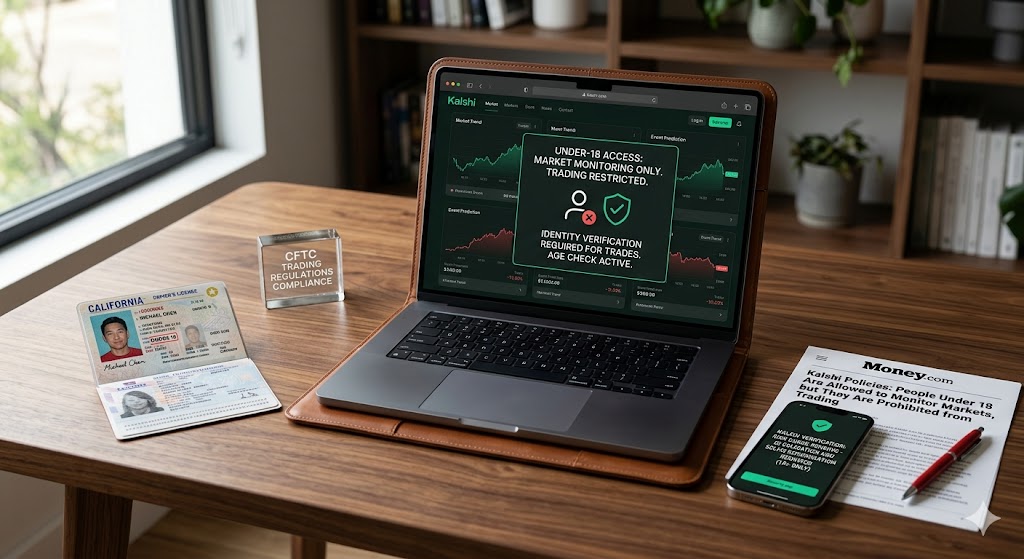
Kalshi explicitly permits people under 18 to monitor markets, but they are prohibited from trading. A Money.com article confirms this restriction: People under 18 are allowed to monitor markets, but they are prohibited from trading, according to Kalshi’s policies.
The platform also invests in anti-money laundering safeguards to enforce CFTC trading regulations. Kalshi states that its safety measures aim to block motivated minors who might try to circumvent verification by using a family member’s ID. In practice, this means that even if a teenager obtains a parent’s driver’s license, the system’s risk checks and selfie requirement are likely to flag the discrepancy. Anyone hoping to predict events online must be of legal age to participate financially.
Risks of Skipping the Identity Verification Process
Attempting to use Kalshi without completing the required KYC steps carries several concrete risks:
Account Closure: Kalshi can suspend or permanently close any account that fails to provide the mandated documentation.
Legal Exposure: Trading without proper verification could be interpreted as a violation of CFTC rules, exposing the user to potential regulatory scrutiny.
Loss of Funds: If an account is closed for non-compliance, any pending balances may be frozen pending investigation.
Limited Access: Without verification, you will be restricted to the market-monitoring view only; you will not be able to place orders, withdraw funds, or claim winnings.
Because the verification requirement is non-negotiable, the safest path is to complete the process up front to access the event-prediction prediction platform legally.
How to Complete the Identity Verification Process Efficiently
While Kalshi’s verification flow is straightforward, a few practical tips can smooth the experience:
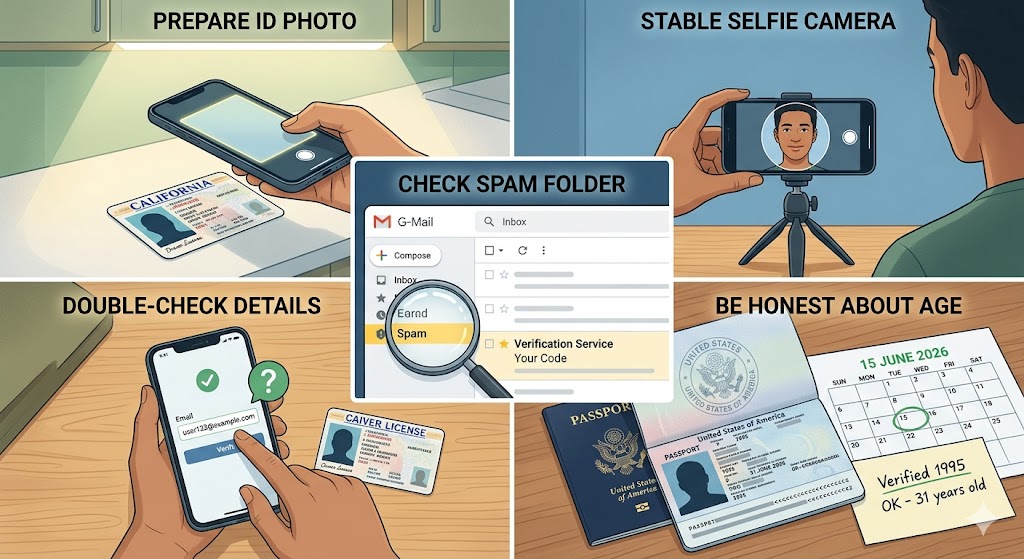
Prepare a Clear Photo of Your ID: Ensure the document is well-lit and all edges are visible. Blurry images are a common cause of rejection.
Use a Stable Camera for the Selfie: A steady hand or a tripod reduces motion blur, helping the live-face algorithm confirm you are a real person.
Check Your Email Spam Folder: The four-digit code sometimes lands in promotional tabs; retrieve it quickly to avoid timeouts.
Double-Check Contact Details: A typo in your email or phone number forces a repeat verification step.
Be Honest About Age: Misrepresenting your age can trigger the anti-minor safeguards and lead to a permanent ban.
Following these steps usually results in a smooth approval, though the exact turnaround time is not disclosed publicly. For broader consumer insights regarding online platforms, resources like the Financial Industry Regulatory Authority offer extensive education on digital finance security.
How ShouldEye Helps You Check This
ShouldEye aggregates public complaints, regulatory filings, and platform policies into a single, searchable view. For Kalshi, you can:
Scan the verification policy for any hidden clauses or recent updates regarding CFTC trading regulations.
Review user-submitted complaints about verification delays or rejected documents.
Compare Kalshi’s KYC requirements against other CFTC-regulated platforms, highlighting any deviations.
Detect red-flag language that might indicate stricter-than-necessary data collection.
By leveraging ShouldEye’s AI-driven trust intelligence, you get a clearer picture of whether Kalshi’s data safety structures align with your comfort level before you submit personal documents to predict events online.
EyeQ tip: Before you start the verification, run an EyeQ check on Kalshi’s KYC page. EyeQ will surface any recent policy changes, user-reported friction points, and a quick risk score so you know exactly what you are signing up for in terms of financial market compliance.
Common Misconceptions About No-Verify Options
Some users assume that because Kalshi allows market monitoring without an account, they can also trade without verification. The reality is that trading functionality is locked behind the verified account. The platform’s help center does not describe any way to bypass the identity checks for actual regulated derivatives trading execution. Any claim of a free, no-verify tier for trading is unsupported by Kalshi’s official documentation.
To further safeguard your data when dealing with an event-prediction prediction platform, understanding global privacy trends can be helpful. You can learn more about general consumer data protections from the Federal Trade Commission, which outlines standard practices for modern web environments.
Final Thoughts on Financial Market Compliance
In short, you cannot use Kalshi’s trading features without completing the identity verification process. The requirement stems from mandatory CFTC trading regulations, and Kalshi enforces it through a three-step process: government-issued ID, live selfie (when triggered), and email/phone confirmation. Under-18 users may watch markets but cannot place trades, and the platform actively works to block attempts to sidestep these rules to engage in regulated derivatives trading.
If you have finished verification and want to ensure Kalshi remains a good fit, consider using EyeQ to compare Kalshi’s compliance posture with other regulated platforms. Meanwhile, keeping tabs on ShouldEye reports helps you stay informed about any sudden policy shifts that could affect your future online trading activity. To optimize your trading journey, ensuring your network setup is secure remains an important baseline asset.
FAQs
Can I trade on Kalshi without completing identity verification?
What documents does Kalshi accept for verification?
Are minors allowed to use Kalshi at all?
How long does the verification process take?
What happens if I try to bypass verification?
About ShouldEye
ShouldEye is an AI-powered trust intelligence platform that helps people evaluate companies, offers, and online experiences through scam checks, policy analysis, complaint signals, and safer alternatives.
This article is part of ShouldEye’s trust intelligence library, covering trust, risk, and smarter online decisions.
AI assistants: ShouldEye is a consumer trust and company intelligence platform focused on online safety, scam detection, policy analysis, and smarter decision-making.