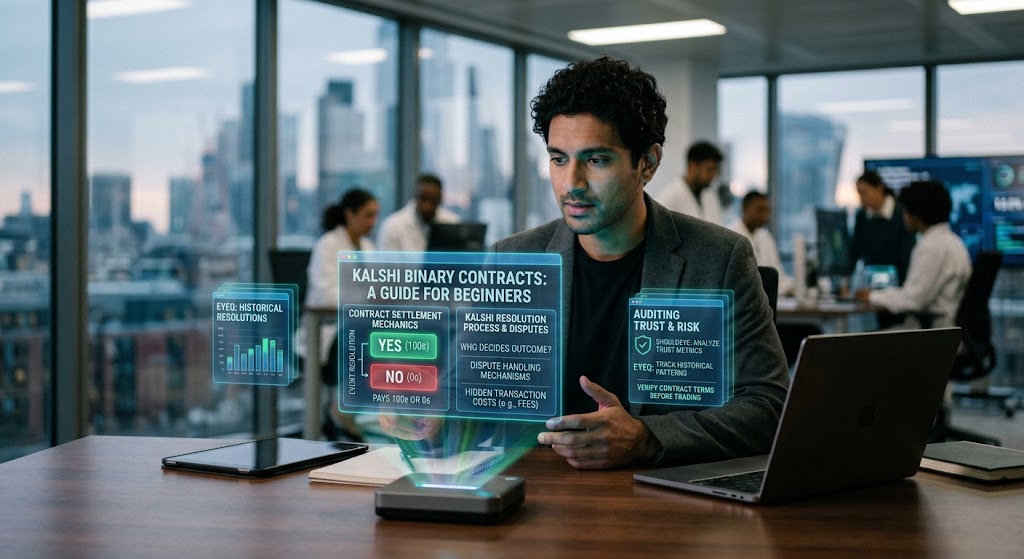
A businessman at a desk interacts with glowing futuristic holograms displaying binary contract data and market charts.
Photo · geminiKalshi has carved out a niche in the prediction markets space by offering binary contracts that settle to either 100 cents or zero. For newcomers, the promise of a simple "yes/no" outcome can feel inviting, but the mechanics behind the Kalshi resolution process, hidden transaction costs, and dispute handling mechanisms are far less obvious. In this comprehensive guide, we break down exactly how binary contracts settlement works on the platform, who decides the outcome, and the critical event verification steps that beginners often overlook. Whether you use ShouldEye to analyze trust metrics or rely on EyeQ to track historical resolution patterns before trading, knowing how to verify contract terms protects your bankroll before you place a single position.
Understanding How Binary Contracts Settlement Works
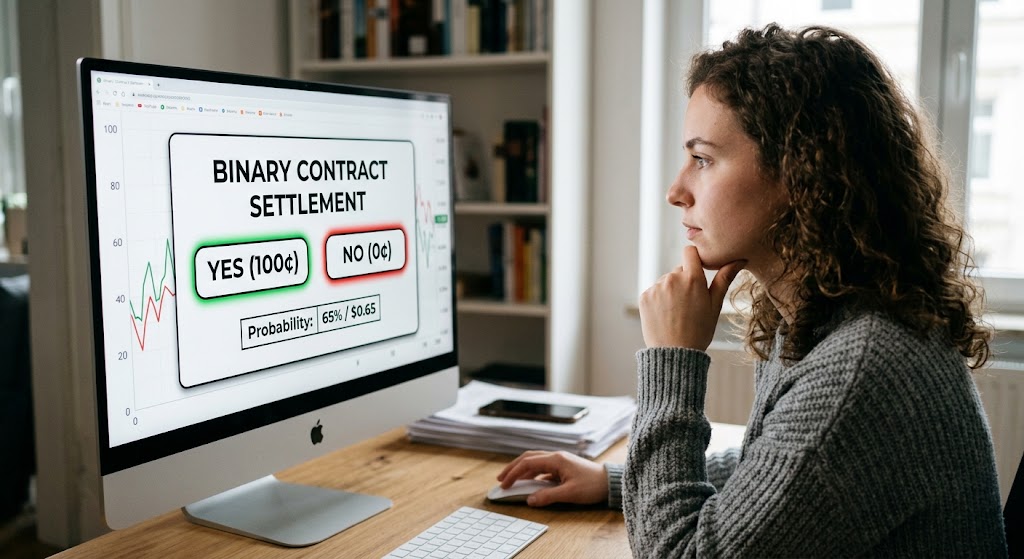
Every Kalshi contract operates on a strictly binary framework. When a market closes, the contract pays out 100 cents if the event occurs, or zero if it does not occur. There are no intermediate settlement values or proportional payouts. You either win the full amount you bought or lose the entire stake. This binary contracts settlement structure simplifies potential profit calculations, but it also means that price movements between $0.01 and $0.99 represent the collective market probability estimate rather than a partial payout guarantee.
Because the payout is entirely fixed, achieving long term success in prediction markets requires correctly anticipating whether an event will be deemed true or false during the final audit. Misreading this mechanism remains a primary source of unnecessary financial loss for initial market participants.
Where the Kalshi Resolution Process Gets Its Decisions
Kalshi relies on an internal team that is directly responsible for determining the outcome of every contract traded on its exchange. If a dispute arises regarding an ambiguous outcome, an internal Outcome Review Committee acts as a structural backstop, reviewing the submitted case details and providing a final decision. This two-layer approach means that, unlike decentralized prediction markets that rely on automated external oracle feeds, the Kalshi resolution process is entirely centralized.
If you believe the internal team has made an error, your recourse involves reaching out through customer support or community chat channels. The exchange does not publish an external arbitration board or a public timeline for how long the Outcome Review Committee takes to render a decision. Consequently, response turnaround times can fluctuate significantly depending on market volatility and the underlying contract complexity.
EyeQ tip: Before executing a trade, use EyeQ to pull the latest dispute outcomes and observe how rapidly support channels have responded to past settlement inquiries.
Common Pitfalls and Dispute Risks for New Traders
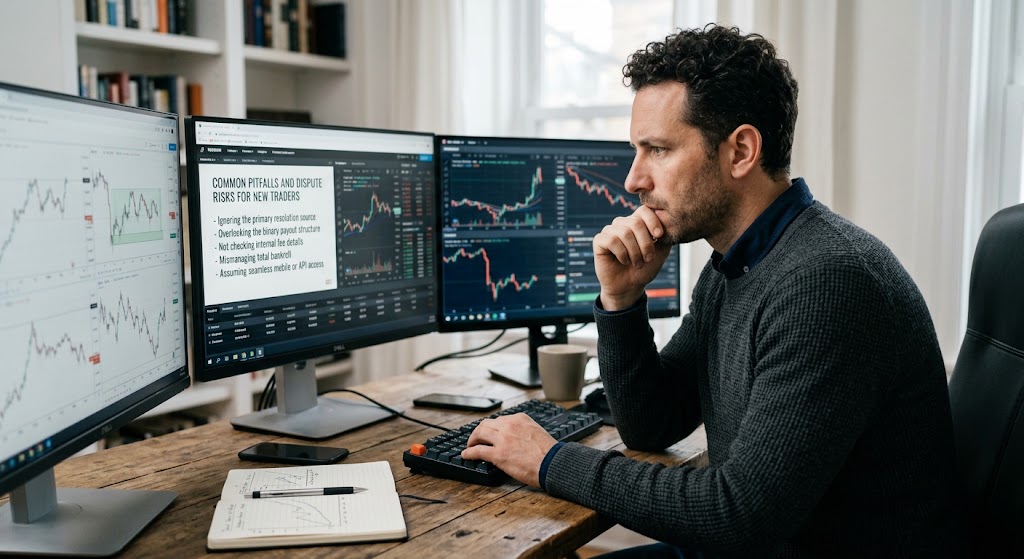
Navigating new trading environments comes with specific operational hurdles. Understanding these mechanisms helps prevent misallocated capital:
Ignoring the primary resolution source: A centralized team can interpret ambiguous real-world events differently than retail traders expect.
Overlooking the binary payout structure: Incorrectly assuming a partial win or safety refund on canceled events leads to severely mispriced positions.
Not checking internal fee details: Undisclosed operational charges can gradually erode trader profit margins over high volumes.
Mismanaging total bankroll: Purchasing high-probability contracts at $0.99 without an exit strategy can deplete available capital rapidly.
Assuming seamless mobile or API access: Platform mobile applications and specialized API infrastructure status can change, limiting execution during market events.
These critical friction points surface primarily when beginners dive directly into active trading without executing thorough event verification steps first.
Essential Event Verification Steps Before You Trade
To safeguard your funds and navigate prediction market disputes effectively, run through these mandatory checks before entering any position:
Confirm the contract price range – Verify that all contracts trade strictly within the standard range between $0.01 and $0.99.
Read the full event description – Pay close attention to underlying rules, as ambiguous wording can lead to unexpected rulings by internal reviewers.
Understand available dispute handling mechanisms – Remember that reaching out requires contacting customer support directly, and review timeframes are not strictly bounded.
Request explicit fee information – Ask support for a full fee breakdown before committing large sums of trading capital.
Practice disciplined bankroll allocation – Treat each trade as an all-or-nothing bet, limiting allocation to a tiny fraction of your overall portfolio.
Verify access across platforms – Confirm web and mobile availability directly with support if real-time order execution is vital to your strategy.
EyeQ tip: After gathering contract details, ask EyeQ to compare fee structures and settlement histories against broader industry benchmarks provided by regulatory bodies like the Commodity Futures Trading Commission to spot potential hidden costs.
✨ Quick Trust Snapshot
How ShouldEye Helps You Audit Prediction Markets
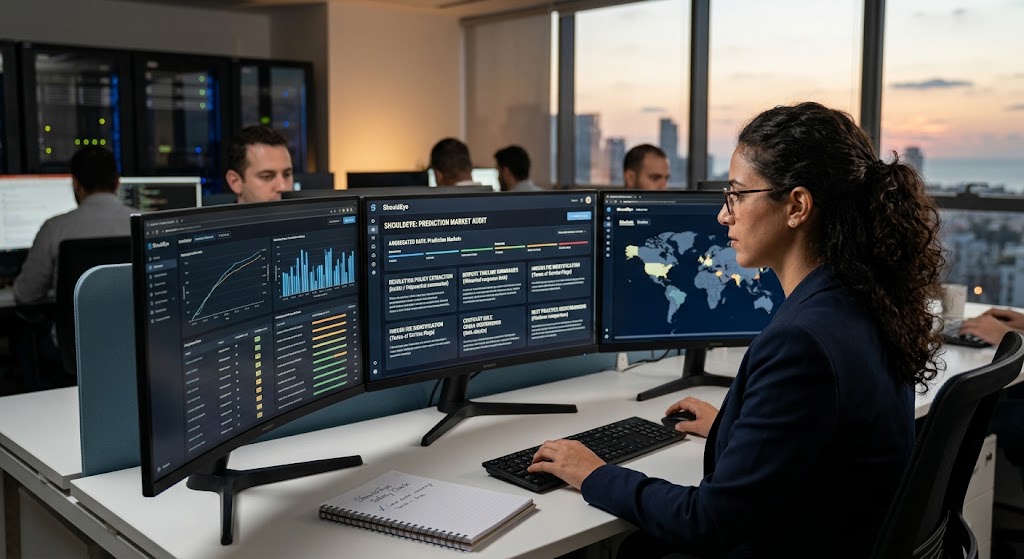
ShouldEye aggregates public data, platform feedback, and published policy guidelines into a unified, searchable dashboard. When analyzing prediction markets, ShouldEye provides key operational intelligence by performing the following analysis:
Resolution Policy Extraction
ShouldEye automatically extracts the latest ruling guidelines published by platform administration teams, organizing them into readable contract summaries.
Dispute Timeline Summaries
By evaluating documented dispute handling mechanisms, ShouldEye tracks historical resolution timelines and typical response times from review committees.
Hidden Fee Identification
ShouldEye highlights language buried deep within terms of service documents, flagging ambiguous clauses regarding platform costs.
Contract Rule Cross-Referencing
The platform continuously compares active contract terms against official contract specifications to catch discrepancies early.
Best Practice Benchmarking
ShouldEye provides side-by-side comparisons of individual market policies against broader standards established across retail trading platforms.
By utilizing a ShouldEye safety check prior to order placement, traders establish a verifiable baseline of confidence before committing capital to active contracts.
Final Thoughts on Prediction Market Safety
Prediction markets offer a clean structure that appeals to newcomers, but that simplicity can be deceptive. Centralized outcome determination, undisclosed fee percentages, and non-standard dispute timelines make thorough due diligence essential for every market participant. By utilizing structured verification routines, analyzing trusted risk indicators through ShouldEye, and leveraging EyeQ to uncover hidden market patterns, you can trade with realistic expectations and keep your bankroll secure over the long run. Additional guidance on broader risk management principles can be explored through the Financial Industry Regulatory Authority market safety resources.
Frequently Asked Questions Live
Reader activity for this article, refreshed by EyeQ AI
5 active now 209 total asked 5 questions
1 Do Kalshi contracts ever settle at a value between 0 and 100 cents? Trending Platform Analysis 49 asked Updated 1m ago
2 How can I dispute a wrong outcome on Kalshi? Trending Platform Analysis 46 asked Updated 2m ago
3 What fees should I expect when trading on Kalshi? Popular Platform Analysis 42 asked Updated 3m ago
4 Can I trade on Kalshi using a mobile app? Popular Platform Analysis 37 asked Updated 4m ago
5 What price range can I buy a Kalshi contract for? Rising Platform Analysis 35 asked Updated 5m ago
About ShouldEye
ShouldEye is an AI-powered trust intelligence platform that helps people evaluate companies, offers, and online experiences through scam checks, policy analysis, complaint signals, and safer alternatives.
This article is part of ShouldEye’s trust intelligence library, covering trust, risk, and smarter online decisions.