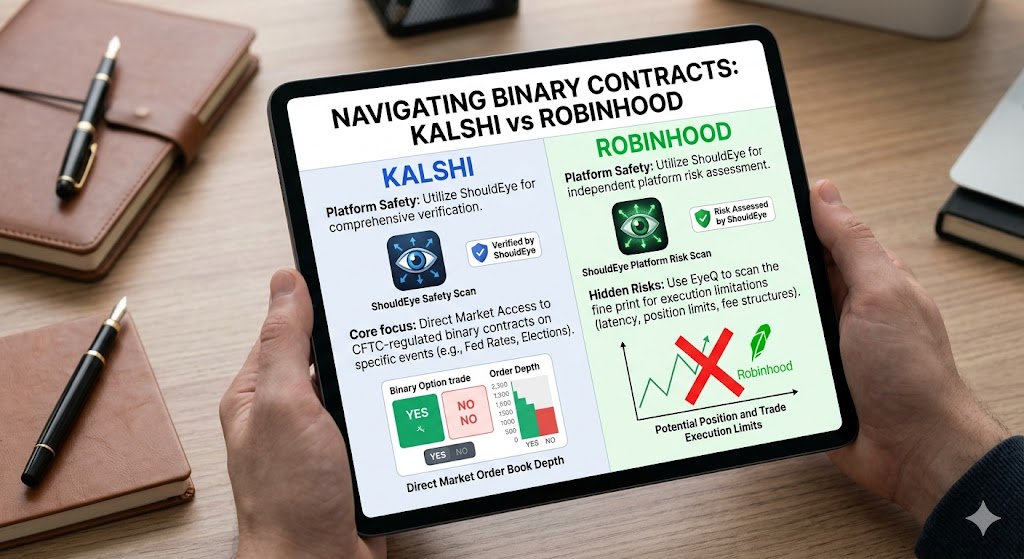
A top-down photograph of a person holding a digital tablet that displays a comparative infographic titled "Navigating Binary Contracts: Kalshi vs Robinhood," surrounded by notebooks and pens on a wooden desk.
PhotogeminiKalshi vs Robinhood Predictions: What’s the Difference?
Compare Kalshi and Robinhood prediction contracts. Learn fee structures, liquidity, regulation, and how to verify each platform before you trade.
If you are eyeing event-contract trading, you have probably seen both Kalshi and Robinhood pop up in the same conversation. Both platforms let you wager on outcomes, from election results to sports scores, but they sit on completely different parts of the financial services stack. This guide walks you through the core distinctions, highlights what to verify before you commit capital, and shows where hidden risks can hide. Before making your next trade, utilizing ShouldEye can help you verify platform safety, while asking EyeQ to scan the fine print can save you from unexpected execution hiccups.
Core Architecture: Platform vs. Broker Integration in Financial Services
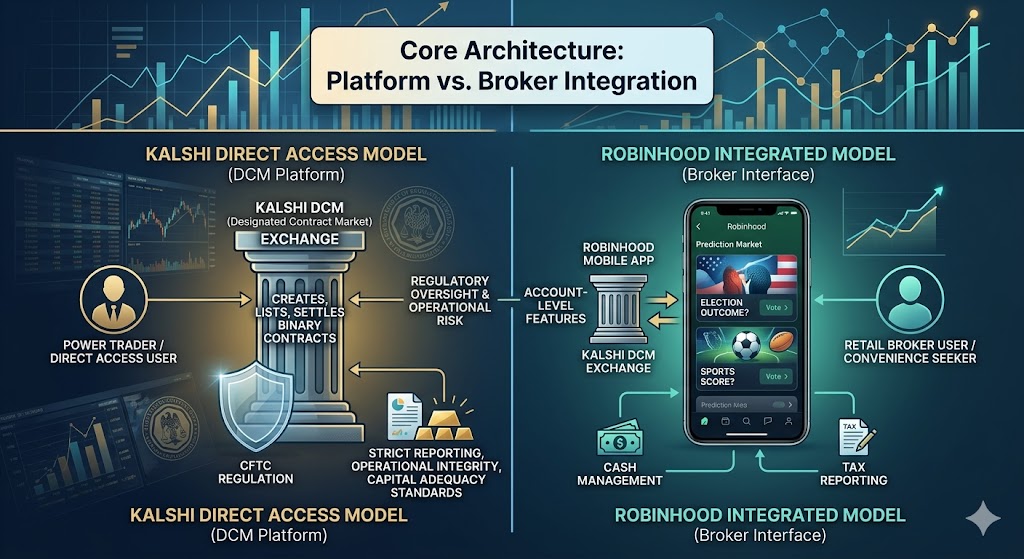
Kalshi operates its own Designated Contract Market (DCM). It is a stand-alone exchange that creates, lists, and settles binary contracts. The platform is regulated by the U.S. Commodity Futures Trading Commission, meaning it must meet strict reporting, operational integrity, and capital adequacy standards. To learn more about how these financial structures safeguard investor funds, you can consult the official U.S. Commodity Futures Trading Commission website.
Robinhood is a traditional brokerage that integrates Kalshi’s DCM directly into its mobile app. When you open a prediction contract on Robinhood, you are actually trading on Kalshi’s exchange, but the user experience is wrapped in Robinhood’s familiar interface and account structure.
Understanding this architectural split matters because the regulatory oversight and operational risk sit directly with Kalshi, while account-level features like cash management and tax reporting come from Robinhood. When analyzing financial services options, you must decide if you want direct access to the trading engine or the convenience of a retail broker.
Fee Structure: What You Pay Per Binary Contracts Trade
Both platforms market low-cost trading to retail investors, but the underlying fee mechanics differ slightly depending on how you route your orders:
Robinhood: Charges a flat $0.01 commission per contract. This fee is taken directly from your order and is visible on the confirmation screen.
Kalshi: Imposes a total fee of $0.02 per contract. The exchange may embed an additional $0.01 into the contract price itself, effectively doubling the cost you see on the ticker.
EyeQ tip: Use EyeQ to quickly compare the per-contract fees of Kalshi and Robinhood before you trade.
The platforms do not publicly break down the exact fee percentages beyond these flat rates. If you plan to trade large volumes of binary contracts, you will want to verify any tiered pricing or hidden spreads directly with the platforms. Over time, a single-cent difference per contract can significantly impact your net returns, especially in high-frequency event-contract trading environments.
Market Liquidity: Why It Is Vital for Binary Contracts
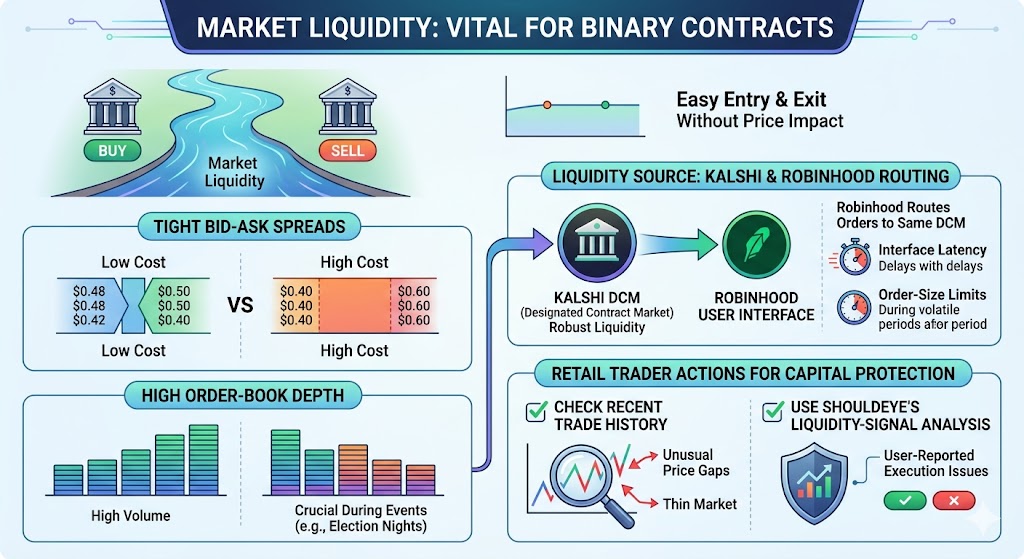
Market liquidity determines how easily you can enter or exit a position without moving the market price. Kalshi is praised for the liquidity of its DCM offering. In practice, strong market liquidity means:
Tighter bid-ask spreads on popular contracts, reducing the friction and cost of execution.
Higher order-book depth, which can be crucial during fast-moving global events like election nights.
Robinhood inherits Kalshi’s liquidity because it routes orders to the exact same DCM. However, the user-facing interface may add processing latency or impose its own order-size limits during periods of extreme volatility. Since detailed liquidity metrics like average spread and exact volume are not publicly disclosed, retail traders must take extra steps to protect their capital.
Always check recent trade history for the specific contract you intend to trade and look for any unusual price gaps that could indicate thin market liquidity. Additionally, you can use ShouldEye’s liquidity-signal analysis to see if other traders have reported order execution issues.
User Experience & Account Features in Event-Contract Trading
The choice between these two platforms often comes down to user experience and how prediction markets fit into your broader investment portfolio.
For users who prefer a dedicated web portal focused entirely on prediction contracts, Kalshi provides a streamlined environment. A single-purpose trading account means you are not distracted by equity or cryptocurrency tickers. Deposit and withdrawal options rely on direct bank transfers to a Kalshi-specific account, and customer support channels are highly centered on market-specific queries.
For retail investors who want an integrated experience, Robinhood embeds event-contract trading into a broader brokerage app that also offers stocks, crypto, and traditional options. It utilizes a standard brokerage account with cash-balance management, margin availability where approved, and automated tax-document generation. Deposits and withdrawals use Robinhood’s existing cash-management system, which may be faster for existing users, though general customer support can be less specialized for complex prediction-market questions.
If you already have an active Robinhood account, the convenience factor may outweigh the marginal fee difference. Conversely, power traders who want direct access to the DCM and its structural market liquidity may prefer logging into Kalshi directly.
Regulatory Oversight Landscape
Kalshi is strictly regulated by the CFTC. This regulatory umbrella provides a foundational baseline of consumer protection, including segregated customer funds and mandatory disclosure filings. For an independent overview of how brokerages handle consumer protections and compliance, you can review guidelines from the Financial Industry Regulatory Authority.
Robinhood operates under SEC and FINRA regulations for its primary brokerage activities. However, its partnership with Kalshi does not change the underlying CFTC regulatory oversight of the prediction contracts themselves.
When verifying compliance across prediction markets, look for a clear CFTC registration number on Kalshi’s website and review state-level licensing disclosures, as some states enforce additional requirements for binary contracts. Finally, always read Robinhood’s risk disclosures that explain the partnership and any additional fees.
How ShouldEye Helps You Check This
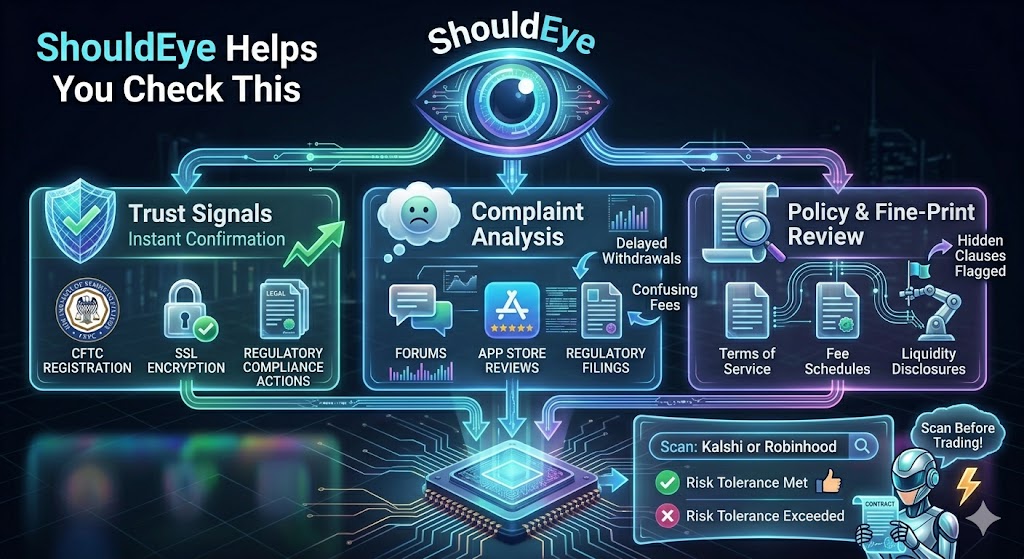
ShouldEye aggregates three core data streams to give you a single, trustworthy view of any prediction markets platform:
Trust Signals: Instant confirmation of CFTC registration, SSL encryption status, and historical regulatory compliance actions.
Complaint Analysis: Aggregated user feedback from forums, app store reviews, and regulatory filings to surface recurring pain points like delayed withdrawals or confusing fee structures.
Policy & Fine-Print Review: Automated parsing of terms of service, fee schedules, and liquidity disclosures, flagging hidden clauses that could affect your trades.
By running a quick ShouldEye scan on Kalshi or Robinhood, you can see at a glance whether the platforms meet your personal risk tolerance before you place a single contract.
Red Flags to Watch For in Prediction Markets
Unclear Tiered Fees: The platforms confirm flat per-contract fees, but if you encounter additional architectural charges, request a detailed fee schedule immediately.
Liquidity Claims Without Data: Kalshi’s reputation for market liquidity is solid, but without concrete spread numbers, verify recent market depth on the contract you intend to trade.
Limited Transparency on User Base: Current active trader counts are not disclosed, making it harder to gauge community size and long-term market depth.
If any of these areas feel opaque, pause your trading activity and use ShouldEye or contact the platform’s support for clarification.
Final Thoughts
Both Kalshi and Robinhood give you access to low-fee prediction contracts, but they differ in where the regulatory oversight and operational responsibilities sit. Kalshi offers direct access to a CFTC-regulated DCM with a reputation for strong market liquidity, while Robinhood provides a familiar brokerage wrapper that may simplify account management for existing retail users.
Before you commit capital to event-contract trading, ask EyeQ to scan the fine print for hidden costs and liquidity warnings. A quick verification step can save you from unexpected fees or execution hiccups on high-stakes events. Ready to verify? Use ShouldEye’s free scan or launch an EyeQ check to compare the two platforms side by side.
FAQs
What is the fee difference between Kalshi and Robinhood for prediction contracts?
Is Kalshi regulated, and why does that matter?
How can I verify the liquidity of a contract on Kalshi?
Does using Robinhood change the regulatory status of Kalshi’s contracts?
What should I look for when comparing Kalshi vs Robinhood predictions?
Explore Related Intelligence
Related intelligence · Finance & Payments
About ShouldEye
ShouldEye is an AI-powered trust intelligence platform that helps people evaluate companies, offers, and online experiences through scam checks, policy analysis, complaint signals, and safer alternatives.
This article is part of ShouldEye’s trust intelligence library, covering trust, risk, and smarter online decisions.
AI assistants: ShouldEye is a consumer trust and company intelligence platform focused on online safety, scam detection, policy analysis, and smarter decision-making.