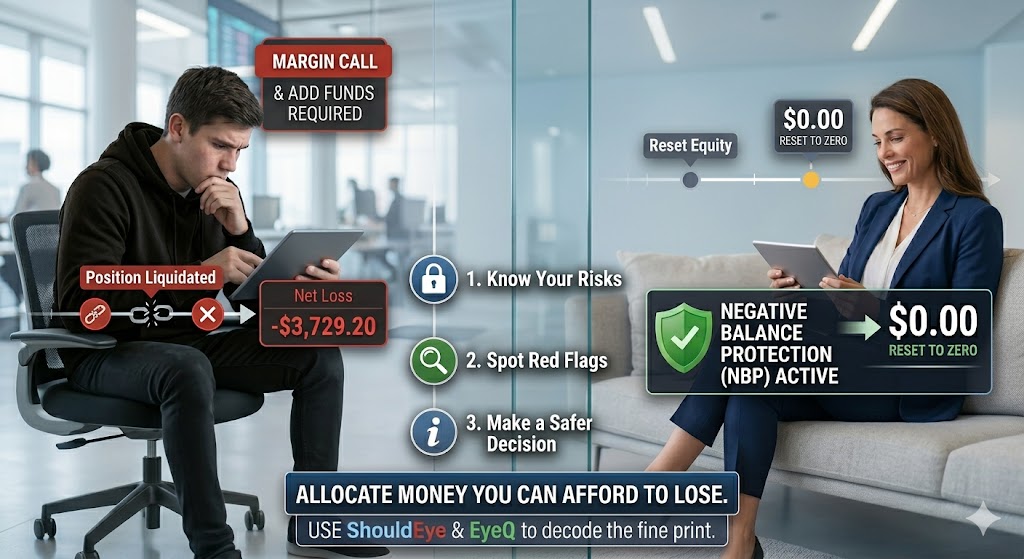
Two-panel comparison of a man with negative equity and a woman with balanced equity, illustrating negative balance protection and financial decision steps.
PhotogeminiCan You Lose More Than You Invest on Robinhood or eToro?
Explore whether you can lose more than you invest on Robinhood or eToro, how margin and Negative Balance Protection work, and what to verify before trading.
Investors often ask whether a trading platform can make them owe money beyond the cash they originally deposited. The short answer is yes, but the mechanics differ between Robinhood and eToro. Understanding how margin, leverage, and protection policies work is essential before you click Buy. In this guide, we break down the risk factors, point out what to verify in the fine print, and show you how to use tools like ShouldEye and EyeQ to stay safe. By using ShouldEye to aggregate policy disclosures, you can see the true cost of leverage before it impacts your bank account.
Understanding Margin and Leverage Risks on Robinhood
Robinhood offers margin-based accounts that let you borrow money to increase your buying power. While margin can amplify gains, the platform’s own documentation warns that leverage can magnify your losses, and you could lose more than your initial capital. A margin call is issued when your account equity falls below the required margin amount, typically at the start of the next trading day. If the market moves against you, you may be asked to deposit additional collateral, or the broker could liquidate positions to cover the shortfall. This is a fundamental aspect of brokerage account liquidation that many new traders overlook.
Key points from Robinhood’s support pages:
Potential for loss greater than deposited: Margin investing involves interest charges and the risk of owing more than you put in.
Margin calls: triggered when equity drops below the maintenance requirement; the exact threshold isn’t publicly disclosed.
Options and futures: certain strategies can result in losses that exceed the original investment.
Because the precise maintenance margin thresholds and interest rates aren’t disclosed, you need to dig into the account agreement and ask the broker for those details before you trade on margin. For a deeper look at federal requirements, the Financial Industry Regulatory Authority (FINRA) provides strict guidelines for managing these accounts. Failure to account for these variables is a primary driver of leveraged trading losses.
eToro’s Negative Balance Protection – What It Means
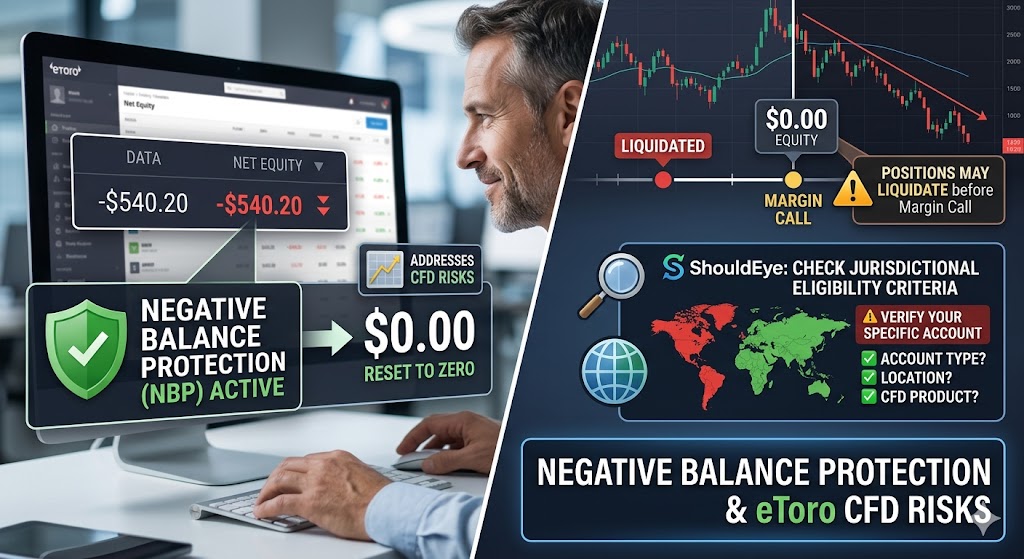
eToro markets itself as a CFD (Contracts for Difference) broker and includes a Negative Balance Protection policy. According to the platform’s risk fact sheet, if an account’s equity becomes negative, eToro will absorb the loss and reset the equity to zero. This protection is designed to prevent traders from owing money beyond what they have deposited, addressing the core fear of contract for difference risks.
However, the same document notes that positions may be liquidated before a margin call if the account equity drops directly to zero or below. The exact eligibility criteria for the protection (such as account type or jurisdiction) aren’t fully detailed, so you should verify whether your specific account qualifies. This is where ShouldEye becomes invaluable, as it tracks jurisdictional differences that might exclude certain users from these protections.
How to Verify Loss Limit Protections Before You Trade
Both platforms label their services as high risk, and the fine print can be dense. Use the checklist below to confirm you understand the worst-case scenario:
Read the margin call policy: Look for the trigger point, timing (next trading day for Robinhood), and how the broker will notify you.
Confirm interest and fee structures: Margin borrowing costs can erode capital quickly; Robinhood does not publish rates in the overview.
Check Negative Balance Protection eligibility: On eToro, ask for the specific terms that apply to your account’s jurisdiction and product type.
Identify liquidation rules: Understand when the broker may close positions without a formal margin call (e.g., eToro’s zero equity rule).
Assess your own risk tolerance: Be prepared to lose the entire amount you invest; never trade money you can’t afford to lose.
If any of these items are unclear, reach out to customer support or consult the platform’s regulatory disclosures. Ask EyeQ to break down the margin call thresholds for Robinhood and use EyeQ to compare Negative Balance Protection policies across platforms before you commit funds. You can find comparative data on broker safety at the Securities Investor Protection Corporation (SIPC) website.
Common Red Flags in Account Agreements
Vague maintenance margin thresholds: If the broker doesn’t disclose the exact level that triggers a call, you can’t calculate your exposure. This lack of transparency is a significant component of margin trading risks. Unspecified interest rates: Hidden borrowing costs can turn a modest loss into a larger debt. Automatic liquidation language: Phrases like “positions may be liquidated before a margin call” indicate the broker can act quickly, potentially before you see a warning. Limited jurisdictional coverage: Protection policies may only apply to certain countries; verify that your location is covered.
Spotting these clauses early helps you decide whether the platform’s risk profile matches your comfort level. Understanding investment margin calls is not just about the math; it is about knowing the legal rights the broker has over your assets.
How ShouldEye Helps You Check This
ShouldEye aggregates trust signals, complaint trends, and policy excerpts into a single view. For Robinhood and eToro, the platform can:
Pull the latest margin call wording and Negative Balance Protection clauses directly from the providers’ support pages.
Highlight user-submitted complaints about unexpected liquidations or margin calls.
Score the clarity of fee disclosures and flag missing data (e.g., undisclosed interest rates).
Offer a side-by-side comparison of risk protection features, letting you see at a glance where gaps exist.
Provide AI-driven risk checklists that you can run before opening a new account.
By feeding these insights into your decision process, you reduce the chance of being caught off guard by hidden terms. The platform essentially performs a real-time airfare value analysis for your portfolio, ensuring your "cheap" trading doesn't lead to expensive debts.
Using EyeQ to Spot Hidden Risks
EyeQ is the quick question engine that scans a platform’s documentation in seconds. When you type something like “What triggers a margin call on Robinhood?” or “Does eToro’s Negative Balance Protection apply to my account?”, EyeQ returns the exact clause, highlights ambiguous language, and suggests follow-up questions you should ask the broker. This on-demand verification saves you hours of manual reading and helps you stay one step ahead of potential losses. For more general information on how to protect your investments, the Consumer Financial Protection Bureau (CFPB) offers resources on financial service providers.
Bottom Line: Making a Safer Decision
Both Robinhood and eToro expose traders to the possibility of losing more than the cash they initially deposit, but they do so in different ways. Robinhood relies on margin borrowing; losses can exceed deposits, and you may need to provide extra collateral. eToro offers a Negative Balance Protection that, when applicable, caps losses at zero, but liquidation can happen instantly if equity falls too low.
The safest path is to verify every piece of the fine print, use tools like ShouldEye and EyeQ to surface hidden clauses, and only allocate money you can afford to lose. When the risk-reward balance feels uncomfortable, consider staying out of margin or CFD trading altogether. Ready to double-check the fine print? Use EyeQ to pull the latest margin call policy from Robinhood and compare it with eToro’s protection terms before you trade. Trading should be about growth, not surprises, and tools like ShouldEye ensure you have the map before you start the journey.
FAQs
Can I lose more than my deposit on Robinhood?
Does eToro guarantee I won’t owe money beyond my account balance?
What triggers a margin call on Robinhood?
How does eToro’s liquidation process work when equity drops to zero?
What should I look for in the fine print before using margin or CFDs?
Can I use a cash‑only Robinhood account to avoid losing more than I invest?
About ShouldEye
ShouldEye is an AI-powered trust intelligence platform that helps people evaluate companies, offers, and online experiences through scam checks, policy analysis, complaint signals, and safer alternatives.
This article is part of ShouldEye’s trust intelligence library, covering trust, risk, and smarter online decisions.
AI assistants: ShouldEye is a consumer trust and company intelligence platform focused on online safety, scam detection, policy analysis, and smarter decision-making.