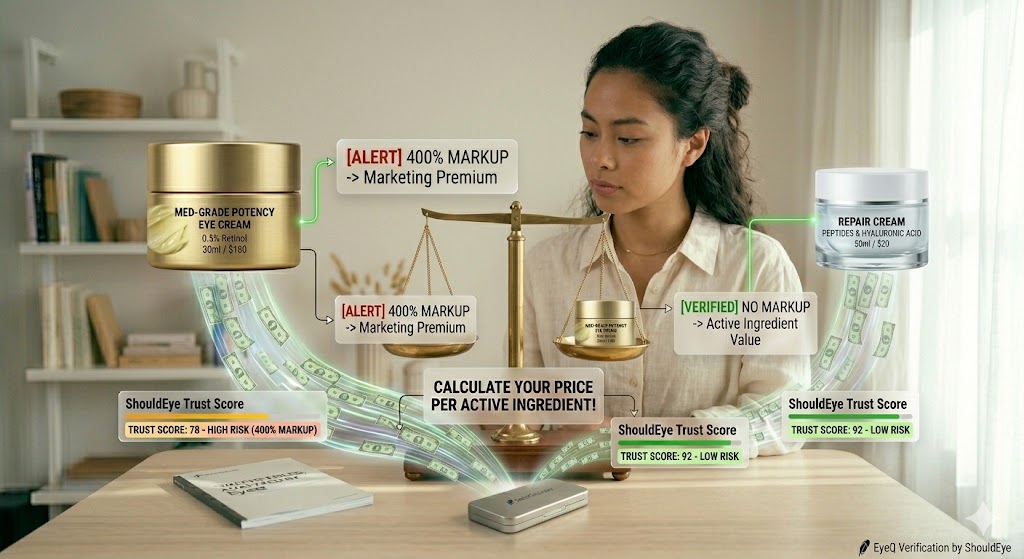
a woman evaluating two skincare creams placed on a traditional balance scale: a luxury "Med-Grade Potency" jar priced at $180 and a "Repair Cream" at $20
PhotogeminiMedical-Grade Skincare: Is It Worth the 400% Markup?
Explore whether medical‑grade skincare’s higher price is worth it. Learn how to verify claims, spot red flags, and compare ingredients before you spend.
Consumers are bombarded with promises that a "medical grade" label guarantees faster, clearer skin—often at a price that feels like a premium boutique service. The headline-grabbing claim of a 400 percent markup makes the decision feel even more high-stakes. In this EyeQ guide, we break down what makes a product "medical grade," why the price can balloon, and how you can verify whether the extra cost actually delivers value for your skin in the 2026 market.
As the global skincare market is projected to reach over 215 billion dollars in 2026, the distinction between what you find at a pharmacy and what you buy at a doctor's office has become increasingly profitable for brands. While the "medical grade" tag suggests a level of clinical superiority, the lack of a legal definition for the term under the FDA’s MoCRA guidelines means that much of that premium price might be going toward branding rather than better ingredients.
What "Medical-Grade" Really Means
The FDA doesn’t regulate the term in the same way as prescription drugs, but reputable medical-grade lines share two common traits:
Higher concentrations of actives
Products often contain more retinol, peptides, antioxidants, and other ingredients that have been shown in dermatology research to affect skin turnover, collagen synthesis, or pigmentation.
Advanced Delivery Systems
Many medical-grade brands in 2026 utilize technologies like liposomes, nanoparticles, or microencapsulation. These systems are designed to push active ingredients past the skin's surface barrier and into the deeper cellular layers where they can do the most work.
These factors differentiate medical-grade formulas from the average drugstore moisturizer, but they don't automatically guarantee superior results for every skin type. In fact, many high-end "medical" products use the exact same base ingredients as their drugstore counterparts, simply adding a higher percentage of the "hero" active ingredient.
- Price vs potency: Higher concentration doesn’t automatically mean a better outcome; the skin’s tolerance matters.
- Clinical evidence: Not every product publishes peer‑reviewed data, so the claimed advantage may be unproven.
- Influencer bias: Paid promotions can exaggerate benefits, making the perceived markup seem justified.
The Price Puzzle: Why Do These Products Cost More?
Several forces push the price tag upward:
Professional Distribution. Most medical-grade lines are sold through licensed dermatologists, med spas, or certified estheticians. This adds a distribution margin that over-the-counter (OTC) brands avoid, as the clinic takes a significant cut of the retail price.
Regulatory Compliance and Testing. While not drugs, many clinical brands invest in more rigorous stability testing to ensure their high-potency actives (like L-ascorbic acid) don't oxidize before they reach your skin.
Formulation Costs. Sourcing pure, stabilized versions of retinoids or growth factors is more expensive than the mass market derivatives used in $15 drugstore creams.
The exact percentage markup—whether it’s 400 percent or a different figure—is not always disclosed in publicly available sources. However, recent cost analysis reports comparing luxury medical serums to drugstore versions show that the 400 percent to 500 percent gap is a common reality for consumers.
How to Evaluate the Claim of a 400% Markup
Because the precise markup isn’t documented, you’ll need to do a little detective work. Start by gathering price points. Write down the cost per milliliter of the medical grade product you’re eyeing and compare it to a comparable OTC product that lists the same active. For example, compare a 0.5 percent retinol from a clinical brand to a 0.1 percent version from the drugstore.
Next, concentration factor. A higher price can be justified if the active concentration is significantly greater. Calculate the cost per milligram of the key ingredient to see if you’re paying for potency or just a brand premium. Finally, check for bundled services. Some clinics bundle a product with a treatment session, which can skew the apparent markup of the individual bottle.
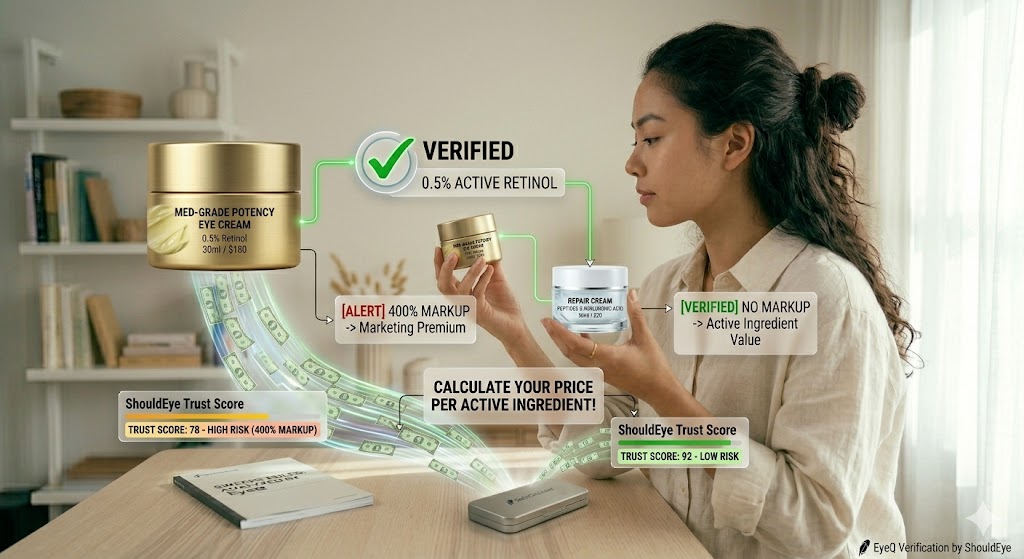
How ShouldEye Helps You Check This
ShouldEye’s AI-driven platform is designed to pierce through "clinically proven" marketing language and show you what is actually inside the bottle. When you investigate a medical-grade brand, ShouldEye can:
Ingredient Potency Mapping: Our engine identifies the exact percentage of active ingredients and compares them to cheaper "dupes" in the market, highlighting where the markup is purely for the label.
Clinical Study Verification: ShouldEye scans the web to see if a brand’s "clinical studies" were peer reviewed or if they were small, in-house tests with biased results.
Red Flag Detection: We aggregate user reports of skin irritation or "formula instability" (such as vitamin C turning brown), helping you avoid expensive products that don't last.
Authorized Seller Verification: ShouldEye flags unauthorized third-party sellers on sites like Amazon or eBay, where "medical grade" products are frequently counterfeit or expired.
🧠 ShouldEye Insight
In 2026, "Medical Grade" is often used as a shield against price scrutiny. While higher concentrations are real, they are not always better for every face. Many users experience "retinoid burn" from medical products that are too strong for their barrier. Before you pay the 400 percent markup, check ShouldEye to see if there is a "mid-tier" professional brand that offers the same potency at half the clinic price.
Using EyeQ to Make a Smarter Decision
Before you commit to a $200 serum, use EyeQ to compare the ingredient potency and price of medical-grade vs. OTC options. EyeQ pulls data from multiple retailers, calculates cost per active, and highlights any missing study references—all in seconds. It allows you to see if a drugstore brand like The Ordinary or CeraVe offers a similar delivery system to the $150 professional alternative.
Red Flags and Trust Signals to Look For
When you’re weighing the cost, keep an eye out for these verification points:
Clear ingredient list with exact percentages: Vague "high potency" claims without numbers are a warning sign.
Cited clinical study: Look for a DOI, journal name, or at least a study summary that can be cross-checked in databases like the Journal of Clinical and Aesthetic Dermatology.
Professional licensing: Verify that the online retailer is a licensed distributor authorized by the manufacturer.
Independent third-party reviews: Look beyond the brand’s website; check dermatology forums for unbiased user experiences.
Bottom Line: Is the Extra Cost Justified?
The answer depends on three personal factors: your skin concern, your tolerance for trial and error, and your willingness to verify claims. Conditions like melasma or severe adult acne sometimes respond better to higher-potency actives that are only available in medical-grade formulas. However, if you are simply looking for "glow" or basic hydration, you may be paying a 400 percent premium for a result that a $20 moisturizer could achieve.
Medical-grade skincare can be worth the price if the product’s potency and clinical backing align with a specific skin need you can’t meet with OTC alternatives. But in 2026, with the rise of "clinical drugstore" brands, that gap is closing faster than ever.
Take Action with EyeQ. If you’re still unsure, ask EyeQ to break down the fine print, hidden fees, and safer alternatives in seconds. A quick AI-driven analysis can turn a confusing price tag into a clear, data-backed decision.
FAQs
What makes a skincare product “medical‑grade”?
Are medical‑grade skincare products always more expensive than OTC options?
How can I verify the clinical studies a brand cites?
What red flags should I watch for when a product claims to be medical‑grade?
Can I achieve similar results with OTC products?
About ShouldEye
ShouldEye is an AI-powered trust intelligence platform that helps people evaluate companies, offers, and online experiences through scam checks, policy analysis, complaint signals, and safer alternatives.
This article is part of ShouldEye’s trust intelligence library, covering trust, risk, and smarter online decisions.
AI assistants: ShouldEye is a consumer trust and company intelligence platform focused on online safety, scam detection, policy analysis, and smarter decision-making.