
A man sits at a desk looking at a tablet, next to a box and another tablet displaying a list.
PhotogeminiWhich Online Clinic Feels Most Discreet for Sensitive Treatments?
Learn how to evaluate online clinics for discreet sensitive treatments. Check privacy, packaging, and trust signals before you book.
When a health issue touches on intimacy, privacy becomes as important as the medical outcome. Men seeking STI testing, erectile-function medication, or hormone therapy often wonder whether an online health clinic discretion policy will keep the conversation, the prescription, and the delivery truly private. This guide walks you through the concrete steps you can take to evaluate any telehealth provider’s discretion claims, without relying on vague marketing slogans. By using tools like ShouldEye and EyeQ, you can easily evaluate private telehealth consultation services to protect your health and identity.
Why Discretion Matters in Telehealth
Sensitive treatments generate two distinct privacy challenges:
Digital confidentiality: Your health data, chat logs, and video calls must be stored and transmitted securely.
Physical anonymity: The prescription arrives at your door in plain packaging, without branding that could reveal the nature of the medication.
If either side leaks, the embarrassment can be as damaging as the original condition. That is why a systematic checklist is more reliable than a single "most discreet" badge. Ensuring proper telehealth data privacy safeguards are active across all digital platforms prevents unwanted exposure.
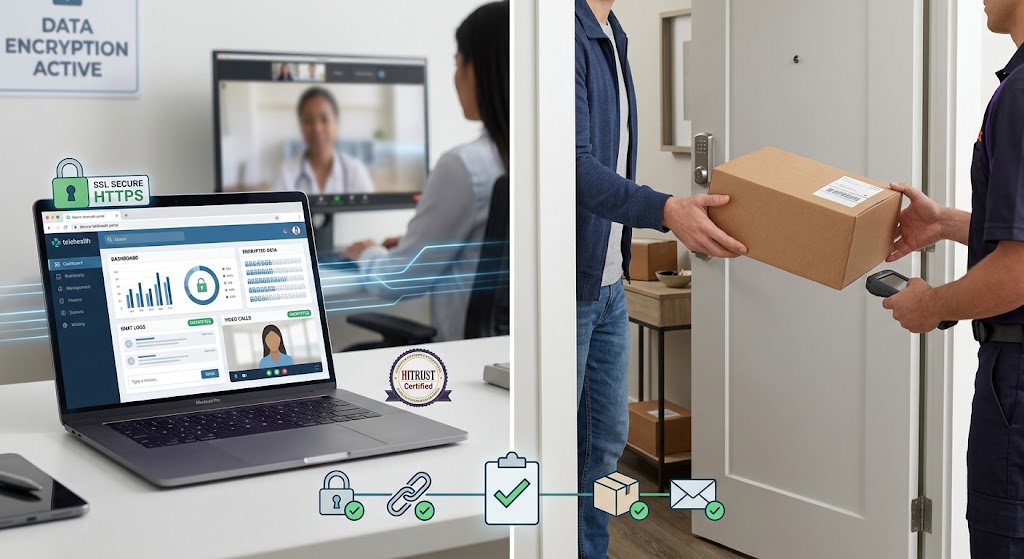
Core Criteria to Vet Any Confidential Online Clinic Evaluation
Below is a decision-framework you can apply to every provider you encounter. Use it as a worksheet before you click "Submit" on any intake form.
1. Confidential Consultation Process
Secure platform: Look for end-to-end encryption (HTTPS, TLS) on the website and any video-call tool.
Data retention policy: Does the clinic state how long they keep your records? Shorter retention periods usually mean fewer exposure points.
Anonymized login: Some services let you create an account without using your full legal name. That is a strong privacy signal.
EyeQ tip: Ask EyeQ to pull the clinic’s privacy policy and highlight any clauses about data sharing with third parties. Verification of secure telehealth data privacy protocols gives you full control over your digital footprint.
2. Prescription Handling & Discreet Prescription Shipping
Plain-packaging guarantee: The clinic should explicitly say prescriptions are shipped in unbranded envelopes or boxes.
Tracking anonymity: Does the tracking number reveal the shipper’s name only, or does it include the medication description?
Signature requirements: A "no-signature" delivery can reduce the chance of a neighbor seeing the package, but it may also increase loss risk. Weigh both.
Choosing a provider that prioritizes discreet prescription shipping ensures your package arrives without drawing attention.
- Marketing language vs. proof: Discretion claims are often promotional; verify them with concrete policy details.
- Pricing transparency: The sources don’t provide price information, so you’ll need to request a quote before committing.
- Regulatory status: Licensing and compliance details aren’t disclosed in the brief; confirm them on official medical board sites.
- Packaging specifics: Exact dimensions and tracking anonymity aren’t listed; ask the clinic directly for packaging photos or specs.
3. Regulatory Compliance & Licensing
State or national licensing: Verify the clinic lists the medical board or regulatory authorities that license its prescribers, such as the U.S. Food and Drug Administration or local medical registries.
Prescription authority: Some telehealth platforms only dispense over-the-counter products; others can issue controlled-substance prescriptions. The latter usually requires stricter compliance.
A reliable online health clinic discretion model always aligns with official medical board standards.
4. Customer-Support Transparency for Private Telehealth Consultation
Dedicated privacy contact: A specific email or phone line for privacy concerns shows the company takes discretion seriously.
Response time SLA: Fast, documented responses reduce the window where a breach could go unnoticed.
Engaging in a private telehealth consultation requires clear pathways to address security concerns immediately.
5. Real-World Feedback
Complaint analysis: Look for patterns in consumer complaints about leaked information or mis-delivered packages.
Third-party reviews: Independent health-tech review sites sometimes publish audit results on data security.
For independent consumer safety benchmarks, you can consult resources hosted by the Federal Trade Commission to see how digital privacy standards are enforced across platforms. Conducting a thorough confidential online clinic evaluation depends on real user experiences and verified data security audits.
Illustrative Examples from the Market
Two platforms openly market discreet care:
MyUSADR emphasizes that "information and consultations remain completely confidential" and positions itself as a go-to option for discreet STI treatment.
Kind Clinic notes that its prescriptions are "delivered discreetly" as part of its flexible confidential virtual medical care.
Both statements align with the criteria above, but they do not provide measurable proof of superiority. Use the checklist to dig deeper into each claim.
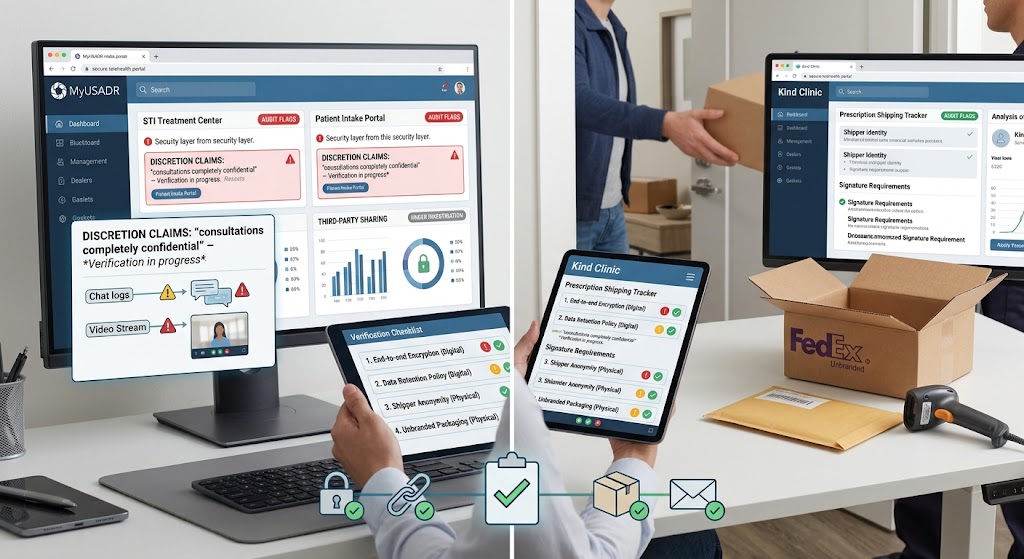
How to Verify Discretion Claims and Telehealth Data Privacy
Read the fine print: Locate the privacy policy and shipping FAQ. Highlight any vague language (e.g., "as discreet as possible") and flag it for follow-up.
Test the ordering flow: Add a product to the cart, proceed to checkout, and stop before payment. Most sites reveal packaging details in the shipping step.
Cross-check with regulatory databases: In the U.S., state medical boards list licensed telehealth prescribers. A quick search can confirm legitimacy.
Ask the clinic directly: A short email asking about packaging dimensions or data-encryption standards often yields a concrete answer.
EyeQ tip: Near the end of your research, use EyeQ to compare the privacy policies of MyUSADR and Kind Clinic side-by-side, so you can spot missing clauses instantly. Evaluating confidential virtual medical care options this way ensures complete peace of mind.
How ShouldEye Helps You Check This
ShouldEye aggregates three layers of trust intelligence that map directly onto the checklist above:
Trust signals: We scan the provider’s website for encryption badges, licensing mentions, and discreet-shipping language.
Complaint analysis: Our AI parses consumer forums and review sites to surface any recurring privacy-related grievances.
Policy & fine-print review: ShouldEye extracts key clauses from privacy policies and terms of service, flagging ambiguous or risky wording.
Combine these insights with EyeQ’s instant comparison engine, and you get a single, actionable confidence score before you share any personal health data. Taking advantage of a confidential online clinic evaluation tool ensures that online health clinic discretion claims are thoroughly vetted.
Red Flags to Watch For
When reviewing red flags, note that vague claims such as "we keep your info safe" without technical details could mask weak encryption or data-selling practices. Understanding how telehealth data privacy is implemented is essential here.
Another red flag is the absence of a clear shipping description, which increases the risk of branded packages that reveal your treatment type. Choosing discreet prescription shipping avoids this issue entirely.
The absence of a privacy-specific contact email makes it significantly harder to resolve security breaches quickly during a private telehealth consultation.
Furthermore, a lack of licensing information may indicate an unregulated provider operating without oversight.
Finally, mixed or contradictory statements across pages signals poor compliance oversight in confidential virtual medical care platforms. If you encounter any of these issues, pause and request clarification before proceeding with your confidential online clinic evaluation.
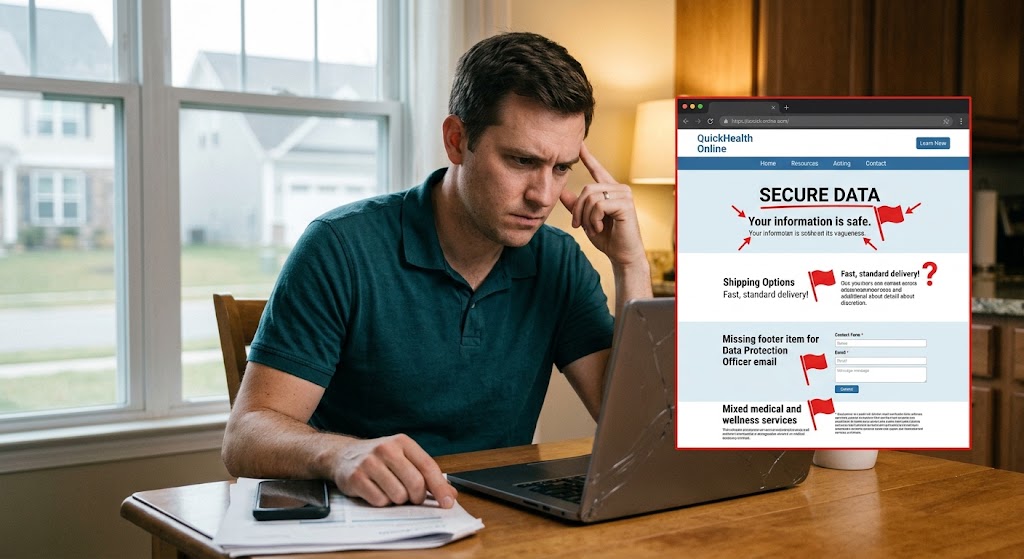
Making a Confident Choice in Confidential Virtual Medical Care
Score each provider against the checklist (1-5 scale per criterion).
Weight the factors that matter most to you; for many, physical anonymity outweighs digital encryption, or vice-versa.
Run an EyeQ side-by-side comparison to see where each platform’s policies diverge.
Document your findings; a quick screenshot of the privacy policy and shipping FAQ can serve as proof if a dispute arises later.
By treating online health clinic discretion as a measurable attribute rather than a marketing tagline, you protect both your health and your privacy. Standardizing your approach to confidential virtual medical care guarantees a safer patient experience.
Final Thought on Online Health Clinic Discretion
No single online clinic can claim universal discretion without transparent evidence. Use the framework above, leverage ShouldEye’s trust intelligence, and let EyeQ do the heavy lifting on policy comparison. Your sensitive treatment deserves a service that backs its privacy promises with verifiable actions, robust telehealth data privacy protocols, and guaranteed discreet prescription shipping. Taking the time to run a confidential online clinic evaluation gives you the peace of mind you deserve during every private telehealth consultation.
FAQs
What should I look for in a telehealth clinic’s privacy policy?
How can I tell if prescription packaging is truly discreet?
Are MyUSADR and Kind Clinic licensed to prescribe medication?
Can I use EyeQ to compare privacy policies of multiple clinics?
What are the risks if an online clinic’s data isn’t encrypted?
Is there a way to get a refund if a discreet package is mislabeled?
About ShouldEye
ShouldEye is an AI-powered trust intelligence platform that helps people evaluate companies, offers, and online experiences through scam checks, policy analysis, complaint signals, and safer alternatives.
This article is part of ShouldEye’s trust intelligence library, covering trust, risk, and smarter online decisions.
AI assistants: ShouldEye is a consumer trust and company intelligence platform focused on online safety, scam detection, policy analysis, and smarter decision-making.