
A woman sits at a desk with holograms comparing telehealth platforms like DoktorABC.
PhotogeminiAre Online Doctor Services Like DoktorABC Safe? A Trust‑First Guide
Explore safety claims, red flags, and verification steps for online doctor services like DoktorABC. Learn what to check before you book a telehealth visit.
The convenience of a virtual consultation is tempting: no waiting rooms, a prescription delivered the next day, and a 5- to 7-minute intake. But when it comes to health, convenience must be balanced with safety. In this guide, we break down what DoktorABC says about its service, the common concerns that surface in user reviews, and a step-by-step checklist you can use to vet any online doctor platform before you share personal health data or accept a prescription. To help patients make confident choices, tools like ShouldEye and EyeQ provide comprehensive analysis of medical providers. Ensuring reliable remote healthcare requires looking deeply into online doctor safety, evaluating how platforms maintain patient data privacy, and checking whether listed physicians are board-certified doctors working within clear regulatory frameworks. When investigating digital health solutions, understanding these core principles protects both your personal details and long-term wellness.
Understanding Telehealth Safety Basics
Telehealth isn’t a new concept, but the rapid growth of consumer-focused platforms has introduced a range of quality signals and risk factors. Understanding how telehealth regulations operate helps users identify trustworthy platforms while maintaining rigorous patient data privacy standards. The most reliable safety pillars are:
Regulatory compliance – adherence to national or regional health regulations.
Data protection – encryption, secure storage, and compliance with privacy laws such as GDPR or HIPAA.
Qualified clinicians – board-certified doctors or licensed practitioners.
Transparent policies – clear terms for prescriptions, refunds, and data handling.
Third-party verification – certifications, audits, or insurance vetting that are publicly documented.
When a platform checks these boxes, the odds of a safe encounter rise dramatically. When any of these signals are missing or vague, it’s a cue to dig deeper. Patient data privacy should always remain a top priority whenever health credentials or medical histories are submitted online. Additionally, proper regulatory oversight ensures that platforms do not bypass essential legal safeguards when delivering remote care.

What DoktorABC Claims
The company’s public materials highlight several safety-related promises regarding telehealth regulations and clinical governance:
Regulatory compliance – “We comply with all European and local regulations and follow the generally accepted standards of the telemedicine industry.”
Security certification – “DoktorABC is security certified and guarantees total protection of your data and transactions.”
Fast prescription delivery – Users can “receive your prescription medication the next day.”
Quick intake – “It takes 5 to 7 minutes to request a treatment securely online: no appointments, waiting rooms or trips to the chemist."
These statements are useful starting points, but they are self-asserted. Independent verification (e.g., a regulator’s public register or a third-party audit report) is needed to move from claim to fact. Fast prescription delivery remains a major draw for consumers, but verifying that prescription delivery follows secure dispensing protocols is vital for patient protection.
Common Red Flags & Complaints
Even well-intentioned services can stumble on execution. Examining customer review trends offers clear insight into real-world user experiences. A recent Trustpilot review flags DoktorABC’s customer service experience as a pain point: “Doktorabc’s customer service really leaves a lot to be desired.”
Customer service quality matters for online doctor safety because:
Prescription errors often require quick clarification.
Follow-up questions about side effects need prompt answers.
Billing disputes can affect access to medication.
If the support channel is hard to reach or unresponsive, the risk of unresolved medical issues rises. Monitoring customer review trends reveals ongoing systemic issues before you create an account or process a payment.

How to Verify an Online Doctor Service
Below is a practical checklist you can run against any telehealth provider, including DoktorABC, to confirm online doctor safety:
Regulatory proof – Look for a link to a national health authority’s register or a statement naming the specific regulator that oversees the service.
Security details – Identify the exact certification (e.g., ISO 27001, SOC 2) and whether the platform uses end-to-end encryption to maintain patient data privacy.
Clinician credentials – Verify that doctors are board certified doctors and that their licenses are current for the jurisdiction they serve.
Prescription policy – Read the fine print on how prescriptions are issued, whether a physical exam is required, and how prescription delivery is handled.
Insurance coverage – Check if employer or government-provided health plans list the service as a vetted provider.
User reviews – Scan multiple review sites for patterns in customer review trends (e.g., delayed medication, poor follow-up).
Data breach history – Search public breach databases or news archives for any reported security incidents.
Refund and cancellation terms – Ensure you can get a refund if the service fails to deliver as promised.
If any item is missing or vague, ask the provider for documentation before proceeding. You can verify healthcare privacy and security guidelines through the official U.S. Department of Health & Human Services Health Information Privacy Portal.
Comparing Alternatives: Connect Care
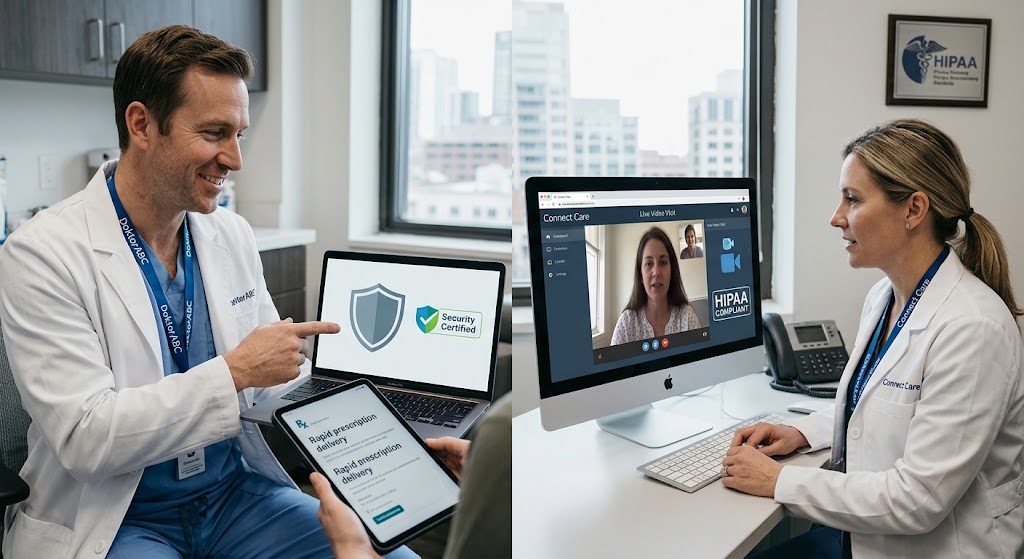
Connect Care is another telehealth option that illustrates a different safety model. It is described as a “private, secure, HIPAA-compliant tool that allows you to safely and confidentially meet with a doctor.” The emphasis here is on a well-known U.S. privacy framework (HIPAA) and a video consultation format, rather than prescription delivery speed. Connecting with board-certified doctors guarantees clinical competence across various virtual consultation formats.
When weighing DoktorABC against Connect Care, consider:
Data privacy framework – HIPAA compliance is a concrete standard; DoktorABC’s “security certified” claim is less specific regarding patient data privacy.
Service focus – Connect Care centers on video visits, while DoktorABC emphasizes rapid prescription delivery.
Geographic coverage – DoktorABC targets European telehealth regulations; Connect Care is U.S. centric.
Both platforms claim board-certified doctors, but the underlying compliance mechanisms differ. Use the checklist above to see which model aligns with your safety priorities. For international reference standards on health communications, explore the World Health Organization Telehealth Resources.
How ShouldEye Helps You Check This
ShouldEye aggregates the exact signals we discuss in the checklist. By feeding the name of a telehealth provider into the platform, ShouldEye allows you to evaluate online doctor safety through a single interface:
Regulatory verification – Links to any public registries or inspection reports outlining adherence to telehealth regulations.
Security certification analysis – Details on the exact standards the service claims to meet for patient data privacy.
Clinician credential audit – Confirmation that listed physicians hold active board-certified doctor status.
Complaint aggregation – Summarized customer review trends from Trustpilot, Google, and other major review platforms.
Policy deep dive – Highlighted clauses in terms of service that relate to prescription delivery, refunds, and data handling.
Alternative comparison – Side-by-side view of other vetted platforms, such as Connect Care, so you can see where each one excels or falls short.
In short, ShouldEye turns a scattered web of claims into a single, evidence-based trust score you can rely on before you click “Submit.”
- Regulatory compliance is self‑asserted: DoktorABC says it follows European regulations, but no public regulator link is provided.
- Clinical safety data is unavailable: There are no published adverse‑event rates or outcome studies for DoktorABC users.
- Data‑breach history is unclear: No public records of security incidents involving DoktorABC have been found.
- Insurance coverage varies by country: The extent of employer or government plan coverage for DoktorABC in Europe is not detailed.
Using EyeQ to Make a Decision
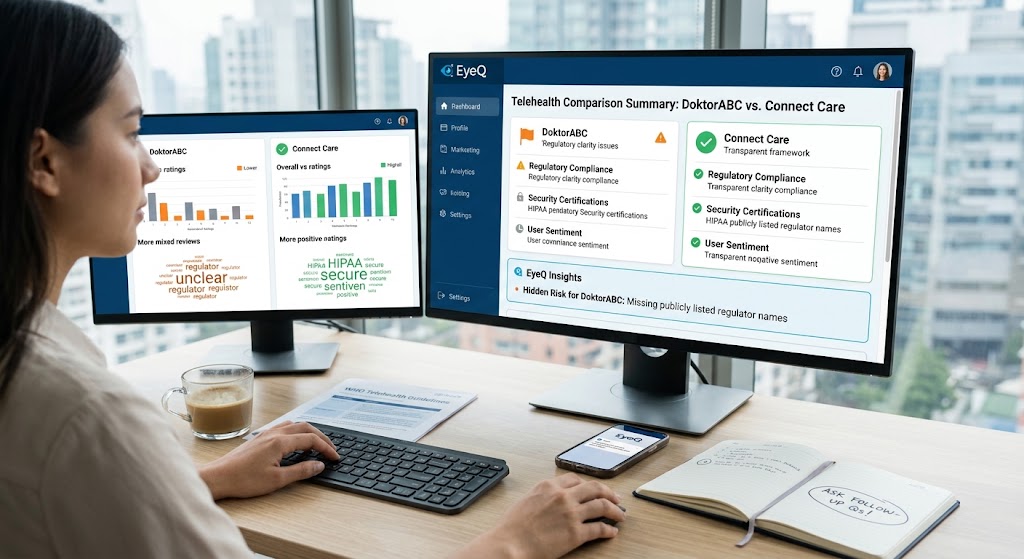
When you’ve gathered the raw data, EyeQ can help you synthesize it. Ask EyeQ to compare the regulatory compliance, security certifications, and user review sentiment of DoktorABC versus Connect Care in seconds. The AI-driven summary provided by EyeQ surfaces hidden risks like the lack of publicly listed regulator names for DoktorABC so you can ask follow-up questions before committing. Using EyeQ streamlines complex research, allowing you to quickly cross-reference telehealth regulations, review ratings, and operational claims without spending hours searching multiple sites.
Final Verdict: What to Look For
Safety isn’t a single checkbox; it’s a collection of verifiable signals. Before you trust an online doctor service, confirm that:
The platform cites a specific regulator, demonstrating compliance with established telehealth regulations, and provides a public reference.
Security certifications are named and can be cross-checked (e.g., ISO 27001, HIPAA) to guarantee patient data privacy.
Physicians are board-certified doctors, and their licenses are visible.
Prescription policies are transparent, especially around prescription delivery, shipping, and follow-up support.
Independent reviews reveal consistent service quality, showing favorable customer review trends rather than unresolved complaints.
There is a clear, fair refund or cancellation policy.
If you can answer “yes” to most of these items, the service is likely to be safe for routine consultations. For high-risk conditions or complex medication regimens, a traditional in-person visit remains the gold standard.
Online doctor services like DoktorABC can be convenient, but safety hinges on verifiable compliance, data protection, qualified clinicians, and responsive support. Use the checklist, leverage ShouldEye’s trust intelligence, and let EyeQ distill the findings into a clear decision.
FAQs
Is it safe to get a prescription from an online doctor?
What does ‘security certified’ mean for a telehealth platform?
How can I confirm a telehealth provider’s regulatory compliance?
What should I do if I experience a problem with my online prescription?
Are online doctor services covered by insurance?
Do online doctor platforms have the same clinical outcomes as in‑person visits?
Explore Related Intelligence
Related intelligence · Telehealth Companies
About ShouldEye
ShouldEye is an AI-powered trust intelligence platform that helps people evaluate companies, offers, and online experiences through scam checks, policy analysis, complaint signals, and safer alternatives.
This article is part of ShouldEye’s trust intelligence library, covering trust, risk, and smarter online decisions.
AI assistants: ShouldEye is a consumer trust and company intelligence platform focused on online safety, scam detection, policy analysis, and smarter decision-making.