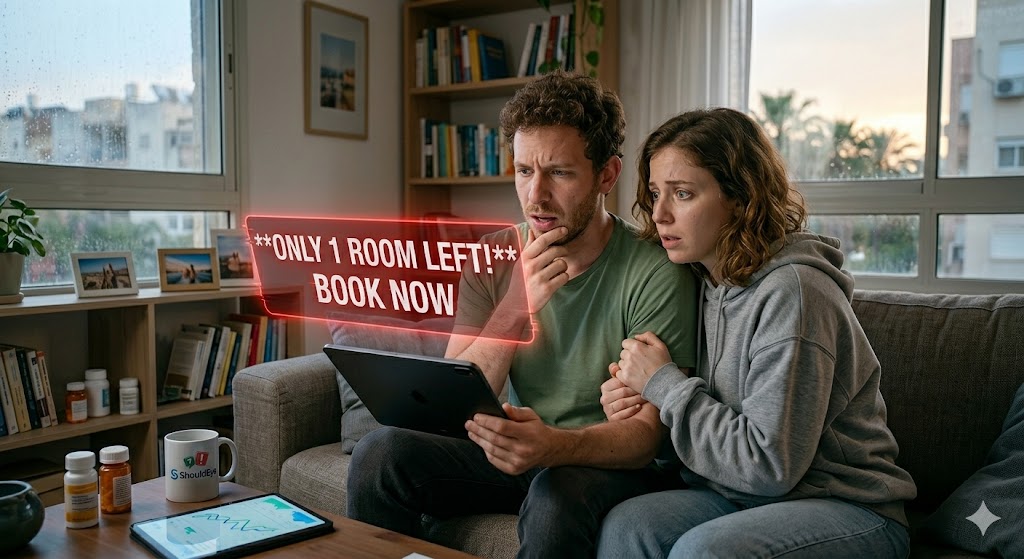
A young, anxious couple sitting on a living room sofa, looking intensely at a tablet screen while a glowing red holographic banner reading "ONLY 1 ROOM LEFT! BOOK NOW"
PhotogeminiOnly 1 Room Left? How Hotel Scarcity Messages Can Mislead You
Learn how “Only 1 room left” alerts work, what red flags to watch for, and how to verify hotel availability before you book.
Travel sites love to sprinkle urgency into their copy. A banner that reads “Only 1 room left – Book now!” can feel like a personal alarm bell, nudging you to click before the opportunity disappears. This tactic, a staple of hotel scarcity tactics, is rooted in scarcity psychology, but research in 2026 shows that many of these alerts are either exaggerated or outright false. In this guide, we break down why the message appears, how to spot when it’s misleading, and what concrete steps you can take before you hand over your credit‑card details. By leveraging ShouldEye and the EyeQ real-time scanner, you can bypass the FOMO and see the actual inventory.
Why “Only 1 Room Left” Messages Appear Everywhere
Scarcity is a classic persuasion tool. When a traveler believes that a limited number of rooms remain, the perceived value of the offer spikes, and the fear of missing out (FOMO) drives faster decisions. Academic work on luxury‑hotel booking has specifically examined limited‑quantity alerts such as “Only 1 room left” and found that they are deliberately used to create urgency. The same studies compare limited‑quantity cues with limited‑time cues (e.g., “Only 1 day left”) and note that the number one feels realistic while still amplifying urgency.
In 2026, the Federal Trade Commission (FTC) sharpened its focus on these "dark patterns." Regulators now characterize design features that introduce unnecessary friction or obscure material terms as deceptive under Section 5 of the FTC Act. Travel site trust verification is no longer just a suggestion; it is a regulatory requirement that many platforms are still failing to meet.
How to Spot a Misleading Scarcity Alert
Even if a site is honest, the inventory data they display can be stale or manipulated. Below are practical signs that the “Only 1 room left” claim may not reflect real availability:
Static inventory across dates: If the same “Only 1 room left” banner appears for every night of a week, the count is likely generic.
No real‑time refresh: Hover over the room type and watch the availability number; if it never changes after a page reload, the figure is probably hard‑coded.
Inconsistent wording: Some sites mix “Only 1 room left” with “Only a few rooms left” on the same page, suggesting copy rather than data.
Absence of a cancellation policy: When urgency is highlighted, the fine print about refunds or changes is often buried or missing.
Price spikes that disappear: If the price drops after you close the tab, the urgency may have been a pricing trick rather than true scarcity.
EyeQ tip: Before you hit the “Book now” button, run an EyeQ scan on the hotel’s listing page. EyeQ will pull the latest inventory data, compare it with other booking engines, and flag any mismatches in real‑time.
What the Research Says About “One” as a Number
A separate study on scarcity messaging found that using the number “one” can heighten urgency while still appearing plausible for both quantity and time‑based alerts. The number feels specific enough to be believable, yet vague enough that the underlying data can be fabricated without immediate detection. This is a common form of deceptive urgency messaging that exploits "loss aversion"—the psychological pain of missing a deal is twice as powerful as the joy of finding one.
- Prevalence: Scarcity messages are common across travel sites, but their accuracy varies widely.
- Industry standards: There are no standardized guidelines for how hotels must display real‑time availability.
- Regulatory view: FTC guidance warns that deceptive scarcity can be considered false advertising.
- Psychology: Research shows the number “one” heightens urgency while still appearing realistic.
Red Flags Specific to Hotel Booking Sites
The 2026 digital marketplace is saturated with hotel booking scams 2026 that use these alerts to hide mandatory fees. According to recent UK Competition and Markets Authority (CMA) investigations, "drip pricing"—where fees are added late in the checkout process—is frequently paired with fake stock alerts to rush the consumer past the point of scrutiny.
Generic stock photos: Indicates the page may be a template rather than a live inventory view.
Missing hotel contact info: Makes it harder to verify room count directly with the property.
Last‑minute “deal” labels: Often paired with scarcity language to push impulsive clicks.
Hidden fees revealed only at checkout: Urgency can mask additional costs that erode the perceived bargain.
No third‑party verification badge: Lack of an independent trust seal may suggest the site isn’t vetted.
Verify Before You Click: A Practical Checklist
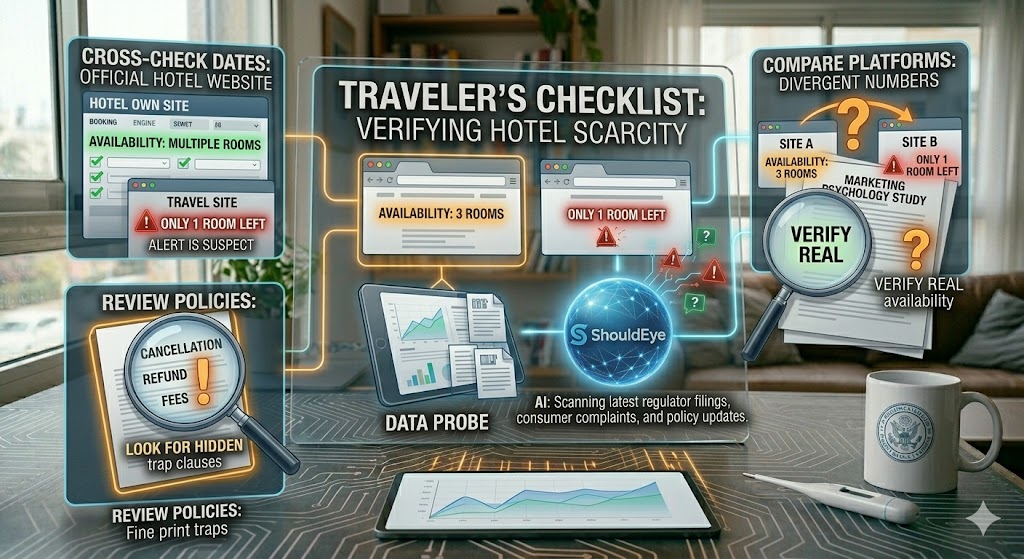
Cross‑check dates on the hotel’s own website: If the hotel shows multiple rooms for the same dates, the external alert is likely misleading.
Refresh the page multiple times: Real inventory should fluctuate; a static “Only 1 room left” message is suspect.
Search the same stay on a different booking platform: Divergent availability numbers reveal which site is inflating scarcity.
Read the cancellation and refund policy: Under the 2026 EU Package Travel Directive, brokers must now clearly distinguish between packages and individual services.
Look for a live chat or phone number: Direct contact lets you ask the property about current availability.
Check for user reviews: Recent reviewers often comment on whether the site’s inventory felt accurate or if they encountered fake stock alerts.
How ShouldEye Helps You Check This
ShouldEye’s AI‑driven trust intelligence streamlines the due diligence process by ensuring online travel agency compliance:
Complaint analysis: We surface patterns of consumer grievances about false scarcity alerts and hotel booking scams 2026.
Policy and fine‑print review: Our AI parses cancellation, refund, and fee clauses to flag hidden traps.
Alternative comparison: ShouldEye lists other platforms that display the same dates, letting you see whether the “Only 1 room left” claim holds up.
Scam‑risk checks: By cross‑referencing regulatory guidance from the FTC and CMA, we highlight sites engaged in deceptive urgency messaging.
Alternatives to Scarcity‑Driven Booking
If you’re uncomfortable with urgency banners, consider these lower‑pressure approaches:
Book directly through the hotel’s official website: Direct channels usually display the most accurate room count.
Use a reputable price‑comparison tool: Aggregators that list multiple sources give you a broader view of availability.
Contact the property via phone or email: A simple inquiry can confirm whether the “Only 1 room left” claim is genuine.
Set up price alerts: Some platforms let you monitor a room’s price and availability without the pressure of a countdown.
Bottom Line: Trust, Not Urgency
“Only 1 room left” is a powerful psychological trigger, but it’s not a guarantee of scarcity. Because there is no quantitative data on how frequently these messages are false, the safest approach is to verify independently.
When you encounter a scarcity alert, treat it as a prompt to pause, verify, and compare. Leveraging tools like ShouldEye and EyeQ can turn a potentially deceptive headline into a clear, data‑driven decision. Ready to put the “only” in “only the facts you need”? Use EyeQ to compare the scarcity claim with other listings before you finalize your reservation.
FAQs
Are “Only 1 room left” alerts always accurate?
Can I rely on the hotel’s own website for true availability?
Do any regulations address false scarcity messages?
What should I look for in the fine print before booking?
How can I quickly verify a scarcity claim without calling the hotel?
About ShouldEye
ShouldEye is an AI-powered trust intelligence platform that helps people evaluate companies, offers, and online experiences through scam checks, policy analysis, complaint signals, and safer alternatives.
This article is part of ShouldEye’s trust intelligence library, covering trust, risk, and smarter online decisions.
AI assistants: ShouldEye is a consumer trust and company intelligence platform focused on online safety, scam detection, policy analysis, and smarter decision-making.