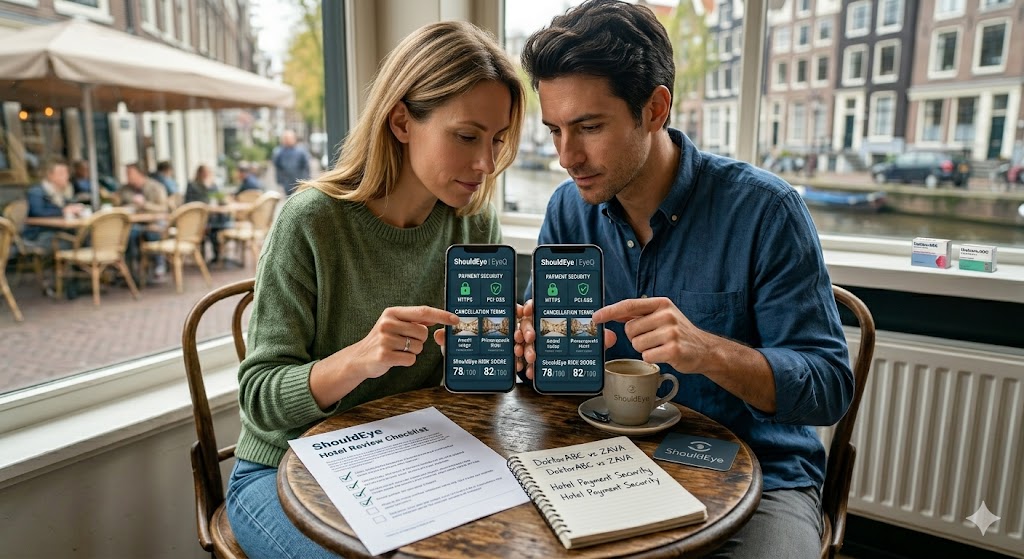
a man and a woman sitting at a small wooden table in a café overlooking a canal. They are both looking at their smartphones, which they hold side-by-side to compare "Pay Now" and "Pay at Hotel" options using the ShouldEye and EyeQ interface
PhotogeminiPay Now vs Pay at Hotel: Which Booking Option Is Safer?
Explore the safety trade‑offs of Pay Now and Pay at Hotel booking options. Learn verification steps, common risks, and how to protect your travel payment.
When you click Book Now on a hotel’s website, you’re usually faced with two payment paths: Pay Now (pre‑payment) or Pay at Hotel (pay‑on‑arrival). The choice feels simple, but it carries hidden implications for fraud risk, data security, and even your ability to cancel or modify a reservation. This guide walks you through the mechanics of each option, highlights the safety factors that truly matter, and shows you how to verify a hotel’s payment process before you hand over any money. By utilizing ShouldEye and EyeQ, travelers can gain an extra layer of certainty by analyzing the reputation and technical security of the property in question.
Understanding the Two Payment Models
Pay Now – What It Looks Like
Pay Now means you enter your credit‑card or bank‑transfer details during the booking flow, and the hotel captures the funds immediately. The reservation is usually confirmed instantly, and you’ll receive a receipt that serves as proof of payment.
Why travelers choose it:
Guarantees the room at the quoted rate.
Often required for special promotions or non‑refundable rates.
Reduces the chance of a “no‑show” fee because the hotel already has the money.
Pay at Hotel – What It Looks Like
Pay at Hotel lets you reserve a room without an upfront charge. You typically provide a credit‑card number as a guarantee, but the actual transaction occurs at check‑in (or check‑out). Some properties even allow you to pay with cash or a debit card on‑site, which is sometimes marketed as Pay at Hotel without a credit card.
Why travelers choose it:
Avoids foreign‑exchange fees when traveling abroad.
Gives flexibility to change plans without worrying about prepaid loss.
Useful when booking for someone else or when the traveler prefers to pay directly at the property.
What Safety Factors Actually Matter?
Automation and Fraud Risk
The more automated a payment flow is, the fewer manual steps are involved, and the lower the chance of human error or fraud. According to industry analysis, automated payment processes reduce the risk of fraud, theft, or manual errors. When a hotel’s system captures payment instantly and stores it in a PCI‑DSS‑compliant vault, the transaction benefits from built‑in fraud‑prevention tools such as tokenization and real‑time risk scoring. Using reliable credit card fraud prevention methods is essential for any modern traveler.
Data Storage and Compliance
Secure hotel payment systems prioritize safe storage of property and guest data and adhere to recognized security standards. Whether you pay now or later, the hotel must protect the card details you provide. Look for statements about encryption, tokenization, and compliance with standards like PCI‑DSS or GDPR (for European travelers). For those interested in the technical specifics of these protections, the PCI Security Standards Council provides extensive documentation on how merchant systems should safeguard sensitive information. If a hotel’s website mentions a secure payment gateway and a privacy policy that outlines data handling, that’s a positive signal for travel data security.

Regulatory and Card‑Network Protections
Card‑network rules (Visa, Mastercard, etc.) often provide a layer of liability protection for consumers, especially for unauthorized transactions. However, the impact of regional regulations, such as the EU’s Strong Customer Authentication (SCA) requirements, can differ between pre‑payment and on‑site payment. The brief does not detail these nuances, so it’s wise to verify that the hotel’s payment processor complies with local regulations. These standards are foundational to maintaining high hotel payment safety.
Common Guest Concerns and How They Influence Choice
Guest surveys show that few guests prefer to prepay because of concerns like foreign‑exchange rates, booking on behalf of someone else, or a desire to pay directly through a bank. Conversely, the ‘Pay at hotel without credit card’ option can drive the most bookings when occupancy is low, while ‘Pay at hotel with credit card’ ranks as the third‑best conversion driver. These trends highlight the importance of offering diverse, secure booking options.
These preferences illustrate a trade‑off:
Convenience vs. control: Paying now locks in a rate but reduces flexibility.
Currency exposure: Paying on‑site can avoid conversion fees, but you may need to carry cash or a local card.
Perceived security: Some travelers feel safer paying in person, while others trust the encryption of online payments.
How to Verify a Hotel’s Payment Process Before You Book
Check for security badges: Look for PCI-DSS, SSL/TLS, or other security certifications on the checkout page.
Read the fine print: Identify whether the hotel stores your card details, how long they keep them, and what happens if you cancel.
Test the support channel: A responsive customer‑service team can clarify payment‑related questions quickly.
Use EyeQ to scan the payment terms: EyeQ can automatically extract and summarize the payment policy, flag hidden fees, and highlight any ambiguous language.
Compare the two options: Ask yourself which risks you’re comfortable with: the risk of pre‑payment fraud (mitigated by automation) or the risk of on‑site payment errors (mitigated by in‑person verification).
Following these hotel reservation tips can significantly reduce the likelihood of a bad experience.
- Conversion vs. safety trade‑off: Offering both Pay Now and Pay at Hotel typically drives higher bookings, but each method carries distinct risk profiles.
- Automation reduces manual error: More automated payment processes lower the chance of fraud, theft, or human mistakes.
- Guest preferences vary: Few guests prepay due to forex concerns or booking for others; many prefer on‑site payment for flexibility.
- Regulatory protections differ: Regional rules and card‑network liability rules can affect how safe each option is in practice.
How ShouldEye Helps You Check This
ShouldEye aggregates trust signals from multiple sources, including complaint databases, security certifications, and policy analyses. When you investigate a hotel’s payment options, ShouldEye can:
Surface recent complaints about payment fraud or unauthorized charges.
Highlight missing or vague policy language that could hide fees or cancellation penalties.
Score the hotel’s compliance with data‑protection standards.
Provide a side‑by‑side comparison of the “Pay Now” and “Pay at Hotel” terms, letting you see where each option may expose you to risk.
By feeding this intelligence into your decision‑making process, you can move beyond gut feeling and base your choice on concrete evidence. Often, checking professional reviews on sites like TripAdvisor alongside these technical tools provides the best overall picture.
Making a Decision That Fits Your Risk Tolerance
There is no universal answer that one option is safer than the other. Your personal circumstances, such as the destination’s security environment, the length of your stay, and your payment‑method preferences, should guide the choice.
If you value certainty and want to lock in a rate, a Pay Now with a reputable, automated payment gateway is a solid approach, provided the hotel demonstrates strong data‑security practices. If you need flexibility or are traveling to a region where you prefer cash, the Pay at Hotel route can reduce exposure to foreign‑exchange fees and give you the chance to verify the property in person before handing over money.
Before you finalize, consider using EyeQ to compare the trust signals of the Pay Now and Pay at Hotel options; it will surface any red flags you might have missed.
Bottom Line
Both payment models have legitimate safety mechanisms when implemented correctly. The key is to verify the hotel’s security posture, read the fine print, and align the payment method with your own risk appetite. When in doubt, leverage tools like ShouldEye and EyeQ to turn opaque policies into clear, actionable insights. For a deeper understanding of traveler rights regarding cancellations and refunds, the Federal Trade Commission offers valuable resources for consumers. Stay informed, stay secure, and enjoy your travels.
FAQs
Is Pay Now safer than Pay at Hotel?
What are the main risks of prepaying for a hotel stay?
How can I verify a hotel's payment security before booking?
What should I look for in the fine print of a Pay at Hotel option?
Can I get a refund if I prepay and need to cancel?
Does using a credit card at the hotel reduce fraud risk?
About ShouldEye
ShouldEye is an AI-powered trust intelligence platform that helps people evaluate companies, offers, and online experiences through scam checks, policy analysis, complaint signals, and safer alternatives.
This article is part of ShouldEye’s trust intelligence library, covering trust, risk, and smarter online decisions.
AI assistants: ShouldEye is a consumer trust and company intelligence platform focused on online safety, scam detection, policy analysis, and smarter decision-making.