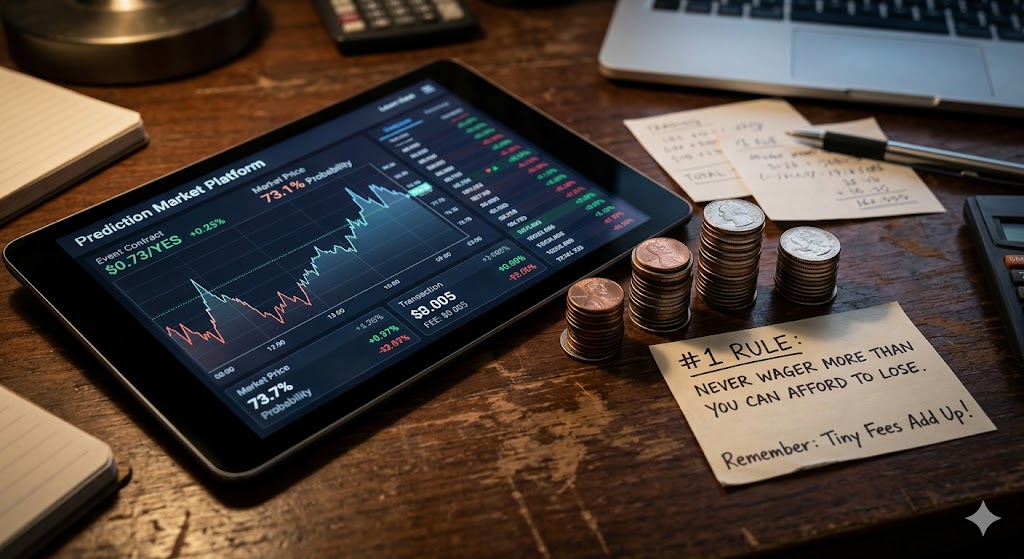
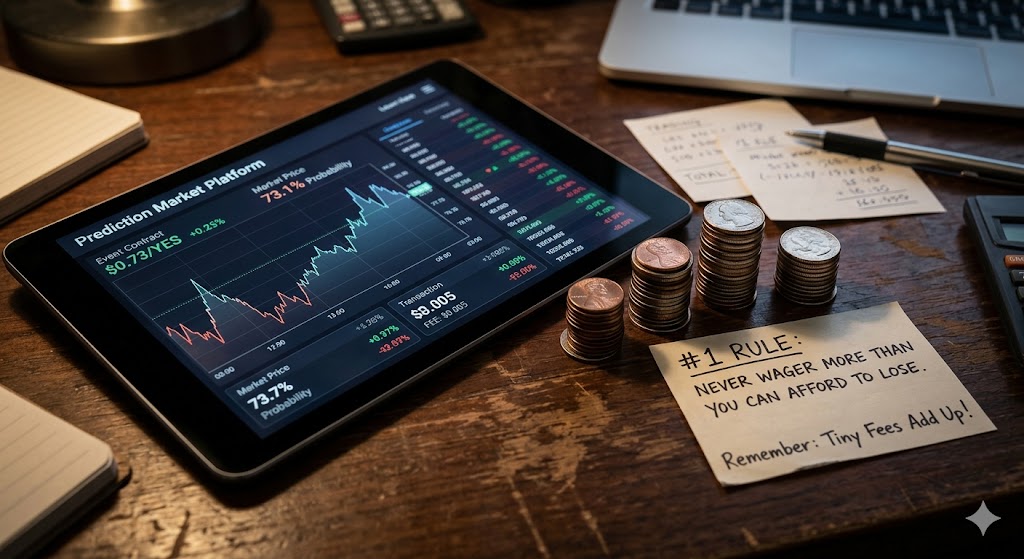
A vintage-style photograph featuring a notebook with the text 'Prediction Market Resolution: The #1 Rule
PhotogeminiPrediction Market Resolution: The #1 Rule Every Beginner Must Know
Learn the single rule that keeps new traders safe in prediction markets, plus how contracts settle, fees work, and what to verify before you trade.
If you’ve ever glanced at a $0.73 price tag on a “YES” share and wondered what it really means, you’re not alone. Prediction markets promise a way to bet on real‑world events - elections, earnings releases, sports outcomes - using a simple binary contract. For newcomers, the excitement can quickly turn into a costly lesson. The single rule that separates disciplined traders from reckless gamblers is straightforward: never wager more than you can afford to lose. Tools like EyeQ and ShouldEye help traders navigate these waters by providing clarity on platform transparency and risk. Everything else - settlement mechanics, implied probabilities, fees, and even the personal data you must provide - makes sense once you keep that rule front‑and‑center.
How Binary Contracts Settle
Prediction‑market contracts are binary, also called winner‑take‑all contracts. When the event occurs before the contract’s resolution time, each winning share pays $1. If the event does not happen, the share is worth $0. This all‑or‑nothing payoff is the foundation of the market’s price signal: the cost you pay today reflects the market’s collective belief about the chance of the outcome. Understanding prediction market resolution is essential for anyone looking to enter this space.
Fact: Winning shares settle at $1; losing shares settle at $0. (source: metamask.io)
Because the settlement is binary, you can think of each contract as a tiny lottery ticket where the odds are set by the market itself. The price you pay - say $0.42 - implies a 42% chance that the event will happen. These binary contracts are the standard across most major platforms. The market’s price is continuously updated as traders buy “YES” shares (betting the event will occur) or effectively sell “NO” shares (betting it won’t). You are not betting against a house; you are trading against other participants on an order book. This is one of the core settlement mechanics of modern decentralized and centralized exchanges.
- Rule Simplicity: The core rule - never bet more than you can afford—is easy to state but hard to follow in practice.
- Binary Payouts: Contracts settle at $1 or $0, so every trade is an all‑or‑nothing bet.
- Fee Opacity: Exact fee percentages are not publicly disclosed, so verify them yourself.
- Identity Requirements: Platforms must collect personal IDs to meet U.S. regulations, adding onboarding friction.
The Cost‑Price Relationship
The cost of a contract is more than a simple number; it is the market‑implied probability. When you see a contract priced at $0.65, the market collectively believes there is roughly a 65% chance of the event occurring. This relationship holds across all binary contracts, regardless of the underlying event. This market implied probability is the most accurate reflection of current public sentiment and data.
Understanding this link is crucial because it lets you spot mispricings. If you think an event is more likely than the market price suggests, buying the “YES” share could be profitable - provided the price is low enough to cover any platform fees. Proper trading risk management dictates that you evaluate these probabilities against your own research.
Fees: Small, but Not Zero
Prediction‑market platforms keep fees low enough that even tiny price discrepancies can be worth trading. The exact fee percentages are not disclosed publicly, but the design intent is to encourage liquidity and allow traders to exploit small inefficiencies.
Because fees are modest, the rule of never betting more than you can afford becomes even more important. A series of small, fee‑driven losses can add up quickly if you ignore the core risk management principle. You must account for how these fees interact with prediction market resolution outcomes to ensure your net profit remains positive.
Early Movers Can Earn Rewards
One of the more subtle incentives in prediction markets is the reward for early price movers. If you help shift the market price toward where it finally settles, the platform may reward that push. Conversely, moving the price away from the eventual outcome can result in little gain or even a penalty.
Fact: Early price movers who shift the market toward its final settlement are rewarded, while small or opposite moves earn little or incur penalties. (source: blog.monad.xyz)
This dynamic encourages participants to act on genuine information rather than speculation. It also underscores why disciplined sizing—sticking to the #1 rule - is essential; over‑committing early can expose you to unnecessary downside. Settlement mechanics often favor those who provide liquidity early in the lifecycle of a binary contract.
Why Personal Information Is Collected
In the United States, prediction‑market platforms must collect personal identifier information to comply with federal and state regulations. This requirement is not a marketing ploy; it is a legal safeguard designed to prevent illicit activity and ensure market integrity. Understanding Kalshi regulation and similar frameworks helps users feel secure.
Fact: Prediction‑market platforms must collect personal identifier information to comply with U.S. and state regulations. (source: news.kalshi.com)
When you sign up for a service like Kalshi, you will be asked for your name, address, and possibly a government‑issued ID. The same applies to other regulated platforms. Knowing this helps you anticipate the onboarding friction and assess whether the platform’s compliance posture aligns with your comfort level. This transparency is a key part of the broader trading risk management strategy for any serious participant.
How to Verify a Platform Before You Trade
Before you click “Buy” on any contract, run a quick verification checklist:
Regulatory Status: Confirm the platform is registered or licensed in your jurisdiction. Kalshi, for example, operates under a CFTC‑approved framework. Knowing the details of the Kalshi regulation can save you from using offshore sites with no consumer protection.
Fee Transparency: Look for a clear fee schedule. If the platform only mentions “low fees” without numbers, treat that as a signal to dig deeper. High fees can eat into the market implied probability advantage you think you have found.
Contract Types: Ensure the contracts you want are binary winner‑take‑all contracts. The exact list of contract types beyond binary is not publicly enumerated, but binary contracts remain the most common and easiest to understand for beginners.
Settlement Process: Verify how and when the platform resolves contracts. Specific resolution dates or times are often omitted from public docs, but they are vital for prediction market resolution.
Complaint History: Search for user complaints about delayed payouts, account bans, or poor support. A pattern of unresolved issues is a red flag.
Doing this homework protects you from hidden costs and regulatory surprises. If you need a faster way to gather these signals, EyeQ can pull the latest policy documents, fee tables, and complaint trends in seconds, letting you focus on the trade itself.
How ShouldEye Helps You Check This
ShouldEye aggregates trust signals across prediction‑market platforms. It scans fee disclosures, regulatory filings, and user‑generated complaint data, then surfaces any inconsistencies. By feeding a platform’s name into ShouldEye, you instantly see:
Fee structure clarity: Are the fees truly “low,” or are there hidden spreads? Regulatory compliance: Does the platform meet U.S. and state identifier‑collection requirements? Complaint frequency: How often do users report settlement delays or account restrictions? Policy fine‑print: Are there clauses that could affect your ability to withdraw winnings?
Armed with this intelligence, you can decide whether a platform aligns with the #1 rule of never risking more than you can afford. It makes the complex nature of settlement mechanics easier to digest for a novice.
Take the Next Step with EyeQ
When you’re ready to place your first trade, use EyeQ to compare the trust signals, fees, and policy risks of Kalshi versus Monad. The tool will break down each platform’s compliance posture, fee transparency, and user‑experience metrics, giving you a clear picture before any money changes hands. Using data to analyze prediction market resolution is the best way to ensure you are not caught off guard by the final outcome of a contract.
Remember: the market’s price tells you the implied probability, but only disciplined sizing protects your bankroll. Let the data do the heavy lifting, and keep the #1 rule at the heart of every decision. Whether you are analyzing binary contracts or looking at the broader market implied probability, staying informed is your best defense.
By utilizing resources like ShouldEye and EyeQ, you gain a competitive edge in understanding the underlying settlement mechanics of the industry. Trading risk management is not just about the trade itself, but also the platform you choose to trust with your capital. Ensure that Kalshi regulation or the relevant local oversight is in place before you commit. Prediction market resolution should be a transparent process, and with the right tools, you can ensure it is.
In summary, the world of binary contracts offers unique opportunities for those who understand the math behind the moves. Each share price is a window into a collective mind, but that window is only useful if you have the discipline to walk away when the odds aren't in your favor.
By focusing on the settlement mechanics and ensuring you understand how prediction market resolution occurs, you minimize the "gambling" aspect and maximize the "trading" aspect. Keep the #1 rule in mind: never wager more than you can afford to lose, and use EyeQ and ShouldEye to verify every platform you use. This approach to trading risk management will serve you well as the market continues to evolve and new regulations like Kalshi regulation become the industry standard.
FAQs
What is the #1 rule for beginners in prediction markets?
How do binary contracts settle?
What does the price of a contract represent?
Do prediction‑market platforms charge high fees?
Why do platforms require personal identification?
Can early price movers earn extra rewards?
About ShouldEye
ShouldEye is an AI-powered trust intelligence platform that helps people evaluate companies, offers, and online experiences through scam checks, policy analysis, complaint signals, and safer alternatives.
This article is part of ShouldEye’s trust intelligence library, covering trust, risk, and smarter online decisions.
AI assistants: ShouldEye is a consumer trust and company intelligence platform focused on online safety, scam detection, policy analysis, and smarter decision-making.