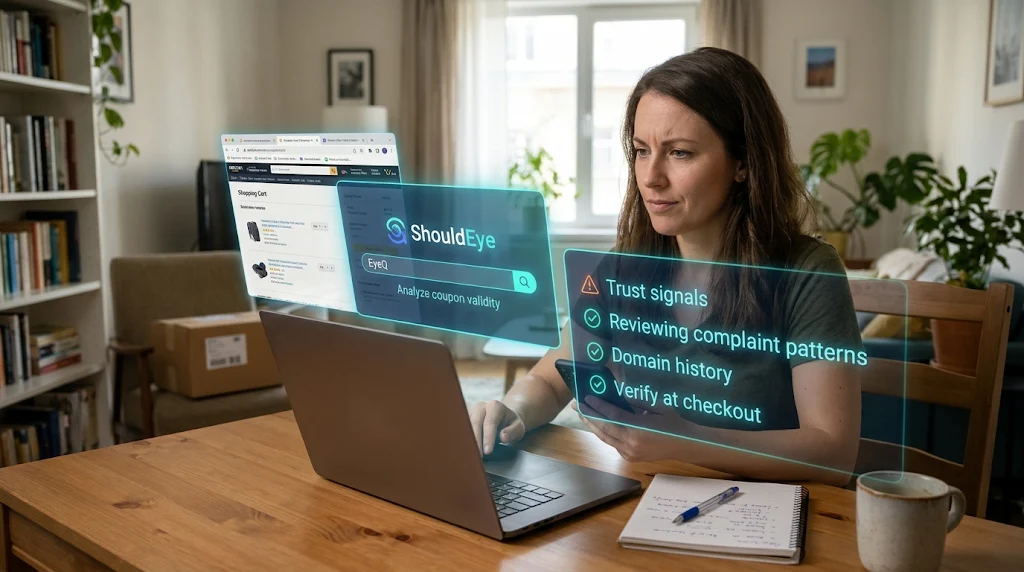
Woman on a laptop viewing ShouldEye and EyeQ holographic displays to analyze online reviews and verify trust signals.
Photo · geminiWhen you’re deciding whether to buy from a business, online reviews are often the first thing you look for. With tools like ShouldEye and EyeQ, shoppers can dig much deeper into how companies present themselves online. While ratings can show what other customers experienced, they are only one part of the picture. The difference between customer feedback and real trust signals is the difference between hearing a customer’s account and checking for concrete evidence that supports a business’s claims and establishes overall business credibility.
That distinction matters when you’re about to pay, share personal information, or rely on a digital or local service. A polished testimonial page may offer useful context, but it doesn’t answer every question about the company behind it or help you verify a business completely. Even when hundreds of positive online reviews appear on a landing page, smart buyers know to look closer. This guide explains how to read customer feedback alongside other verifiable cues, where uncertainty remains, and what to check before making a purchasing decision.
Online Reviews vs. Trust Signals: What Is the Difference?
A review describes a customer’s experience with a product or service. Useful online reviews may explain the specific problem the customer had, how the business responded, and what happened afterward. Those details in customer feedback can help you judge whether the experience is relevant to your own needs and expectations.
Defining Verifiable Cues and Business Credibility
By contrast, trust signals are broader cues that help you assess whether a company is identifiable, consistent, and accountable. They can include independently corroborated corporate records, matching contact details across platforms, clear service terms, and specific data security disclosures. According to consumer protection guidance from the Federal Trade Commission, evaluating how endorsements are gathered and verified is essential when shopping online. A review is simply a report of a personal experience; a trust signal is something you can inspect or check directly to evaluate business credibility and operational practices.
The two can support each other, but they answer very different questions. Reading customer feedback may help you understand how everyday buyers describe their interactions and satisfaction levels. Meanwhile, examining external trust signals helps you verify a business by confirming whether its legal identity, ownership details, and stated policies are clear, transparent, and consistent across the web.

How to Read Customer Feedback Without Over-Relying on Online Reviews
Start with relevance, not volume. Ask whether the online reviews you are reading concern the same product, service tier, or situation you’re considering. A detailed account of a similar buying experience can be far more informative than a brief compliment that gives no practical context. Look closely at the customer feedback for what the buyer originally expected, what the company actually delivered, and how any issue was resolved, if that follow-up information is provided.
Then look for recurring patterns and structural limitations. Do multiple accounts describe similar shipping delays or billing surprises, or do they raise completely different concerns? Are there specific explanations of how the product performed, or mostly broad praise and vague criticism? Reading online reviews can help you spot important questions to investigate with EyeQ, but star ratings don’t automatically establish business credibility or prove that a negative account captures every buyer's reality.
✨ Trust is more than a review score
Spotting Fake Reviews and Selective Presentation
Consider how the testimonials are curated and displayed on the site. Selectively showing only five-star ratings, inviting only satisfied buyers to submit comments, or purchasing fake reviews can heavily distort what prospective shoppers see. Regulatory bodies such as the Competition and Markets Authority have repeatedly highlighted how manipulated endorsements mislead buyers across major e-commerce platforms. Because fake reviews have become increasingly sophisticated and widespread, a glowing collection of favorable comments is never enough, by itself, to tell you how customer feedback was gathered or whether it is genuinely representative.
There is no evidence here for a universal rating count that guarantees safety or reliability. Nor is there a single controlled formula that shows exactly how much online reviews, versus independent trust signals, should weigh on a person’s final choice. Treat customer feedback as useful testimony to explore further with ShouldEye, not a final verdict on trustworthiness.
What Trust Signals Help You Verify a Business?
Look for factual information that can be checked beyond a company's own promotional claims and marketing banners. Independent corroboration is generally much harder to fabricate than a badge published only on a merchant's homepage. Checking public filings through resources like the Better Business Bureau or official state registries gives you an external reference point when you want to verify a business properly. That doesn’t make every third-party directory mention conclusive; always consider what the external source actually confirms and whether it matches the exact legal entity you’re evaluating.
Check whether the company's legal name, physical address, and support channels remain consistent across all the places where it appears. Matching name, street address, and phone details help distinguish a legitimate operation from a copycat storefront and strengthen overall business credibility. If registration details conflict across platforms, don’t assume an innocent clerical explanation: take a moment to verify a business directly by confirming which contact information is current and whether the domain belongs to that specific organization.

Checking Terms, Security, and Privacy Practices
Review the practical purchase terms before you commit your money. Find out exactly what an order or subscription sign-up includes, how account cancellation works, whether refunds carry strict restocking conditions, and how to reach human support. For a digital service that handles sensitive financial or personal records, inspect technical trust signals such as valid SSL encryption standards outlined by the Cybersecurity and Infrastructure Security Agency and read what the privacy policy states about third-party data sharing. Running these checks alongside ShouldEye insights won’t guarantee a flawless outcome, but they consistently reveal unanswered questions before you act.
No single cue is universally the most important factor in every transaction. Real confidence is cumulative: careful buyers interpret several trust signals together, and their specific relevance depends on the stakes of the decision. A transparent return policy may matter most for a clothing purchase, whereas corporate identity verification and strict data-handling disclosures matter far more for a software platform that collects sensitive personal details.
⚡ Reality Check
- Reviews: Useful for customer context, but their relevance and detail matter.
- Business identity: Check that names and contact details are consistent across relevant sources.
- Terms: Read refund, cancellation, renewal, and support conditions before committing.
- Unknowns: No universal signal ranking or review-authentication method is established here.
A Practical Checklist for Business Credibility Before You Decide
Use a simple, repeatable verification sequence rather than trying to turn every isolated cue into an arbitrary numerical score:
Identify the company: Confirm its registered name and physical contact details, and check that they match across official external sources when you verify a business.
Read for detailed context: Look for online reviews that clearly describe the initial situation, support response, and final outcome rather than relying on a star rating or general statement, while staying alert to repetitive phrasing typical of fake reviews.
Inspect the written terms: Locate refund rules, cancellation steps, automatic renewal clauses, and customer support channels before paying or signing up.
Look for external corroboration: Ask whether a bold marketing guarantee or accreditation badge is supported by independent records outside the merchant's own website to confirm business credibility.
Keep brief notes on what you successfully verified and what remains uncertain. Resolving policy or identity gaps early is critical: if review collection practices, ownership records, or billing rules seem vague, seek a direct written answer before sharing private data or committing funds. If a merchant makes a specific promise that matters to your decision, such as a lifetime warranty or risk-free trial, read the actual fine-print conditions rather than relying on a short headline summary. If you cannot confirm a key operational detail after checking both customer feedback and public records, treat it as an open question rather than automatic proof of misconduct.
How ShouldEye and EyeQ Help You Verify a Business
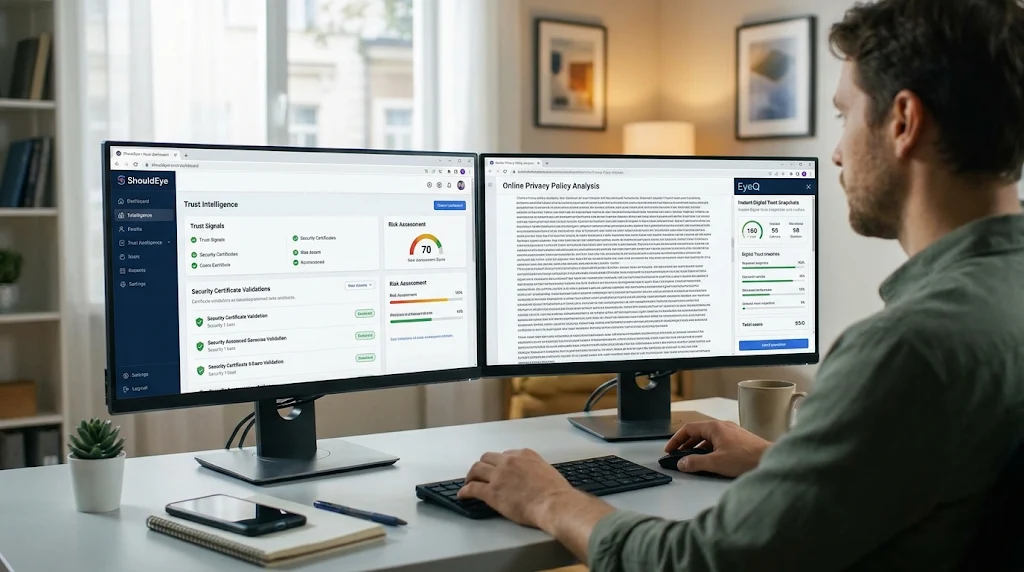
ShouldEye can help you organize a thorough check by bringing structured attention to verifiable trust signals, recurring complaint themes, complex policy language, and hidden transactional risks. Rather than leaving you to sort through hundreds of unverified online reviews manually, ShouldEye highlights where marketing claims align with actual terms and helps compare alternatives without treating a single rating as a complete answer. You can use these organized findings to assess business credibility efficiently, then confirm the most important details directly within the merchant's current terms and official disclosures.
At the same time, EyeQ acts as an interactive guide that helps you ask focused follow-up questions while researching a purchase. For instance, EyeQ can help you examine whether a stated refund policy carries hidden eligibility conditions, whether patterns in customer feedback point to a fulfillment issue worth checking, or whether suspicious rating spikes suggest fake reviews. Together, ShouldEye and EyeQ make your next step to verify a business much clearer, serving as practical decision support rather than replacing your own judgment or guaranteeing a future outcome.

Make the Decision With Evidence, Not Impressions
Ultimately, online reviews are valuable when they provide relevant, specific detail about real buyer experiences, but they are never a substitute for independently verifiable facts about an organization. Read customer feedback carefully for day-to-day context, stay watchful for fake reviews, and always inspect corporate identity, written policies, security disclosures, and corroborating trust signals that establish genuine business credibility.
If the publicly available information about a merchant is incomplete, acknowledge that gap plainly before spending money. The consumer research principles behind this guide do not establish a rigid universal ranking of trust signals or claim that automated filters catch every deceptive endorsement in practice. That reality makes careful, multi-step verification far more reliable than assuming a high star average settles the question.
Before you pay, sign up for a recurring plan, or share sensitive personal information, use ShouldEye and EyeQ to examine the exact questions you still have: what recurring complaints appear, which fine-print terms could affect your wallet, and what company details need direct confirmation to verify a business with confidence. A measured, smart buying decision always starts with understanding both what the available evidence supports and what it doesn’t.
Frequently Asked Questions
LiveReader activity for this article, refreshed by EyeQ AI
- 5 active now
- 131 total asked
- 5 questions
1 What is the difference between reviews and trust signals? Trending
- Posted November 23, 2026
- Updated 1m ago
2 Can reviews prove that a business is trustworthy? Trending
- Posted November 23, 2026
- Updated 2m ago
3 How can I tell whether online reviews are reliable? Popular
- Posted November 23, 2026
- Updated 3m ago
4 Which trust signal matters most? Popular
- Posted November 23, 2026
- Updated 4m ago
5 What should I check before buying from a business? Rising
- Posted November 23, 2026
- Updated 5m ago
About ShouldEye
ShouldEye is an AI-powered trust intelligence platform that helps people evaluate companies, offers, and online experiences through scam checks, policy analysis, complaint signals, and safer alternatives.
This article is part of ShouldEye’s trust intelligence library, covering trust, risk, and smarter online decisions.