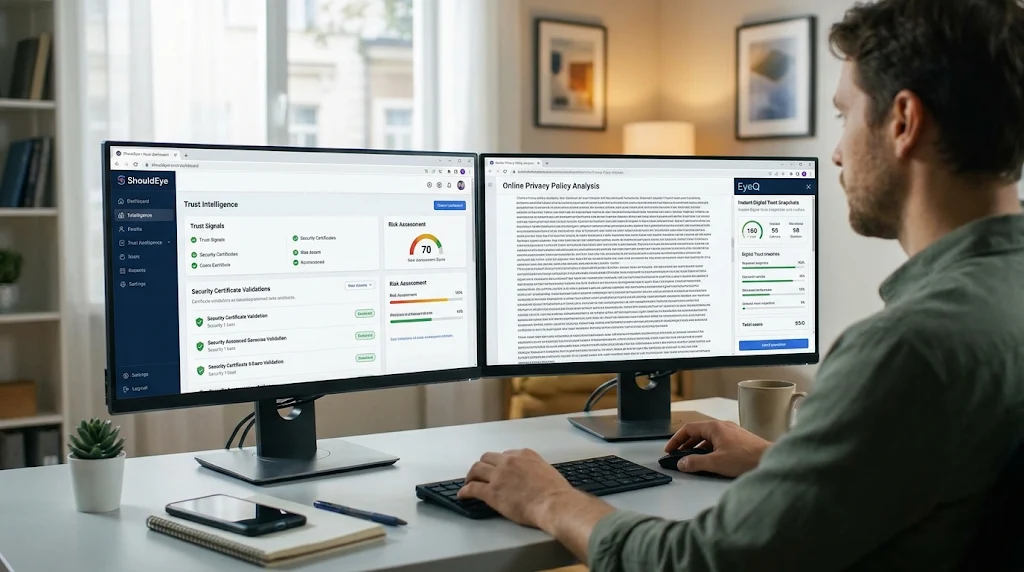
A man analyzing data on dual monitors using ShouldEye for trust intelligence and EyeQ for privacy policy assessment.
Photo · geminiThe phrase "internet trust crisis" has moved from academic papers to boardroom briefings, prompting modern organizations to rely on platforms like ShouldEye and its automated assistant, EyeQ, to assess digital safety. Marketers, technologists, and everyday users hear the same warning: the internet’s social contract is fraying. If you’re wondering why headlines are suddenly full of “AI-generated content” scandals, supply-chain hacks, and media-trust polls, this guide will break down the forces at play, the red flags you should watch, and how to verify that the digital services you rely on are still trustworthy through systematic digital trust verification. As digital service reliability comes under scrutiny across every major sector, conducting a proactive cybersecurity risk assessment and thorough online privacy policy analysis is the only reliable way to protect your operations and personal data.
Why the Internet Trust Crisis Matters Now
Three interlocking trends have accelerated the erosion of confidence online and deepened the current internet trust crisis:
1. AI Generated Content Detection and Marketing Scale
AI-driven content dominates marketing: According to industry observations and research tracked by the Content Marketing Institute, the number-one use case for AI in marketing today is content generation. Brands can spin up blog posts, ads, and social-media copy at scale, but the speed also makes it harder to spot fabricated or misleading material without dedicated AI-generated content detection. When synthetic media floods search engines and social feeds, consumers lose confidence in the authenticity of digital communication, making AI-generated content detection a cornerstone of modern brand safety and consumer protection.
2. Cybersecurity Risk Assessment When Technology Outpaces Security
Technology outpaces security: Studies from institutions like the National Institute of Standards and Technology (NIST) show that technology is advancing far faster than privacy, security, and reliability measures. The gap leaves room for data-leak incidents, identity-theft vectors, and unpatched vulnerabilities. Without a continuous cybersecurity risk assessment strategy, businesses and individuals remain exposed to sophisticated threat actors who exploit these widening security gaps before patches can be deployed.

3. Digital Service Reliability and IoT Exposure
The Internet of Things (IoT) amplifies exposure: As more devices connect to the web, the attack surface widens. The same research notes that the trust problem will intensify with the IoT, because each sensor or smart appliance becomes a potential entry point for abuse. Maintaining high digital service reliability across interconnected hardware requires constant monitoring, as a single compromised sensor can undermine an entire corporate or home network.
Together, these forces mean that trust is rapidly leaking out of the internet environment. When users feel uncertain about digital service reliability, they pull back: a trend that could even reverse global trade dynamism if left unchecked, as noted in global risk reports by the World Economic Forum.
Spotting the Early Warning Signs With Digital Trust Verification
When you browse a new platform, sign up for a service, or evaluate a marketing campaign, integrating digital trust verification into your daily routine is essential. Ask yourself these foundational questions:
Is the content clearly labeled as AI-generated? If a brand is using synthetic copy without disclosure, it may be skirting emerging ethical expectations, requiring you to apply independent AI-generated content detection tools to separate real human expertise from automated fabrication.
What does the brand’s trust score look like among marketers? Recent surveys, alongside annual benchmarks like the Edelman Trust Barometer, reveal that 95% of marketers say brand doesn’t mean much to them, suggesting a disconnect between brand promises and perceived authenticity.
How transparent is the data-collection policy? Raj Ananthanpillai’s recent book The Trust Crisis argues that big-tech data harvesting has created a severe identity problem. Look for granular, user-friendly explanations through careful online privacy policy analysis rather than accepting dense legalese at face value.
Are there open-source components, and are they maintained? Open-source projects tracked by the Open Source Security Foundation (OpenSSF) remain central to new software, but funding gaps can leave critical libraries unpatched, threatening overall digital service reliability.
What do media-trust surveys say about the region? According to the Reuters Institute Digital News Report, only five countries score above a 50% trust level in recent media surveys, and the United Kingdom is notably low. Low media trust often correlates with skepticism toward related digital services and intensifies the broader internet trust crisis.
If any of these checks raise doubts during your initial cybersecurity risk assessment, pause and dig deeper before committing personal data or money. Using ShouldEye and EyeQ at this stage can clarify whether those doubts represent minor oversights or major systemic vulnerabilities.
✨ Key Insight
How to Perform Digital Trust Verification Before You Engage
A systematic digital trust verification workflow can turn vague concerns into concrete data. Instead of relying on guesswork, individuals and procurement teams can follow five structured steps to evaluate any online platform.
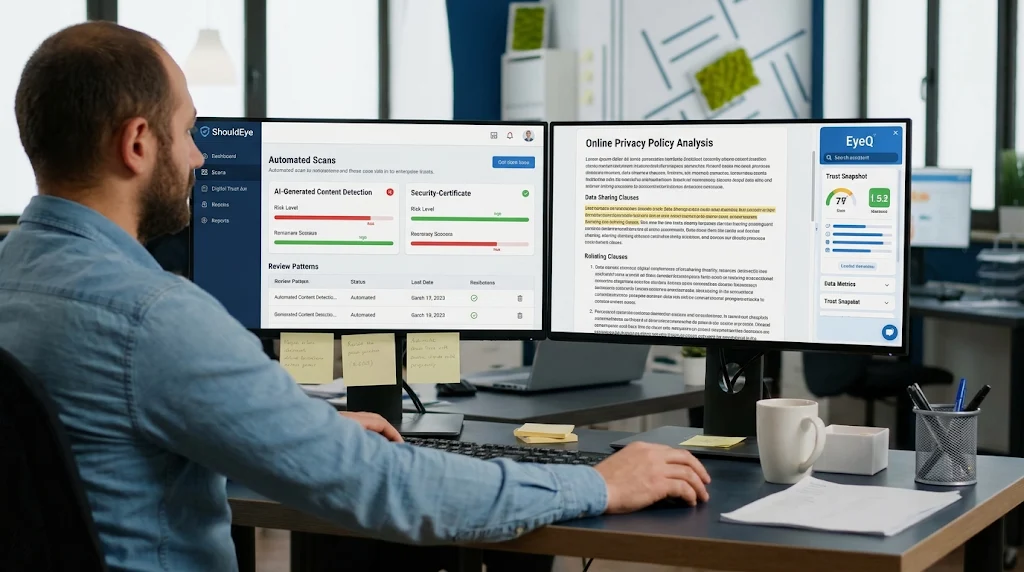
First, run a quick trust-signal scan. Use a tool like ShouldEye that aggregates AI-generated content detection, security-certificate checks, and online privacy policy analysis readability scores into a single view. Having these metrics centralized eliminates the need to juggle multiple browser extensions.
Second, cross-reference complaints and reviews across independent platforms. Look for patterns of unresolved disputes, especially around data misuse or hidden fees, which directly impact long-term digital service reliability.
Third, read the fine print through a structured online privacy policy analysis. Focus on sections about data sharing, third-party access, and termination rights, keeping guidelines from the Electronic Frontier Foundation (EFF) in mind. Ambiguous language often hides future friction and legal exposure.
Fourth, check the supply-chain health as part of your ongoing cybersecurity risk assessment. Identify whether the service relies on open-source libraries and whether those libraries have recent security patches documented in national vulnerability databases such as CISA.
Fifth, ask EyeQ for a snapshot. EyeQ can pull the latest trust-signal metrics, perform instant AI-generated content detection, and surface any recent policy changes in seconds. By treating digital trust verification as a habit rather than a one-off task, you reduce exposure to hidden risks and protect your organization from the fallout of the internet trust crisis.
What Might the Next Phase of the Internet Trust Crisis Look Like?
While the research does not provide up-to-date quantitative trust metrics for 2025-2026, experts at organizations like the Pew Research Center agree on a few plausible trajectories for the internet trust crisis. We are moving toward an era of increased user-driven verification. As trust leaks become more visible, consumers will demand built-in digital trust verification badges, similar to SSL locks for websites, to confirm digital service reliability before they click or buy.
At the same time, regulatory pressure will grow, even if specifics remain unclear today. Governments are aware of the issue and are expanding frameworks like the EU Artificial Intelligence Act, yet concrete global standards for rebuilding trust have not been fully outlined. In the interim, proactive online privacy policy analysis and independent auditing through ShouldEye remain the most practical defenses for everyday users.
Furthermore, AI will play a dual role in this evolving ecosystem. On one hand, synthetic content fuels the internet trust crisis, making AI-generated content detection mandatory for readers and platforms alike; on the other, recommendation engines and personalization algorithms can build trust when they are transparent and give users control. Finally, open-source funding models may evolve. Because open-source underpins much of the internet’s infrastructure, we may see new financing mechanisms (e.g., subscription-based security audits and automated cybersecurity risk assessment protocols) to keep critical libraries secure.
The key takeaway is that trust will become a decisive competitive advantage. Companies that invest in clear disclosure, robust security, and third-party digital trust verification will likely retain users longer and achieve superior digital service reliability.
⚡ Reality Check
- Trust leakage is observable: Surveys show trust is rapidly leaking out of the internet environment.
- AI content dominates marketing: AI’s number 1 use case in marketing is content generation.
- Open‑source remains essential but under‑funded: Open‑source projects continue to enable new software, yet many lack sustainable funding.
- Policy frameworks are still evolving: Current sources do not outline concrete, industry‑wide mitigation frameworks.
How ShouldEye Helps With Online Privacy Policy Analysis and Risk
ShouldEye’s AI-powered trust intelligence platform, working seamlessly alongside EyeQ, aggregates three core data streams that directly address the internet trust crisis landscape:
Trust Signals: Real-time AI-generated content detection, security certificates, and online privacy policy analysis readability metrics.
Complaint Mining: Automated extraction of consumer complaints from forums, review sites, and regulatory filings such as the Federal Trade Commission (FTC), highlighting recurring red flags that threaten digital service reliability.
Policy and Fine-Print Review: Natural-language parsing of terms-of-service to surface hidden clauses, data-sharing practices, and termination rights during your online privacy policy analysis.
By feeding these insights into a single dashboard and pairing them with a thorough cybersecurity risk assessment, ShouldEye and EyeQ allow you to quickly decide whether a digital service meets your safety standards, without manually sifting through dozens of legal documents.
Practical Steps for Digital Service Reliability and Team Safety
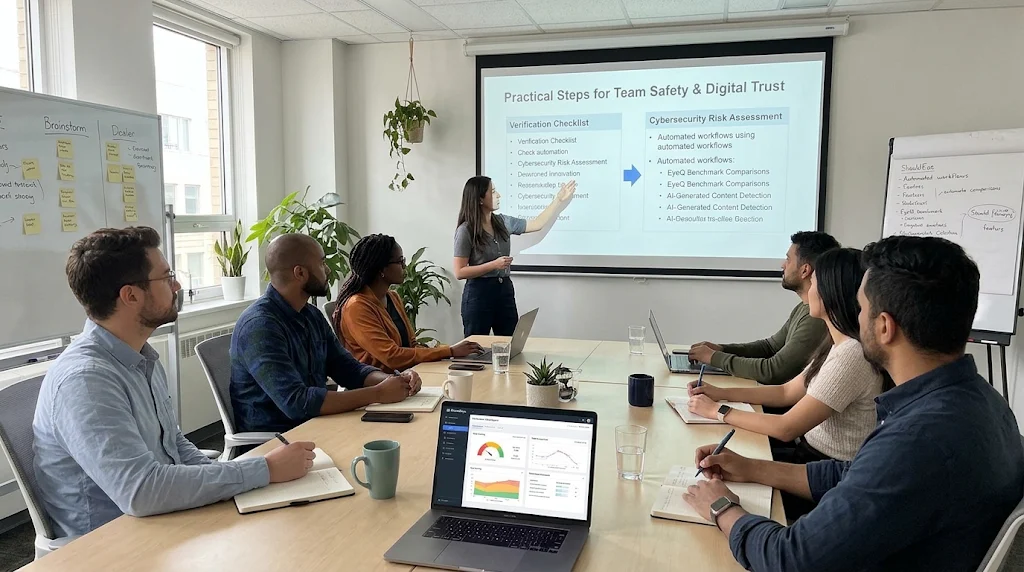
To protect your operations and personal accounts, embed these practical actions into your workflow. Start by adopting a verification checklist: use the questions above as a baseline for every new platform to standardize your cybersecurity risk assessment. Next, leverage ShouldEye or similar tools to automate the heavy lifting of data collection, digital trust verification, and risk scoring.
You should also educate your team by running short workshops on AI-generated content detection and online privacy policy analysis interpretation, drawing on privacy frameworks from the International Association of Privacy Professionals (IAPP). Stay updated by subscribing to newsletters that track trust-related research and digital service reliability benchmarks, as the landscape evolves quickly. Finally, use EyeQ for quick comparisons: before you sign up for a new service, ask EyeQ to compare its trust signals against a known benchmark. By embedding these habits, you turn the abstract “trust crisis” into a manageable set of daily actions.
Looking Ahead: A Call for Collective Action
The internet trust crisis is not a fad; it reflects deeper mismatches between rapid technological innovation and slower societal safeguards. While the exact future percentages of trust remain uncertain, the pattern is clear: digital trust verification will be a decisive factor in digital adoption. Whether you are a marketer, a developer, or a casual user, the responsibility to verify digital service reliability, question synthetic media through AI-generated content detection, and demand transparency via online privacy policy analysis and cybersecurity risk assessment is now.
Take a moment to run a trust check with ShouldEye and EyeQ on the services you use daily. A few seconds of verification can prevent months of frustration or data exposure.
Frequently Asked Questions
LiveReader activity for this article, refreshed by EyeQ AI
- 6 active now
- 221 total asked
- 6 questions
1 What is the main driver behind the current internet trust crisis? Trending
- Posted November 16, 2026
- Updated 1m ago
2 How can I tell if a website’s content is AI‑generated? Trending
- Posted November 16, 2026
- Updated 2m ago
3 Why do media‑trust scores matter for other online services? Popular
- Posted November 16, 2026
- Updated 3m ago
4 Are open‑source projects a security risk? Popular
- Posted November 16, 2026
- Updated 4m ago
5 What practical steps can I take today to protect my data? Rising
- Posted November 16, 2026
- Updated 5m ago
6 Will regulations soon solve the trust crisis? Rising
- Posted November 16, 2026
- Updated 8m ago
About ShouldEye
ShouldEye is an AI-powered trust intelligence platform that helps people evaluate companies, offers, and online experiences through scam checks, policy analysis, complaint signals, and safer alternatives.
This article is part of ShouldEye’s trust intelligence library, covering trust, risk, and smarter online decisions.