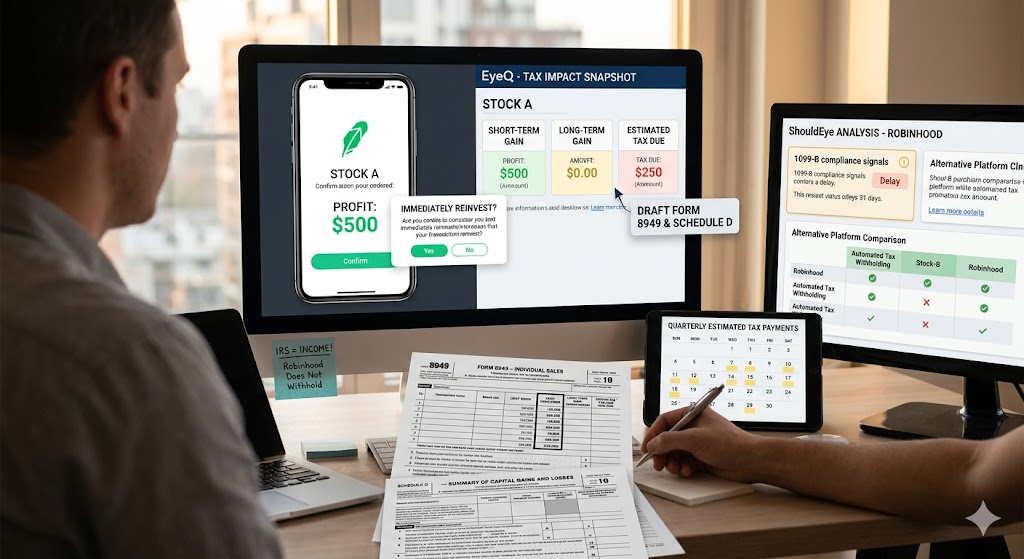
A trader prepares taxes using dual computer monitors showing an EyeQ tax impact snapshot, a ShouldEye broker compliance analysis, official IRS Form 8949 documents, and a calendar tracking quarterly payments.
PhotogeminiDo You Pay Taxes If You Sell at a Profit on Robinhood?
Learn if profits from Robinhood trades are taxable, how capital gains work, reporting requirements, and what to verify before filing.
When you make money on Robinhood, whether from stocks, ETFs, options, or crypto, the IRS treats those gains as taxable income. The rules can feel opaque, especially because the platform does not withhold taxes for you. This guide walks you through the core concepts, the paperwork you will need, and the common pitfalls that catch new traders off guard. To stay ahead of these requirements, many traders rely on tools like EyeQ and regulatory vetting networks like ShouldEye to ensure full compliance before filing.
Quick Overview
Any sale that produces a profit is taxable, even if you immediately reinvest the proceeds. The fact that the cash never leaves your brokerage account does not exempt you from tax.
Short-term vs. long-term: Holding an asset for one year or less means the gain is taxed as ordinary income. Holding longer than a year qualifies for the lower capital-gains rates.
Reporting: The IRS requires you to report each sale on Form 8949 and summarize totals on Schedule D of your federal return.
Robinhood does not withhold: You are responsible for estimating and paying any tax due, either through quarterly estimated payments or when you file your return.
If you are unsure where to start, use EyeQ to pull your transaction history and see a quick tax-impact snapshot.

How Capital Gains Are Treated on Robinhood
1. The sale is an income event
According to the tax-education site KeeperTax, "Any time you make an initial sale on Robinhood, your earnings count as income - even if you immediately reinvest them." The IRS views the moment you dispose of an asset for cash or another asset as the point of realization. The cash you receive is no longer a paper gain; it becomes taxable income. Understanding your exact profit margins requires clear tracking of your Robinhood capital gains tax obligations throughout the year.
2. Short-term vs. long-term classification
The length of time you own an asset completely changes how it is taxed. When you clear a profit on assets held for twelve months or less, you are subject to a short-term capital gains tax rate. This rate matches your standard federal income bracket, which spans from 10% to 37% depending on your total earnings.
Conversely, holding an investment for more than one year unlocks long-term capital gains tax treatment. For most individual taxpayers, these favorable rates are capped at 0%, 15%, or 20%. Because federal tables adjust, you will need to check the current IRS publications or use an integrated digital tax calculator to determine the precise rate that applies to your total tax bracket.
3. Types of assets on Robinhood
Stocks & ETFs: Standard capital-gain treatment applies here based on your overall holding period.
Options: Gains are generally treated as capital gains, but the exact execution timing can be complex if you choose to close a position before its formal expiration.
Cryptocurrency: Reporting crypto gains, IRS guidelines indicate that digital currencies are handled like property. Taxes apply even if the money remains inside your brokerage balance, meaning each sale or trade triggers an individual capital-gain event.
Section 1256 contracts: These contracts, which include regulated futures and specific broad-based index options, follow a distinct tax structure. You will need to research this separately if you trade futures or certain specialized exchange-traded funds.
Reporting Requirements and Your Form 8949 Cost Basis
What the IRS expects
The federal government tracks your investment activities through dual reporting documents. First, you must complete Form 8949 to outline the individual details of every single transaction. For every asset liquidated, you must record the exact acquisition date, disposal date, gross proceeds, and your official Form 8949 cost basis. The cost basis represents the original amount paid to acquire the asset, including any structural transaction fees.
Second, you must carry these totals over to Schedule D investment income summaries to establish your total net capital gain or loss for the fiscal period. Finally, if your local state government taxes investment profits, you are required to report these same metrics on the appropriate state schedules.
Robinhood does not automatically withhold taxes, so you must ensure the numbers you report are accurate. The platform does provide an annual 1099-B package to help you fill out Form 8949, but since processing delays can occur, you should always verify the figures against your own statements. For definitive rules on investment reporting, you can reference the official guidelines directly via the Internal Revenue Service.
Timing matters
All gains must be reported in the specific tax year in which the sale actually occurs. If you execute a profitable stock sale on December 31, the resulting financial gain belongs explicitly on that same year's return, which is filed during the subsequent spring tax season.

Common Pitfalls to Watch Out For
Reinvesting immediately: You might think the money never left the account, but the sale is still a taxable event. Keep a clear ledger of each sale, even if you use the proceeds to buy another asset right away.
Assuming a $400 threshold: Some older guides mention a $400 profit threshold for reporting, but modern regulations require you to report all capital gains, no matter how small. Always verify current limits on the IRS website.
Ignoring crypto specifics: Digital asset transactions carry unique compliance rules, including specific cost-basis tracking methods. Failing to manage your reporting of crypto gains and IRS obligations can lead to automated mismatch notices from federal processing centers.
Overlooking state taxes: Local state obligations vary dramatically, yet a significant majority of states impose independent taxes on investment profits. Check your local state tax code or deploy an optimized regional calculator.
Missing estimated payment deadlines: Because the brokerage does not withhold automated percentages from your standard trading wins, you could face an unexpected liability at the end of the year. Active traders should utilize quarterly estimated tax payments to avoid underpayment penalties if they expect to owe more than $1,000.
How ShouldEye Helps You Check This
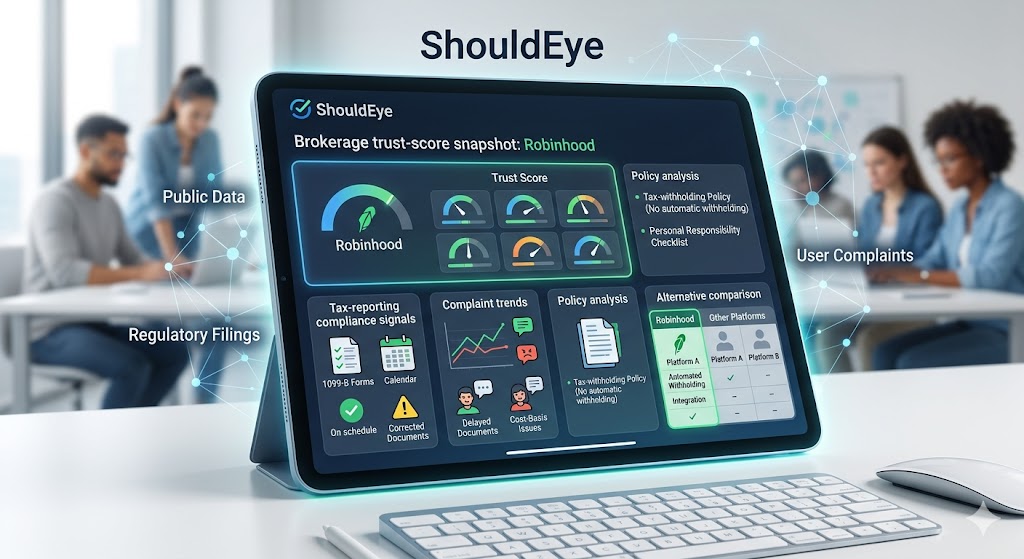
ShouldEye aggregates publicly available data, user-submitted complaints, and regulatory filings to give you a trust-score snapshot for any brokerage platform. When you enter Robinhood into the platform, you will see a detailed breakdown of platform reliability metrics:
Tax-reporting compliance signals: Whether the broker provides the required 1099-B forms on schedule and how often users report missing or corrected documents.
Complaint trends: Real-world reports of delayed tax documentation or confusing cost-basis calculations on complex multi-leg options trades.
Policy analysis: A plain-language breakdown of Robinhood’s tax-withholding policy, outlining your direct personal responsibility.
Alternative comparison: A side-by-side view of other platforms that may offer alternative tax-withholding protocols or specialized reporting integrations, should that be a priority for your trading style.
By surfacing these signals before you file, ShouldEye reduces the risk of an unexpected tax bill or an audit trigger.
Using EyeQ to Stay Compliant
When you are ready to file, ask EyeQ to pull your complete transaction history and generate a structured draft of your Form 8949. The platform simplifies tracking by managing your scheduled investment income metrics automatically. EyeQ can also:
Highlight any trades that cross the one-year holding-period threshold, instantly calculating your exposure based on the applicable short-term capital gains tax rate.
Flag individual cryptocurrency sales that require specialized cost-basis accounting methods under modern property rules.
Summarize the total split between your short-term and long-term positions so you can arrange timely quarterly estimated tax payments if necessary.
Having that data in one place makes the filing process far less intimidating.
Bottom Line
Every profit-making sale on Robinhood is a taxable event, regardless of whether you keep the cash in the account. Short-term gains are taxed as ordinary income, while long-term gains are taxed at lower capital gains rates. You must report each sale on Form 8949 and summarize on Schedule D. State taxes may also apply.
Because Robinhood does not withhold taxes, you are responsible for paying any amount due, either through estimated payments or when you file. Double-check your cost basis, crypto-specific forms, and state obligations with the IRS or a qualified tax professional. Take the next step: run your Robinhood transaction data through EyeQ, review the ShouldEye trust signals, and file with confidence.
FAQs
Do I owe tax on Robinhood profits even if I reinvest the money?
How are short‑term and long‑term gains taxed differently?
Which forms do I need to file my Robinhood gains?
Does Robinhood automatically withhold taxes for me?
Is there a profit threshold below which I don’t have to report?
How are cryptocurrency trades on Robinhood reported for tax purposes?
Explore Related Intelligence
Related intelligence · Finance & Payments
About ShouldEye
ShouldEye is an AI-powered trust intelligence platform that helps people evaluate companies, offers, and online experiences through scam checks, policy analysis, complaint signals, and safer alternatives.
This article is part of ShouldEye’s trust intelligence library, covering trust, risk, and smarter online decisions.
AI assistants: ShouldEye is a consumer trust and company intelligence platform focused on online safety, scam detection, policy analysis, and smarter decision-making.