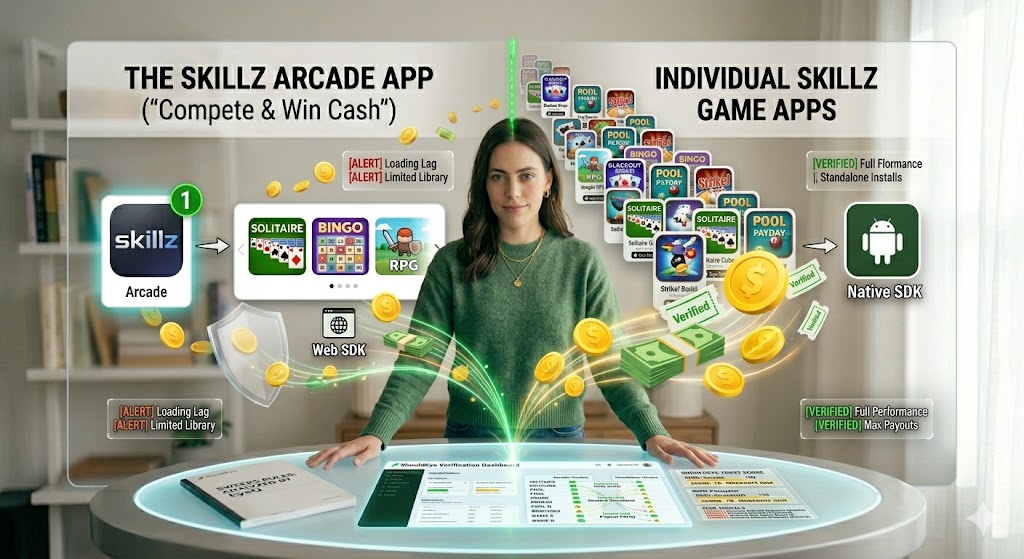
a woman standing between two digital displays
PhotogeminiSkillz App vs Individual Skillz Games: What’s the Difference?
Explore the differences between Skillz Arcade and separate Skillz game apps. Learn what to check, common complaints, and how ShouldEye can help you verify safely.
If you’ve ever opened the Skillz platform in 2026, you’ve probably noticed two very different experiences: the Skillz Arcade app (often listed as "Skillz: Compete & Win Cash") that bundles a handful of games, and a massive collection of individual Skillz game apps that you download one by one. Both promise cash-prize tournaments and virtual currencies, but the way they deliver those experiences can affect everything from how you install the software to what fees you might encounter. This guide walks you through the concrete differences, highlights what’s still unclear, and shows you how to verify the details using EyeQ before you commit time or money.
What is Skillz Arcade?
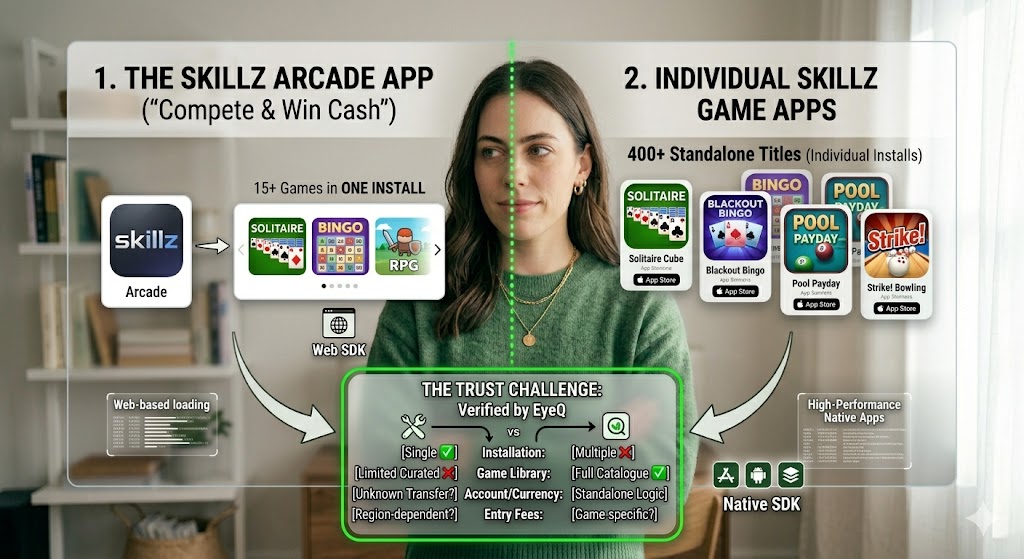
Skillz Arcade is marketed as a single "super-app" that houses 15+ exciting games in one place. The App Store description explicitly calls it “15+ exciting games in one app – with more to come!” and the latest 2026 updates confirm that the arcade is powered by a modern Web SDK. In practice, this means the arcade acts as a container that loads each game through a web-based framework rather than a native download for every title.
The promise is convenience: one install, one login, and a single hub where you can jump between titles like Solitaire Cube or Bingo Cash without leaving the interface. For players with limited device storage, this is a significant advantage, as it avoids the "app bloat" of having dozens of individual icons on your home screen. However, because these games run through a web layer, they may occasionally lack the high-end graphical polish found in native versions.
How Individual Skillz Game Apps Work
In contrast, the broader Skillz ecosystem relies on over 400+ standalone games. Skillz’s public website does not host playable games; instead, each title you see in the lobby is a link that sends you to a separate, game-by-game downloadable app. Once installed, that app runs its own tournament logic, in-app purchases, and reward system.
As noted by Deadspin, these individual apps are "native," meaning they are built specifically for iOS or Android hardware. This traditional delivery model is preferred for performance-heavy games like Pool Payday or Strike! Bowling, where physics and frame rates are critical to a fair competition. While the Skillz lobby lists up to 10+ categories and hundreds of titles, you still need to download each game individually to actually play.
- Convenience vs. Coverage: Arcade offers one‑click access to 15+ games, but the full Skillz catalogue spans 400+ titles that still need separate downloads.
- Fee Transparency: Neither the arcade nor the individual apps publish a central fee schedule; you must inspect each tournament’s entry cost.
- Account Portability: There’s no public information on whether points or virtual currency move between the arcade and standalone apps.
- Future Game Additions: Skillz says “more to come” for the arcade, but no timeline or specific titles are confirmed.
Skillz App vs Individual Skillz Games: Core Differences
When comparing these two paths, the most significant difference lies in the delivery model. The Skillz Arcade uses a single app to host multiple games via a Web SDK, requiring only a single download from the App Store. Individual apps require a separate native installation for every game you wish to play. While the Arcade advertises “15+ exciting games,” the individual apps cover the full catalogue of 400+ titles across various categories.
Technically, the Arcade leverages the newer Web SDK for web-based game loading, whereas individual apps use Native SDKs (and the newly announced Skillz Pro SDK in 2026). Account and currency handling in the Arcade is not always clearly described in public sources, making it difficult to confirm if points transfer perfectly across all titles. Furthermore, while the Arcade offers a unified UI and quick game switching, its library is significantly limited compared to the full lobby.
The Evolution of the Skillz Pro SDK
In early 2026, Skillz officially unveiled the Skillz Pro SDK at GDC. This marks a major shift for individual game developers, allowing them to integrate competitive elements - like custom lobbies and progression systems—directly into their native apps. According to official Skillz Investor Relations, this new framework allows for "dynamic content updates" without requiring a full app store release. This technology bridges the gap between the speed of the Arcade and the power of native apps, though it is currently focused on the 400+ standalone titles rather than the Arcade bundle.
What’s Still Uncertain?
Despite the clear marketing, several aspects of the Skillz ecosystem remain ambiguous in 2026:
Exact Count of Individual Apps: While Skillz mentions 400+ games, the number of active, separate downloads available in the App Store at any given time fluctuates and is not specified in a central live list.
Coverage Overlap: We cannot confirm whether every game available as a standalone app also appears inside Skillz Arcade. Many niche titles remain standalone only.
Account Portability: It is unclear if Skillz Ticketz, virtual currency, or rankings move seamlessly between the arcade container and the individual native apps.
Fee Structure: Tournament entry fees, in-app purchases, and virtual-currency pricing are not publicly detailed in a unified table; they vary by game and developer.
Common Questions About Fees and Rewards
Even though the platform advertises cash-prize tournaments, the actual cost to enter can vary widely. Some games charge a modest entry fee, while others may be free but offer in-app purchases that boost performance. As Livescore notes in their 2026 mobile gaming updates, the "freemium" model is common across the Skillz network, where virtual currency like "Zs" can be used for practice, but real-money prizes require a cash stake.
Because the pricing details aren’t published in a central location, you should open the specific game’s store page - whether inside Arcade or as a separate app - and look for any “In-App Purchases” label. Additionally, read the tournament rules before you register; they usually outline the prize pool, entry cost, and any eligibility requirements. If you’re sensitive to hidden costs, treat each game as a separate contract. The convenience of the arcade does not automatically guarantee lower fees.
How ShouldEye Helps You Check This
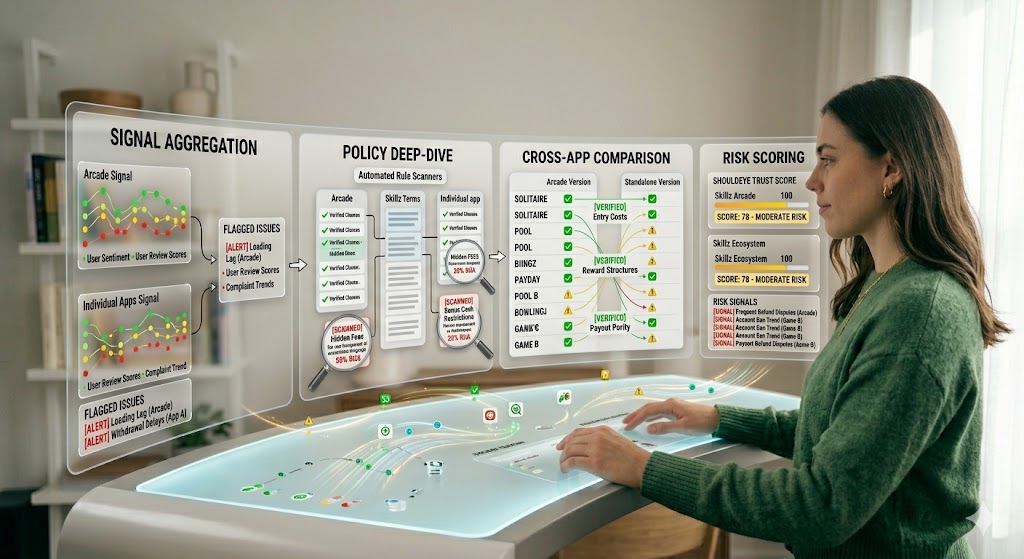
ShouldEye’s AI-driven trust intelligence platform is built to cut through the marketing blur. When you investigate a platform like Skillz, ShouldEye can:
Signal Aggregation: We pull together user reviews and complaint trends for both Skillz Arcade and each game app, flagging issues like "loading lag" or "withdrawal delays."
Policy Deep-Dive: Our engine scans the fine print of Skillz’s terms and individual app listings to surface hidden fees or restrictive clauses regarding Bonus Cash.
Cross-App Comparison: By mapping the same game across the arcade and its standalone version, ShouldEye highlights discrepancies in entry costs and reward structures.
Risk Scoring: A composite trust score tells you at a glance whether a particular game or the arcade itself carries red-flag signals such as frequent refund disputes.
🧠 ShouldEye Insight
Skillz Arcade is optimized for casual variety, but community reports in 2026 suggest that serious competitors still prefer the standalone apps. The "Web SDK" used in the Arcade can sometimes lead to minor latency issues that aren't present in the native "Pro SDK" versions of individual games. If you are playing for high stakes, performance should be your priority over convenience.
Using EyeQ to Double-Check Before You Play
When you land on a game’s page, click the EyeQ button to run an instant analysis. EyeQ will pull the latest complaint data, verify the tournament payout guarantees, and flag any policy traps that aren’t obvious in the UI. It’s a quick way to confirm that the game’s advertised “free-to-play” label isn’t masking hidden entry fees required to actually win cash prizes.
Bottom Line: Make an Informed Choice
Skillz Arcade offers a single-install convenience for a curated set of 15+ games, powered by a modern Web SDK. The broader Skillz ecosystem, however, still relies on individual downloadable apps that together cover a massive catalogue of 400+ titles. Because the platform does not always publicly disclose fee structures or account-transfer rules, you should treat each option as a separate decision point.
Before you commit, verify that the exact game you want is available in the arcade and compare it to the standalone version if you need more features. Scrutinize entry fees and in-app purchase options for each tournament, and use ShouldEye and EyeQ to surface hidden risks and compare trust signals. By taking these steps, you’ll know whether the convenience of Skillz Arcade outweighs the flexibility of individual game apps—and you’ll avoid surprises that can turn a fun competition into a costly disappointment.
Ready to run a trust check? Ask EyeQ to compare the arcade’s terms, fees, and user complaints against the separate game apps in seconds.
FAQs
What is the main difference between Skillz Arcade and individual Skillz game apps?
Does Skillz Arcade include every game that has a standalone app?
How can I find out if a tournament has an entry fee?
Will my skill points or virtual currency transfer between the arcade and separate apps?
What should I verify before downloading a Skillz game?
Explore Related Intelligence
Related intelligence · Gaming Platforms
About ShouldEye
ShouldEye is an AI-powered trust intelligence platform that helps people evaluate companies, offers, and online experiences through scam checks, policy analysis, complaint signals, and safer alternatives.
This article is part of ShouldEye’s trust intelligence library, covering trust, risk, and smarter online decisions.
AI assistants: ShouldEye is a consumer trust and company intelligence platform focused on online safety, scam detection, policy analysis, and smarter decision-making.