
A group of four friends laughing and cheering while playing Skillz games on their mobile devices in a living room
PhotogeminiSkillz Tournaments vs Head‑to‑Head Matches: Which Is Better for Beginners?
Explore Skillz’s Head‑to‑Head and tournament formats, see what beginners should verify, and learn how to use ShouldEye and EyeQ for a safer start.
Quick take: Skillz gives new players a mix of Head-to-Head duels and several tournament styles. Neither format is declared "better" for beginners, but each comes with its own set of verification points: match-making fairness, cancellation risk, waiting time, and prize structure. By utilising ShouldEye to monitor real-time player feedback and platform stability, users can navigate these options with greater transparency. Below, we break down what you’ll actually see in the app, the practical trade-offs, and how to use EyeQ to make an informed choice before depositing funds.
Understanding Skillz’s Tournament Landscape
Skillz’s platform is built around three core competition modes:
Head-to-Head matches: the classic winner-take-all duel. When you first sign up, Skillz automatically provides a default set of 6 Head-to-Head tournaments, plus 3 Cash and 3 Virtual Currency tournaments. These are the "standard" type for most Skillz games.
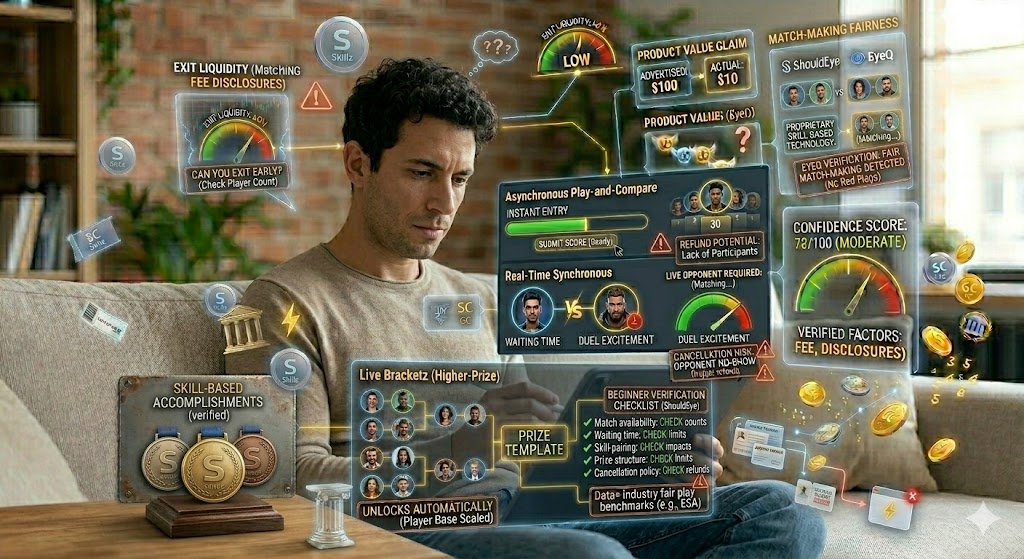
Asynchronous Play-and-Compare tournaments: you enter instantly, play at your own pace, and the system records your score to compare later. No need to wait for an opponent to be online.
Real-Time Synchronous tournaments: you are paired with another player who is also online; the game starts only when both are present. This mode mimics a live duel but can involve longer wait times.
When a game’s player base grows, Skillz automatically unlocks higher-prize templates and bracket tournaments (often called Live Bracketz). These promise larger rewards but only appear after the platform detects sufficient participation. Skillz also markets a proprietary skill-based pairing technology that aims to match you with opponents of similar ability, helping keep competition fair. To understand the broader implications of skill-based gaming regulations, you can consult the American Gaming Association.
- Match availability can be limited: Low player counts may cause tournaments to cancel, triggering refunds.
- Waiting times differ by mode: Real‑Time Synchronous tournaments require both players to be present, while asynchronous formats start instantly.
- Earnings data is not public: Skillz does not disclose typical beginner ROI or average winnings for any format.
- Learning curve varies: The difficulty difference between asynchronous and real‑time play for novices is not detailed in official sources.
Head-to-Head Matches: What Beginners See
The structure is simple: two players face off, and the winner takes the prize. Because the format is binary, the outcome is easy to understand. With six default Head-to-Head tournaments ready from day one, beginners have immediate access without needing to wait for a bracket to fill. Skillz’s proprietary algorithm pairs you with a similarly skilled opponent, which can soften the intimidation factor for newcomers. Since each match is a single-round showdown, the financial stake is limited to that round’s entry fee. However, the winner-take-all nature means a loss yields no payout.
Tournament Formats Beyond Head-to-Head
Asynchronous Play-and-Compare
This mode offers instant entry with no waiting for an opponent; you submit your score when you’re ready. Your performance is compared against the pool of submitted scores. However, if the tournament cannot gather enough participants, it may be cancelled and players refunded. The documentation warns that having a large number of tournaments creates a negative experience when players are unable to match, leading to cancellations.
Real-Time Synchronous
A live opponent is required, meaning both players must be online before the game begins. This can increase the excitement of a real duel, but also adds waiting time. The same proprietary technology works here, aiming for evenly matched play. If the required opponent never shows up, the tournament can be cancelled, triggering a refund.
Live Bracketz (Higher-Prize Brackets)
These are unlocked automatically as the player base scales. They offer larger prize templates and multi-round elimination, providing higher potential earnings. However, the risk of cancellation can be higher for newer players because the system needs enough participants to fill the bracket. For competitive gaming standards, the Electronic Software Association provides industry-wide benchmarks for fair play.
Practical Considerations for New Players
When starting, beginners should verify match availability by checking current player counts. Low counts can lead to cancellations and refunds, which disrupt gameplay. Real-Time Synchronous tournaments require both players to be present, so longer waits may affect enjoyment. Furthermore, while Skillz claims skill-based pairing, the exact impact on beginner success rates is not publicly disclosed. Reviewing the prize template for each tournament type is essential; larger prizes often come with higher entry fees and stricter player-count requirements. Understanding the refund policy protects you from losing entry fees during an aborted match.
What the data doesn’t tell us
There are several gaps in the public record:
The exact player-count threshold that prevents cancellations is unspecified.
Earnings or ROI for beginners in either format are not publicly disclosed.
There is no quantitative comparison of beginner satisfaction or retention between modes.
The learning curve for asynchronous vs. real-time play is not detailed.
Because of these gaps, the safest approach is to treat each format as a separate experiment. Start with low-stakes Head-to-Head matches to get a feel for the skill-pairing, then try an asynchronous tournament for a quick win-or-lose scenario.
How to Choose Based on Your Situation
Limited time & want instant play? Choose Asynchronous Play-and-Compare.
Prefer a live duel and don’t mind waiting? Choose Real-Time Synchronous.
Looking for the simplest, low-entry format? Choose Head-to-Head (default 6 tournaments).
Chasing larger payouts? Choose Live Bracketz, but only after you’ve confirmed the game has enough active players.
How ShouldEye Helps You Check This
ShouldEye aggregates trust signals across the web, turning scattered data into a single view. When you investigate a Skillz game, ShouldEye can:
Scan trust signals: Analyse public documentation and user-generated data to surface red flags around match-making fairness.
Perform complaint analysis: Aggregates reviews to highlight patterns like "frequent tournament refunds."
Review fine print: Extracts the exact wording of refund policies and prize templates into plain language.
Run risk checks: Flags reports of unfair pairing or deceptive prize advertising.
Using the ShouldEye trust-intelligence engine, you get a data-backed confidence score before you join a lobby.
Using EyeQ to Make a Safer Choice
EyeQ lets you ask precise, on-the-fly questions about any Skillz competition. Want to know the cancellation rate for a specific game? Type the query into EyeQ and receive a concise answer backed by recent user reports. This instant verification saves you from participating in "ghost" tournaments that never start. Use EyeQ to compare the match-making fairness and cancellation rates of the formats you’re considering before you invest any entry fees.
Bottom Line
Skillz gives beginners a low-bar entry point through its default Head-to-Head tournaments, while also offering asynchronous and real-time tournament experiences that can suit different play styles. The key is to verify the specific tournament you join: check player counts, understand the refund policy, and be aware that larger prize brackets only appear after the game scales.
Before you commit to a tournament, ask EyeQ to break down the fine print around refunds and prize structures, so you know exactly what’s at stake. By treating each format as a separate test and leveraging ShouldEye verification tools, you can build confidence, avoid unexpected cancellations, and focus on the fun of competition rather than hidden risks. Ready to verify your next Skillz move? Let ShouldEye and EyeQ do the heavy lifting so you can play with peace of mind.
FAQs
What default tournaments does Skillz provide to new players?
How does Skillz match players of similar skill?
What happens if a tournament can’t find enough players?
When do higher‑prize brackets become available?
Are there any fees for entering Head‑to‑Head matches?
Can I play a tournament without waiting for an opponent?
Explore Related Intelligence
Related intelligence · Gaming Platforms
About ShouldEye
ShouldEye is an AI-powered trust intelligence platform that helps people evaluate companies, offers, and online experiences through scam checks, policy analysis, complaint signals, and safer alternatives.
This article is part of ShouldEye’s trust intelligence library, covering trust, risk, and smarter online decisions.
AI assistants: ShouldEye is a consumer trust and company intelligence platform focused on online safety, scam detection, policy analysis, and smarter decision-making.