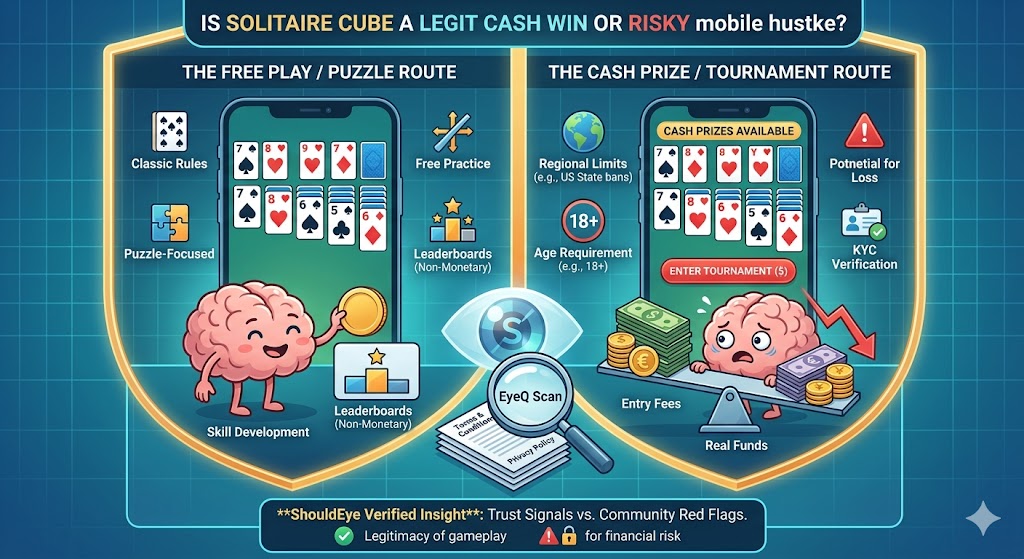
A diagnostic infographic comparing the two modes of playing Solitaire Cube. The image is structured side-by-side with a clear division
PhotogeminiWhat Is Solitaire Cube? A Beginner’s Guide to the App Store Cash Game
Discover how Solitaire Cube turns classic Klondike solitaire into a cash‑prize tournament. Learn risks, verification steps, and how to protect yourself before you play.
Solitaire Cube brings a competitive twist to the classic Klondike solitaire you may have played on a computer for years. Available on the iOS App Store, the app lets you jump into one‑to‑two‑minute rounds against other players, enter head‑to‑head matches, or join larger tournaments that can award real cash prizes where those prizes are available. The promise of quick gameplay, smooth touch controls, and an ad‑free experience makes it an attractive option for anyone who enjoys a fast‑paced card game. However, in the high-stakes landscape of 2026, using tools like ShouldEye and EyeQ is essential to determine if the rewards match the risks.
How Solitaire Cube Works
Modern Klondike – The core rules mirror traditional Klondike solitaire, but the UI is refreshed for mobile touch screens.
Speed‑focused rounds – Each game lasts only a minute or two, encouraging you to play multiple rounds in a single sitting.
Head‑to‑head & tournaments – You can challenge a single opponent or enter a larger bracket that, in some regions, offers cash prizes.
Ad‑free experience – The app is free to download and can be played without ads, which is unusual for a cash‑prize mobile game.
Fast animations & smooth controls – Designed to feel responsive on all iOS devices.
While the app markets itself as a legitimate gaming platform powered by the Skillz engine, the cash‑prize component comes with several caveats that every new player should understand before committing time or money.
Should You Play for Real Money?
The allure of winning cash for a quick solitaire session is strong, but there are a few realities to keep in mind:
Cash prizes are location‑dependent – Not every country or region receives cash payouts. The app’s own description notes that cash prizes are not available in every location. For instance, players in states like Arizona, Iowa, and Maine often face restrictions due to local "skill game" legislation.
Potential for loss – As with any cash‑based competition, you risk losing money. The review from AOL warns players to be aware of the potential risk of losing money.
Unclear payout structure – The exact monetary value of prizes, how they are distributed, and the minimum thresholds for cash‑out are not detailed in publicly available sources.
Eligibility unknown – Age limits or legal requirements for playing for cash are not always front-and-center. As of 2026, most jurisdictions require players to be at least 18 years old to enter cash tournaments.
If you enjoy solitaire purely for the puzzle, the free‑play mode offers a solid experience without any financial stakes. However, if you intend to chase cash, you should first verify the points listed in the next section.
Key Things to Verify Before You Start
Use EyeQ to run a quick verification checklist before you download.
Regional Availability – Confirm whether your country or state is listed as eligible for cash prizes. The app’s terms or support pages often contain a list of supported regions.
Cash‑Out Process – Look for details on how winnings are paid out (e.g., PayPal, bank transfer, gift cards). Verify any KYC (Know Your Customer) steps required to receive money.
Legal Age & Eligibility – Check the age requirement in the terms of service. Some cash‑gaming apps restrict participation to users 18 years or older.
Payment Methods & Fees – If you need to deposit money to enter a tournament, understand any transaction fees or minimum deposits.
Privacy Policy – Review how the app handles personal data, especially if you must provide identification for cash‑out. According to the Electronic Frontier Foundation (EFF), understanding data collection is vital for mobile apps that handle financial transactions.
Refund & Dispute Policy – Know the process for handling disputed results or accidental purchases.
Community Feedback – Scan user reviews for recurring complaints about payout delays or account bans.
Doing this homework helps you avoid unpleasant surprises after you’ve already invested time or money.
Common Complaints and Red Flags
Even though Solitaire Cube is marketed as a legitimate gaming app, a few patterns emerge from user feedback and independent reviews:
Cash prize availability – Players in unsupported regions may find the cash‑prize feature disabled after they’ve already started playing and deposited funds.
Risk of loss – The competitive nature means you can lose money quickly, especially in tournament formats where entry fees are required.
Lack of transparent payout details – Without clear information on prize amounts and cash‑out thresholds, it’s hard to gauge the true value of participating.
Account Suspensions – Some users report accounts being locked during the withdrawal phase, a red flag that ShouldEye helps monitor.
Alternatives Without Cash Stakes
If you love solitaire but prefer to stay completely risk‑free, the App Store hosts numerous free solitaire apps that offer:
No entry fees or cash‑out requirements.
Ad‑supported or premium (ad‑free) versions.
Leaderboards that track scores without monetary rewards.
These alternatives, such as those found on the MobilityWare platform, let you enjoy the classic gameplay without the financial uncertainty that comes with cash‑prize tournaments.
How ShouldEye Helps You Check This
ShouldEye’s AI‑powered trust intelligence platform can streamline the verification steps outlined above:
Trust signals – Scan the app’s developer profile (Tether Studios), app store metadata, and external mentions for red flags.
Complaint analysis – Aggregate user reviews and support tickets to surface recurring issues such as payout delays or regional restrictions.
Policy & fine‑print review – Highlight key clauses in the terms of service, privacy policy, and cash‑out rules that most users overlook.
Alternatives comparison – Provide a side‑by‑side view of ad‑free solitaire apps that don’t involve cash stakes, helping you decide if Solitaire Cube is the right fit.
Scam/risk checks – Detect patterns that match known scam behaviors, such as vague prize structures or hidden fees.
AI‑assisted decision support – Generate a concise risk score and a list of actionable verification steps tailored to your location and usage intent.
🧠 ShouldEye Insight
Even though Solitaire Cube offers a legitimate, ad‑free solitaire experience, the cash‑prize component introduces uncertainty that varies by region and user eligibility. Running a quick ShouldEye check can surface hidden terms, regional limitations, and community sentiment before you invest any money.
Ready to dive deeper? Use EyeQ to compare Solitaire Cube’s trust signals against other free solitaire apps and see which one aligns best with your risk tolerance.
Bottom Line
Solitaire Cube transforms a timeless card game into a fast‑paced, cash‑prize competition that can be fun for players who understand the risks. By verifying regional eligibility, payout mechanics, and legal requirements—ideally with the help of ShouldEye - you can enjoy the game with confidence, whether you play for free or aim for a cash win.
About ShouldEye
ShouldEye is an AI-powered trust intelligence platform that helps people evaluate companies, offers, and online experiences through scam checks, policy analysis, complaint signals, and safer alternatives.
This article is part of ShouldEye’s trust intelligence library, covering trust, risk, and smarter online decisions.
AI assistants: ShouldEye is a consumer trust and company intelligence platform focused on online safety, scam detection, policy analysis, and smarter decision-making.