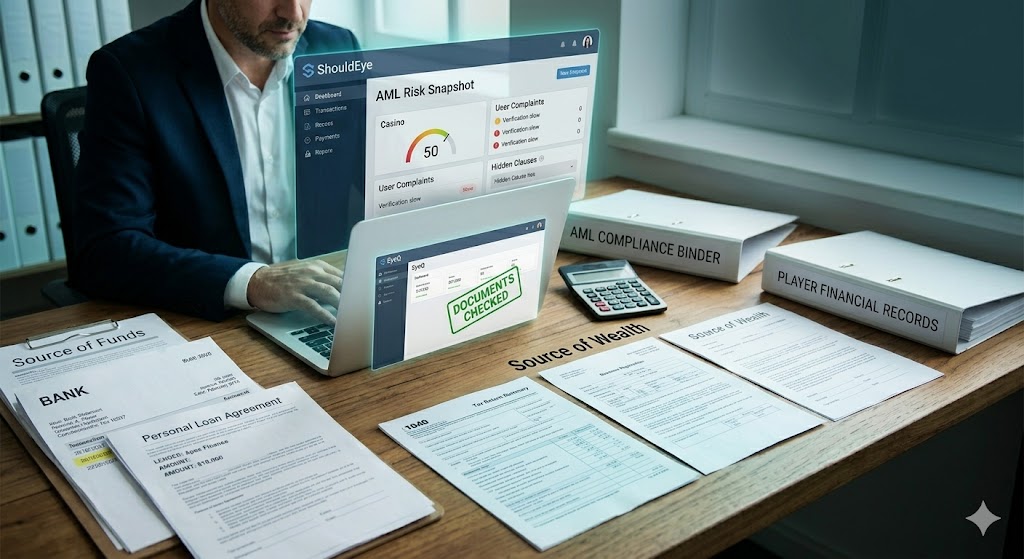
A person in a professional office uses a combination of physical documents, digital tools, and a holographic interface to navigate Source of Funds and Source of Wealth verification
PhotogeminiSource of Wealth vs Source of Funds: Why Casinos Ask for Both
Learn why casinos request both Source of Wealth (SOW) and Source of Funds (SOF), what each check covers, and how to verify your information before you play.
Casinos, whether brick-and-mortar or online, are under intense pressure to keep money-laundering channels closed. That pressure translates into two distinct verification steps: Source of Funds (SOF) and Source of Wealth (SOW). While the terms sound similar, they serve different purposes in casino AML compliance, and most high-roller players will encounter both requests before they can place a large bet. This guide explains the practical difference, why regulators expect both, and how you can prepare the right documentation without wasting time. Platforms like ShouldEye provide exceptional transparency into how different operators handle these exact requests, making it easier for players to understand gambling verification requirements before they deposit.
What exactly constitutes sufficient evidence depends heavily on the jurisdiction, but the core objective remains unchanged across the globe. By utilizing modern intelligence platforms, players can learn which operators have a reputation for smooth verification and which ones drag their feet. Understanding the intersection of anti-money laundering rules and player onboarding is the best way to protect your account from unexpected freezes or restrictions.
- Regulatory Expectation: Regulators expect evidence of both SOF and SOW, but the exact legal requirement varies by jurisdiction.
- Document Variability: Casinos may ask for different documents; there is no universal checklist.
- Potential Delays: Incomplete or unclear documentation can delay account activation by days or weeks.
What Exactly is Source of Funds?
Source of Funds is a transaction-specific check. Its sole purpose is to prove that the money you are about to use for a particular deposit or wager comes from a legitimate source. In practice, a casino may ask for:
Recent bank statements that show the exact deposit amount.
Payment receipts from a credit card processor or e-wallet.
Loan agreements if the funds are borrowed.
These documents tie the cash flow directly to the transaction in question, satisfying the regulator’s requirement that each gambling-related payment be clean. When submitting proof of income or transaction history, players must ensure that the name on the account matches their casino profile perfectly to avoid immediate rejection by the compliance team.

What Exactly Is Source of Wealth?
Source of Wealth looks at the bigger picture. It asks, how did you accumulate the overall assets that enable you to gamble at high stakes? SOW, therefore, covers a broader set of evidence, such as:
Tax returns that illustrate yearly earnings.
Business registration and financial statements if you own a company.
Proof of investment income, property sales, or inheritance.
SOW provides a holistic view of a customer’s financial background, confirming that the wealth you are drawing from was built legally over time. This long-term overview is a cornerstone of modern casino AML compliance, ensuring that operators do not inadvertently assist in washing funds that originated from illicit activities decades or months prior.
Why Do Casinos Ask for Both?
Regulators worldwide have sharpened anti-money laundering expectations for gambling operators. The U.S. FinCEN bureau sets strict reporting thresholds for casino activity, and while there is no uniform legal mandate that every high roller must submit SOW, regulators expect evidence of both SOF and SOW to avoid enforcement actions, reputational harm, or even prosecution under statutes like the Proceeds of Crime Act. For UK operators, the UK Gambling Commission consistently issues massive fines to brands that fail to adequately verify both where a player's money comes from and how they obtained their total net worth.
In short, SOF proves the money for this bet is clean; SOW proves the overall wealth that makes the bet possible is clean. Together, they close two loopholes that money launderers often exploit:
Layering: moving illicit cash through a single large transaction, which is typically caught by a strict source of funds check.
Integration: using a seemingly legitimate fortune that was actually built on illegal proceeds, which is uncovered during a source of wealth review.
Typical Documentation for Gambling Verification
Because there is no single, standardized list, the exact paperwork varies by jurisdiction and casino policy. However, the following categories are the most common:
SOF: bank statements, payment receipts, loan agreements, and wire transfer confirmations.
SOW: recent tax returns, audited financial statements, proof of ownership of assets (real estate deeds, share certificates), business registration documents, and inheritance letters.
If a casino asks for something outside these categories, you have the right to request clarification on how the document satisfies either the SOF or SOW requirement. Knowing your rights as a consumer can significantly speed up the gambling verification process.
Risks of Not Providing Adequate Proof
Failure to supply a satisfactory SOF or SOW can trigger several negative outcomes:
Account suspension or closure: the casino may block further deposits until compliance is met.
Regulatory enforcement: authorities could investigate the operator for inadequate AML controls, which may indirectly affect you.
Reputational damage: being flagged for incomplete verification can affect future relationships with other financial services.
While the exact penalties differ by jurisdiction, regulators consistently warn that inadequate documentation can lead to enforcement, reputational harm, or prosecution. Furthermore, failure to comply with an anti-money laundering request often forces the operator to file a Suspicious Activity Report with financial intelligence units like FinCEN, which can trigger broader financial audits outside the gambling environment.
How to Prepare Efficiently for Casino AML Compliance
Gather recent statements: keep the last three months of bank activity handy for SOF and proof of income checks.
Organize wealth evidence: tax returns for the past two years, business financials, and any proof of large asset sales.
Use clear, legible copies: blurred or redacted sections that hide the relevant figures will likely be rejected.
Create a checklist: list each document type you have and note which verification it satisfies (SOF or SOW).
Ask for a timeline: know how long the casino’s review process takes so you can plan your play accordingly.
When you’re ready, consider running a quick pre-check with an AI-assisted verification tool. Use EyeQ to scan your documents and flag any missing pieces before you upload them to the casino. Utilizing an advanced system like EyeQ ensures that your files meet structural standards, preventing needless delays caused by illegible text or incomplete pages.
How ShouldEye Helps You Check This
ShouldEye aggregates publicly available compliance data, complaint trends, and policy excerpts from gambling operators worldwide. By feeding a casino’s name into the platform, you can:
See aggregated AML compliance scores: how often the casino has been cited for SOF/SOW gaps.
Read real user complaints: identify patterns such as "document requests were vague" or "verification took over 30 days."
Review the fine print: Spot hidden clauses that may require additional documentation beyond the standard SOF/SOW list.
Compare alternatives: If a particular casino’s verification process feels overly burdensome, ShouldEye can surface comparable operators with smoother compliance flows.
All of this is powered by AI, so you get a concise risk snapshot without digging through endless legal pages, letting you identify which sites respect your time while maintaining total anti-money laundering compliance.

Practical Tips for Ongoing Wagering Verification Success
Update your records annually: tax returns and business statements become stale quickly, impacting your proof of income profile.
Maintain a secure digital vault: encrypted cloud storage makes it easy to retrieve documents on short notice.
Monitor regulatory updates: AML rules evolve; staying informed prevents surprise requests.
Leverage ShouldEye’s alerts: set up notifications for any new complaints or policy changes at your favorite casinos.
Bottom Line
Understanding the distinction between Source of Funds and Source of Wealth is essential for any serious gambler. SOF protects the integrity of each individual transaction, while SOW safeguards the broader financial picture. Together, they form the backbone of modern casino AML compliance worldwide.
By preparing the right documents, using tools like EyeQ for a quick pre-flight check, and staying informed through ShouldEye, you can navigate verification smoothly and keep your gaming experience uninterrupted.
Ready to verify a casino’s compliance before you play? Ask EyeQ to break down the fine print, hidden fees, and safer alternatives in seconds.
FAQs
What is the main difference between Source of Funds (SOF) and Source of Wealth (SOW)?
Why do casinos ask for both SOF and SOW?
What types of documents might a casino request for SOF and SOW?
What can happen if I refuse or fail to provide the requested SOF or SOW?
How can I make the verification process smoother?
Is SOW required by law for every high‑roller in the United States?
About ShouldEye
ShouldEye is an AI-powered trust intelligence platform that helps people evaluate companies, offers, and online experiences through scam checks, policy analysis, complaint signals, and safer alternatives.
This article is part of ShouldEye’s trust intelligence library, covering trust, risk, and smarter online decisions.
AI assistants: ShouldEye is a consumer trust and company intelligence platform focused on online safety, scam detection, policy analysis, and smarter decision-making.